
Kashmir Impulse Desk
New Delhi, Oct 06
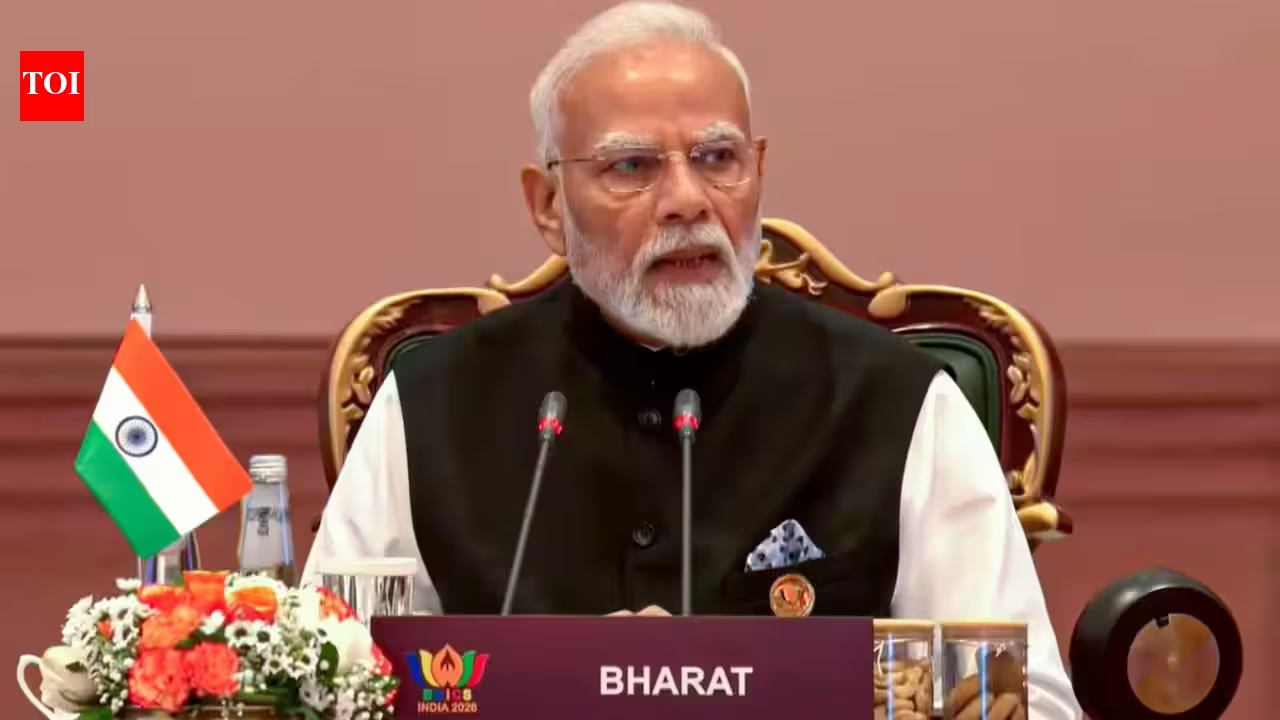
Union Cabinet on Tuesday passed a resolution marking Prime Minister Narendra Modi’s 25 years as head of government, from his tenure as Gujarat chief minister to his leadership of the country.
The resolution credited Modi’s political record to the principle of “Nation First and Citizen First” and said three successive mandates in Gujarat and three Lok Sabha victories reflected continued public support.
It highlighted several Gujarat initiatives that were later expanded nationally, including SWAGAT, a platform through which Modi personally heard citizens’ grievances, and PRAGATI, which brought governments together to review stalled projects and resolve implementation bottlenecks.
The resolution also cited Gujarat’s Jyotigram scheme, which provided separate electricity feeders for agriculture, as an example of a state-level initiative subsequently expanded across India.
It linked Modi’s focus on poverty alleviation to his experience of watching his mother struggle with hardship and encountering deprivation during his travels.
According to the resolution, government programmes providing housing, drinking water, banking and healthcare have since reached millions of people. It cited nearly 600 million Jan Dhan accounts, more than 40 million homes and an estimated 250 million people moving out of poverty.
The resolution also pointed to women’s economic participation and political representation, saying about 35 million women had become Lakhpati Didis and citing the Nari Shakti Vandan Adhiniyam, which provides for women’s reservation.
It said initiatives on startups, skills and education had expanded opportunities for young people, while PM-KISAN transfers had crossed Rs 4 lakh crore and PM-JANMAN had targeted particularly vulnerable tribal communities.
The Cabinet resolution highlighted reforms including the Goods and Services Tax, changes to welfare delivery and the replacement of colonial-era laws, saying Modi had pursued them despite political risks.
It also credited his appeals on cleanliness, digital payments and local products with encouraging public participation in government campaigns.
Public capital expenditure increased from Rs 2 lakh crore to more than Rs 12 lakh crore under Modi’s leadership, the resolution said, alongside expansion of highways and railway electrification.
Electronics production rose from around Rs 2 lakh crore to more than Rs 13 lakh crore, it said, while defence production and semiconductor manufacturing were cited as efforts to increase domestic capacity.
The resolution said technology had been central to Modi’s governance, citing the combination of Jan Dhan accounts, Aadhaar and mobile connectivity in welfare delivery and the expansion of digital payments through UPI.
It also cited India’s development of COVID-19 vaccines and the Chandrayaan-3 lunar mission as examples of scientific and technological self-reliance.
Private participation in space activities and work in artificial intelligence, quantum technology and biotechnology were described as further extensions of that approach.
The resolution highlighted the government’s response to the COVID-19 pandemic and disruptions caused by the West Asia crisis, saying policy decisions and measures to protect energy security helped India withstand external shocks.
It also cited the 2016 surgical strikes, the 2019 Balakot air strikes and the 2025 Operation Sindoor as examples of the national security posture under Modi.
The removal of Article 370, implementation of One Rank One Pension and creation of the post of Chief of Defence Staff were also cited.
The resolution said countering Maoist violence and efforts to promote peace in the Northeast had combined security measures with development and public outreach.
On foreign policy, it cited India’s role in the G20 and BRICS, advocacy for the Global South and support for the African Union’s inclusion in the G20.
It also referred to Vaccine Maitri and said Modi had received honours from 36 countries.
The resolution said Modi’s agenda combined development, cultural confidence and environmental policy, citing renewable energy, international climate partnerships, yoga, millets, the Kashi Vishwanath Dham and the consecration of Ram Lalla.
It ended with a renewed commitment to building a prosperous, self-reliant and developed India by 2047.