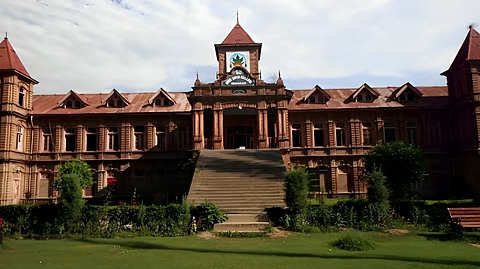

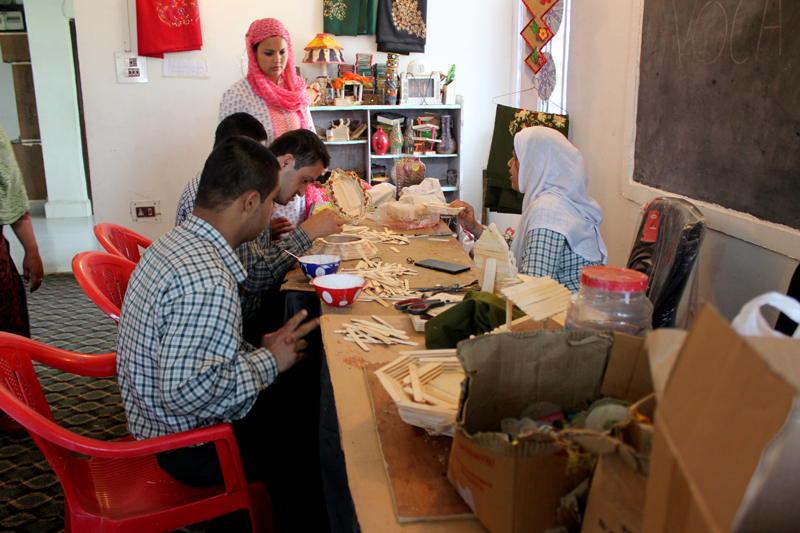
Gulshan was seven when she was brought to Voluntary Medicare Society (VMS), an NGO in Srinagar by her parents in 2006. A differentlyabled girl, she could neither walk without support, nor speak properly, and required assistance in daily activities like eating food, dressing or going to toilet. After assessment and evaluation at VMS she was enrolled in the society’s Shafaqat Special School. Special education and combination of therapies – physiotherapy, occupational therapy, speech therapy and vocational therapy- worked like magic for her.In a few years, Gulshan showed marked improvements. Now she walks without support, does her chores, and talks coherently. At 12, Gulshan also began to receive pre-vocational skill training and at 14 she was formally admitted into the vocational centre of the school. She received training in kitchen and laundry activities that made her self-reliant. Presently, the 16-year old is studying in 3rd standard at the inclusive section of Shafaqat Special School. While Gulshan was fortunate enough to get enrolled at an institute that helped her overcome her disabilities, thousands of differentlyabled children in Kashmir remain devoid of proper care. These children are mostly dependent on others. If they could get proper training like Gulshan they would become independent like her. “According to PWD (Persons With Disabilities) Act, every child with a disability should have access to free education, and setting up of special schools should be promoted in such a manner that children with disabilities living in any part of the country have access to such schools. But in Kashmir, the number of special schools is so few that it can be counted on fingers,” said Dr Bashir Ahmad Lone, Administrator, Shafaqat Special School. Lone says the laws meant to provide facilities for the disabled children are hardly put into practice. “These laws are just on papers; practically they are put to no use. It took us five years to register our school as an inclusive school and after moving from pillar to post we got it registered till primary level,” said Dr Lone. Run by VMS, Shafaqat Special School, was founded in 1995, though (and) it started working from 2000.In the absence of financial support from government, these special schools run on public donations. “Till now Shafaqat Special School is running on donations and voluntary support. There is no involvement of government,” said Dr Mir Mohammad Maqbool, founder and president of the school. Of about 70 million people with disabilities in India, one-third are children, out of whom less than one percent have access to education. In the absence of proper avenues for such children, parents prefer to keep their wards at home, at times, hidden from the society. The onus of establishing adequate facilities for Children with Special Needs (CWSN) on a large scale lies with the government. Sarva Shiksha Abhiyan The Sarva Shiksha Abhiyan (SSA), launched by the Government of India seeks to ensure that every child in the age group of 6-14 years with special needs, irrespective of the kind, category and degree of disability, is provided meaningful and quality education. Under SSA, the focus of the education programme for children with special needs has been on mainstreaming such children in regular schools and supporting their participation in the schooling process. Dr Shah Faesal, told Kashmir Impulse that the directorate was taking the concerns of Special Education Needs (SEN) “seriously”. “We have established resource rooms in all districts, trained teachers and have appointed resource teachers who provide these children with special education. We also constructed ramps in various schools for easy movement of specially challenged students.” Dr Faesal said. Dr Rabia Naseem, added that government was working towards betterment of these children. “Under SSA various steps are being taken like identification of these children, their functional and formal assessment, provision of aids and appliances, teacher training, appointment of resource teachers and therapists, establishing resource rooms to provide specialized support to children with disabilities.” The Jammu and Kashmir government recently revealed that over 24,000 children with special needs were enrolled in governmentrun schools in the state. Experts, however, say that a large number of such children remain unidentified and out of schools. Plus, a few resource rooms and resource teachers are not enough to cater to the large number of such children, spread over vast distances. “Accessible teaching learning material is no where available in the government schools. The children with mental disabilities are totally out of schools, completely dropped out,” said Javed Ahmad Tak, a social activist, associated with the NGO Humanity Welfare Organisation. “There are schemes for scholarship, escort facility, free aids appliances, transport facilities but these facilities are not given. Thus children with disabilities get dropped out on bulk. Aids, appliances like wheelchairs, crutches, spectacles, Braille kits for blind children and hearing aids are given to disabled children under SSA after three years,” he said. Tak lamented that a proper survey or research on differently-abled children in the state was lacking. Tariq Hussain Manhas, District Coordinator for Inclusive Education Baramulla admits that a lot needs to done to cover the children with special needs. “SSA and DSEK are doing a good job but there are few things that need to be done like implementation of all the schemes at grass root level especially in far flung areas. Also there should be an increase in the number of resource rooms and resource teachers.” Dr Rabia says that around 390 teachers are trained every year. “Our first priority is identifying specially challenged children and then we have to do counseling of their parents so that they send their children to our resource centers where they are provided special education by the trained teachers. If not, then we provide home tutoring to such children,” she said. The focus of SSA is to impart quality inclusive education, with an emphasis on strengthening retention of CWSN. Inclusive education strives to address the learning needs of children with special needs, with a particular focus on those who are subject to being isolated and excluded. The philosophy behind inclusive education is to promote opportunities for all children to participate, learn and have equal treatment, irrespective of their mental or physical abilities. While the awareness on inclusive education in schools throughout the country is still at an infancy stage, educational institutions are somewhat skeptical about having both normal and special children studying in the same classroom. “We are trying to provide inclusive education and also raise awareness among people about it. We want that every teacher and every student should know about special education. Every person should know at least about the sign language,” said Dr Rabia. While the government’s efforts look impressive on papers, the real test lies in practice. Not only does it need to identify all the special children, it also has to focus on providing proper guidance to these children. A few resource centers per district, with just two to three resource teachers, are not enough to meet the requirements. Plus as Tak says, facilities like ramps, transport, and aids are not always provided. “Some children with disabilities are also put into risk, reaching home in laps, in harsh climatic conditions in the absence of proper transport and other facilities,” said Tak. Private Sector Mainstream private schools rarely enroll children with special needs, given their lack of facilities. But a few schools are coming forward to help these children, most notably the Delhi Public School Srinagar, which has a special unit for CWSN. In 2011, Cathy Hill a special educator visited Delhi Public School, Srinagar as a member of Global Education Fund and initiated the ground work for teaching the special children. In January 2012, the school sent two teachers to New York to get trained and equipped with modern techniques used to teach special children. In April 2012, a SEN unit was set up. “The school started with 24 students and in year 2014 it had 42 students and 16 teachers. Every teacher has been given a cubicle of 10×8 feet where the teachers are teaching these children on a one to one basis. Currently we have 75 students including two visually impaired students and 26 teachers,” said Ms Saba Banday, Incharge SEN, DPS Srinagar. The children are divided into two groups, functional and integrated group. Functional group includes the children with some kind of medical history due to which they are not able to cope up with the regular class curriculum. After assessing them, teachers at DPS frame their curriculum according to their mental level and they spend most of the time studying with the teachers. Integrated group includes the students who have problems with one of the main subjects like English, Maths and EVS. “In this department the teachers help these students to develop four core skills of English language be it reading, writing, speaking and listening. The best way of doing so is with engaging materials, talented teachers and an opportunity to develop everyday conversational ability utilizing four skills of the English language,” adds Saba. DPS is perhaps the only mainstream school which taken steps to make education inclusive for children with special needs. Besides good infrastructure, counseling, and special education what these specially challenged children need the most is love, care, socialization and support from the society. Acceptance of such children by the society is important. Parents of specially challenged children mostly prefer to keep their children at home, in some cases, totally isolated from society. But these children have equal right to live as do the normal children. Once society accepts these children completely, their life will be more beautiful, more meaningful.
Interview
My family taught me to fight for my rights
Despite suffering from cerebral palsy, Qismat Bukhari strived hard to pursue his education and dreams. Supportive parents and specialized schools helped him overcome his limitations and chart a course of his own. The 23-year-old is now pursuing his graduation in screen writing at Whistling Woods International.
Q1: Tell us about your childhood and schooling
I started out my educational journey in Chennai, at a special school called Vidya Sagar. The best thing about that school was that they helped us to integrate with the mainstream regular schools. One remarkable thing that stayed with me from that school was the chairperson, Ms Poonam Natrajan’s belief in self-advocacy. This became the principle of my life in every thing that I did from then on. From Chennai I moved to Delhi. There I fought for my admission in one of the best regular schools in Delhi called APJ. My mother tried to convince the school that I am like any other child of their school and can perform well with a bit of support but they were very apprehensive. One day when we had almost given up and were heading for an appointment in another school, I told my mother to take me to APJ one last time. I entered the principal’s office without an appointment and said to him, “Sir take me in your school and I promise I will make you proud one day”. The principal looked at me, rushed out of his office and got a form and passed it on to me and said, “I give you six months conditional admission, prove yourself and you are on.” After a few years in APJ, I went to DPS Srinagar. The school was a big beautiful surprise. The school was not just highly equipped for people with limited mobility but extremely sensitive and supportive of the children with special needs. They became a part of my best memories and achievements. After DPS, I moved to Mumbai and finished my 12th from NIOS. Currently I am pursuing my graduation in Whistling Woods International in screen writing.
Q2: How do you see yourself as a person?
I see myself as a regular human being. I take my own decisions. Before doing something, I weigh options in my mind. Yes I do consult people but the final call is mine. I take full responsibility for the decisions I take. I don’t like interference in my life. I am really short tempered and I can sometimes be nasty. I am working on controlling my temper. I am very good at handling relationships.
Q3: What challenges did you face as a special child?
I have been discriminated a lot as a child with special needs. People have underrated me because of my limited mobility. Many people would pity me. Isolating me in school or not involving me in group activities has been massive. Even now many people leave me behind just because it means a bit of an extra effort to go out with me.
Q4: How did you tackle all the difficulties that you faced?
My family supported me a lot when I was growing up. They taught me how to fight for my rights. I was treated as any other kid. No doubt I was very much pampered but I was never given any concessions for anything. I was never allowed to take my condition as an excuse. Many a time things seemed harsh but it made me stronger.
Q5: Do you feel that you are lucky to have a supportive family?
I was born in a family who did every thing they could to support me in every way. Unfortunately, a lot of parents give up on children with certain difficult conditions. I am indeed lucky to have such family.
Q6: how do you think society treats children with special needs?
I think the society hugely underrates them and feels that they have no future. Discrimination, isolation, insensitivity and undue sympathy are what they generally have to offer to these kids.
Q7: What advice will you give to children with special needs to live their life normally?
First of all do not get bogged down by the condition that you may have. Secondly, do not get bogged down by the insensitivities of others. Never think of yourself as lesser beings. Do what you want to do with great conviction. Do not let the perception of others overpower you. Believe in yourself and the world will too.
Do not feel apologetic
Raising a child with special needs is a challenge that breaks even the strong willed. Rabiya Nazki, however, kept her head strong, to ensure that her son Qismet Bukhari takes control of his life.
Q1: Being a parent of child with special needs, what problems you faced?
First of all the trauma of not being able to find a convincing justification for why it happened to my child was tremendous. After coming to terms with this reality, a dire lack of direction in what to do with our child that can make him a contributing member of the society was completely missing. The general attitude of the people and even doctors was pity about what has happened to us. There was this strong vibe of them, thinking that such children are a liability for life and nothing more. There was no one or no place where we could go and ask for proper help or support. For a long time some doctors kept telling us that he has delayed milestones and he will take some time to walk, some doctors even said that he will never be able to do anything and will live like a vegetable. No one gave a solid plan of how to go around making a life out of my child who had limitations. Strangely this gave us the strength to fight back. I read up on internet, watched films on disability, kept working on my instinct till we reached a place called Vidyasagar. There for the first time we got an anchor: Poonam Natrajan, who I consider my Guru, demystified the whole thing. A comprehensive educational and physical training programme was designed for Qismat to work on him.
Q2: What do you think made your son a successful person?
The important factor in him achieving what he has was bringing him up like any other kid of his age. Exposing him to each and every thing that a kid needs and deserves to be exposed to. Which meant reading books to him, taking him out to all my friends’ houses and relatives’ places. Getting him the clothes of latest brands to all the toys that kids of his age would have, movies, outing, parties every thing. This induced a sense of self worth and confidence in him. Isolation is the biggest killer in this situation I feel. I also went to the extent of educating and informing my close friends and relatives of how they should treat him and what his condition is. It was a very hard and a painful journey for both his father, and me but we were determined and consistent in our efforts. When he was a little older we talked to him about how people can be nasty at times but how he needs to be above all their insensitivities. It used to devastate us to see his tiny heart broken all the time by cruel remarks and uncomfortable statements people used to make. But we just stood like a rock behind him. We tried for the best for him and fought for it till we got it.
Q3: Do you think society needs to change its mindset for these children?
Mindset is not a TV channel that can be changed by the push of a button. It needs evolution and evolution happens with appropriate awareness of what we are approaching. The mindset of the people will change only if they are aware of what they are dealing with. There is a massive lack of awareness about disability in our country. Disability is generally associated with illness or a curse. More the awareness, greater are the chances of changing mindsets. Integrating differently abled in the regular society can help a great deal. Designing spaces that are wheel chair accessible is not such big expense but it can go a long way in sending a good signal to people.
Q4: What advice will you give to the parents of differently abled children like how to do the upbringing and how to help them live a better life?
I feel before doing things for a special child, the parents need to be counseled and rehabilitated. The guilt of producing a child like this becomes a huge baggage and it can act as a termite in the lives of the parents with special children. Relationships suffer, health deteriorates and the stress gets unmanageable and you are trapped in a vicious cycle that leaves the family in a big mess. It is no doubt a tough fight but a fight worth fighting. There are so many rights that special needs people have but we are not even aware of them. Read up and know them. Don’t feel apologetic for the condition of your child, feel proud of the fact that you are the chosen one. The one who is thought capable of taking and handling a challenge like this.
Q5: What steps should government or concerned authorities take for the betterment of children with special needs especially in Kashmir?
The execution of the disability laws would be the first. Having ramps in public places, having special educators in regular schools who can support the extra needs of special children. Proper health care and rehabilitation centers for children, that don’t look like hospitals but happy spaces of help. Physiotherapy and occupational therapy centers for special kids. Education and awareness about the parasol of disabilities.
Walk the Extra Mile
Children with Special Needs (CSWN) are a marginalised asset of our society. These children with some kind of disability – physical or mental- often require assistance in day-to-day activities, and may take longer to learn things. Given the added hardships in raising the special children, and little hopes of their self-reliance, often parents in our part of the world tend to consider them a burden. However, it has been seen that with some specialised care, training, and education, these children are able to overcome much of their limitations to not only become self reliant but also excel in life. An opportunity, like a specialised school or a guide, can make all the difference in the lives of special children. Unfortunately, despite government schemes and programs meant for the education of special children, most of them remain confined to their homes, because of lack of accessible facilities, or lack of awareness. In some cases, parents confine them to homes fearing embarrassment and inconvenience. Rather than integration in the larger society, what they face is isolation. Rather than encouragement what they have to encounter is pity. However, things may be changing for good. The government in 2016 disclosed in the Legislative Assembly that as many as 24363 children with special needs have been enrolled in government schools across the state. Under the Sarva Shiksa Abhiyan, the government has embarked on an ambitious program of identifying and integrating the children with special needs into regular schools. Understandably, all schools are required to be CWSN friendly, having both the physical facilities like ramps, and sensitised staff including the specialised resource teachers. As with most government programs, there is bound to be a large gap between the words and deeds, between the program on papers and on ground. However, well begun is half done. While the government initiatives are welcome, we need to understand that there is a still a long way to go. At this stage even a proper survey on the total number of CWSN in the state is lacking and experts say that despite government claims a large number of special children remain out of schools, and facilities in government schools are far from satisfactory. In the NGO sector, there are some institutes working in the field, but their reach is limited. In private sector, there is almost no initiative barring a few like Delhi Public School, which has incorporated a full-fledged professional unit for Special Education Needs in the school. However, it is high time that not only the Education Department gets its act together and plugs the loopholes in its implementation of Special Education Need programs, but private schools should also take lead in reaching out to this important asset of our society. Special focus is required on raising awareness about the benefits of Special Education Needs so that parents also walk an extra mile to help their children becomes self reliant.
Nishah Zargar