




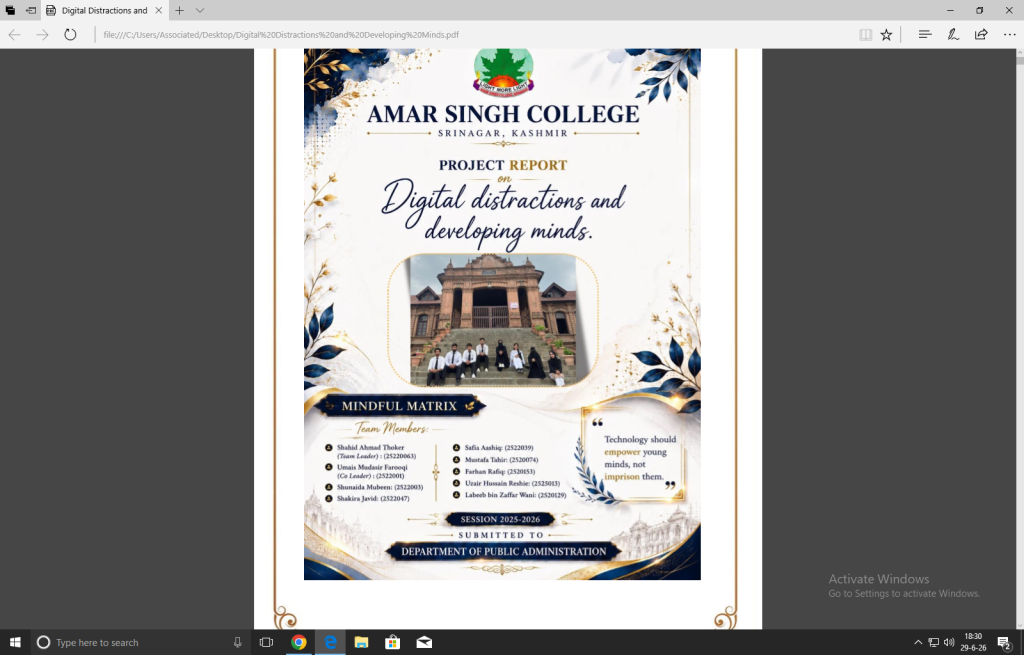
A student-led study reveals how smartphones are quietly reshaping the attention, sleep, emotions, and everyday lives of Kashmir’s adolescents in the digital age. Amir Yaseen reports.
Before the graphs and percentages, before the questionnaires were tabulated and the conclusions were written in academic prose, there was a familiar scene repeated across Kashmir.
A classroom would fall silent for a moment. A teacher would explain a lesson. Somewhere in the room, a phone – not necessarily visible, but present in the mind – would vibrate. Even if the device rested inside a schoolbag, the notification lingered like an unfinished sentence. Attention fractured almost imperceptibly. A glance toward a pocket. A thought about a message. A curiosity about what might be happening elsewhere. Then another attempt to return to the blackboard.
It is difficult to measure the exact instant when distraction becomes habit. Even harder to identify when habit begins reshaping a generation.
That question sits at the heart of an unusually ambitious student-led research project undertaken in Kashmir, where a team of undergraduates from the Department of Public Administration and Political Science at Cluster University of Kashmir set out to investigate something that every parent, teacher and student seemed to recognize intuitively but few had systematically examined: what exactly happens to young minds when the digital world never stops asking for their attention?
The researchers gave their study an understated title – Digital Distractions and Developing Minds. Yet beneath those four words lies a portrait of adolescence in the smartphone era, one that extends far beyond screen time. It is about concentration, sleep, anxiety, identity, physical movement and the subtle negotiations between childhood and technology.
The project surveyed 400 students studying in Classes VII through X across four districts of Kashmir – Shopian, Kulgam, Anantnag, and Srinagar.
Equal numbers of students were selected from each participating school through stratified random sampling, creating one of the more geographically balanced student surveys of its kind conducted locally.
Unlike many discussions surrounding social media, the study did not begin with the assumption that technology itself is harmful.
The opening chapters acknowledge that digital platforms have transformed education in profound ways.
A student in a village today can access lectures from universities across the world.
Classroom notes circulate instantly on messaging applications.
Tutorials exist for almost every conceivable subject.
Knowledge has become astonishingly portable.
Yet the researchers noticed another reality unfolding alongside these opportunities.
The same devices that deliver educational videos also deliver an endless procession of notifications. Every explanation competes with entertainment. Every homework assignment competes with short-form videos. Every moment of quiet concentration exists inside an ecosystem specifically engineered to interrupt it.
The report describes adolescence as a particularly vulnerable stage – not because teenagers lack intelligence, but because they occupy an age when cognitive habits are still taking shape. Attention, memory, emotional regulation and social identity are all under construction. Digital technology enters this developmental landscape not as a visitor but as a permanent resident.
To understand what that coexistence looks like in practice, the researchers travelled across schools in the Valley carrying questionnaires instead of assumptions.
Their methodology combined quantitative surveys with qualitative observations. Anonymous questionnaires allowed students to answer honestly about their digital lives without fear of embarrassment or disciplinary consequences. Questions ranged from daily phone usage to feelings of stress, sleep quality, online safety, emotional well-being and even logical reasoning. The aim was not merely to count hours spent online but to understand what those hours might be doing.
The picture that gradually emerged is remarkably contemporary.
Today’s adolescent does not simply “use” a smartphone. The device functions as classroom companion, entertainment centre, social diary, news source, camera, gaming console, library and emotional refuge. It is often the first object touched in the morning and the last one seen before sleep.
That intimacy is reflected in the numbers.
Among the 400 students surveyed, the single largest category – 35 percent – reported using mobile phones for more than four hours every day. Another quarter spent between two and four hours on their devices. Only a relatively small minority described minimal daily usage. Mobile phones have ceased to be occasional tools; for many students they now constitute the background environment through which adolescence itself unfolds.
The statistic is striking not because 4 hours is an extraordinary amount of time in the digital age, but because of what those hours inevitably replace.
Every hour devoted to scrolling cannot simultaneously be spent reading a novel. Every evening consumed by videos cannot also be spent playing cricket in a neighbourhood field. Every late-night conversation online quietly competes with sleep.
The research repeatedly returns to this notion of substitution rather than outright addiction.
Students are not necessarily abandoning school. Nor are they universally incapable of concentration. Instead, the report documents something subtler: sustained attention has become increasingly difficult to maintain in environments saturated with digital stimulation.
The researchers argue that constant switching between notifications, messages and rapidly changing online content conditions the brain toward fragmented attention rather than prolonged focus. While educational resources remain abundant online, much of students’ actual digital engagement appears centred on entertainment and social networking rather than purposeful learning.
What makes these findings compelling is that they echo observations teachers have quietly shared for years.
Lessons are interrupted not by ringing telephones but by invisible expectations. Students waiting for messages are mentally elsewhere. Reading long passages becomes harder. Assignments compete with algorithms designed to maximise engagement. The classroom increasingly exists alongside another classroom – one curated by recommendation engines operating 24 hours a day.
Yet the survey also reveals a psychological dimension extending beyond attention.
Many adolescents admitted hesitating before expressing their genuine opinions online, worried about negative reactions from peers. Others described feeling significantly less safe expressing themselves on digital platforms than they do in real life, suggesting that the internet, despite promising limitless freedom of expression, often produces its own forms of caution and self-censorship.
This finding complicates one of the defining myths of the social media age.
Digital platforms are often portrayed as spaces where young people freely construct identity. But identity online is rarely free. It is negotiated through likes, comments, visibility and comparison. Every post becomes a small public performance measured almost instantly by an audience that can be supportive one moment and unforgiving the next.
The Kashmir students who answered these questionnaires were not speaking in the abstract. Their responses suggest that many already understand this unwritten social contract.
Another pattern emerged with equal clarity.
Stress – whether arising from academic expectations, social pressures or digital engagement – appeared deeply intertwined with students’ ability to concentrate. More than half of respondents reported that stress frequently or consistently interfered with their focus during studies. An even larger proportion acknowledged that stress clouded their judgment when making decisions, leaving many feeling confused rather than confident.
These responses hint at an educational paradox.
Schools increasingly ask students to demonstrate concentration, creativity and critical thinking while the wider digital environment rewards immediacy, constant responsiveness and divided attention. Young people are expected to excel in both worlds simultaneously.
For many, that balancing act appears exhausting.
The report does not present smartphones as villains. It repeatedly acknowledges their educational value and recognises that digital literacy has become indispensable in modern society. Its argument is more measured – and perhaps more unsettling.
Technology has become so ordinary that its influence is often invisible.
The most consequential digital revolution may not be the invention of new devices but the quiet reshaping of everyday habits: how long a student can read without interruption, how often attention drifts toward imagined notifications, how sleep gradually shortens, how exercise slowly disappears, and how childhood itself increasingly unfolds beneath the glow of a handheld screen.
In Kashmir’s classrooms, these changes rarely announce themselves dramatically.
They accumulate one notification at a time.
The researchers eventually reduced four hundred adolescent lives into charts.
The graphs are clean, almost elegant. Pie charts divide teenagers into percentages. Bar graphs transform unease into coloured rectangles. Statistical tables arrange anxiety with mathematical precision.
Yet every percentage represents a child sitting somewhere in the Kashmir Valley.
One statistic says that nearly 72 percent of respondents admitted that spending time on screens had either definitely or sometimes reduced the amount of time they spent playing outdoors or exercising. On paper, it is simply another data point. In reality, it marks the quiet disappearance of cricket games interrupted by dusk, football matches stretching across neighbourhood grounds, and evenings once measured by the fading light instead of a phone battery.
Technology has not merely occupied young people’s attention. It has occupied their time.
Every technological revolution quietly edits the rhythm of ordinary life. The automobile changed cities. Television rearranged evenings. Smartphones have begun reorganising childhood itself.
The researchers observed this transformation not through dramatic incidents but through accumulated habits. Students described checking notifications while studying, interrupting homework to answer messages, returning to unfinished assignments after wandering through videos that had no relation to schoolwork. None of these interruptions lasted very long. Five minutes became ten. Ten became forty. By the end of an evening, concentration had dissolved into fragments.
The interruption, rather than the device itself, appears to be the central character in this story.
Attention has become a commodity.
Every application competes for it. Every notification requests it. Every algorithm refines itself to capture a little more of it tomorrow than it did yesterday.
The classroom, meanwhile, still depends upon a much older economy – one in which learning requires sustained attention, patience and silence.
The conflict between those two systems rarely announces itself explicitly. Instead, it appears in subtler forms.
Half the surveyed students reported waking each morning feeling tired or very tired. Only a small minority described waking energetic and ready for school. The researchers cautiously point toward excessive nighttime screen exposure, irregular sleep schedules and digital habits that extend well beyond bedtime as likely contributors to this widespread fatigue.
Morning tiredness may seem ordinary. Adolescence has never been synonymous with early mornings.
Yet chronic fatigue changes the texture of an entire school day.
A tired student reads more slowly. Listens less attentively. Forgets instructions more easily. Small frustrations become larger ones. The educational consequences accumulate almost invisibly, one sleepy morning after another.
The report repeatedly returns to sleep – not as an isolated health concern but as the hidden thread connecting concentration, emotional well-being and academic performance.
Then there is the question of dependence.
Researchers asked students how they felt when separated from their phones or computers. A slight majority reported little or only mild discomfort. But nearly forty-five percent described moderate to extreme feelings of irritation, anxiety or emptiness when unable to access their devices. The language resembles what psychologists often associate with behavioural dependence – not necessarily addiction in the clinical sense, but the emotional discomfort that follows the interruption of a deeply ingrained habit.
Perhaps the most revealing observation lies not in the intensity of these emotions but in their normality.
Few teenagers today would consider such feelings unusual.
Entire friendships now unfold inside messaging applications. School announcements circulate digitally. Birthdays are remembered through notifications. Entertainment arrives on demand. The smartphone has evolved into an extension of memory, companionship and identity.
Removing it, even briefly, can feel less like putting away a device than stepping outside one’s social world.
The survey explored another emotional terrain that has become almost synonymous with adolescence in the social-media era: comparison.
Students were asked whether viewing other people’s lives online made them feel those lives were somehow better than their own.
More than half admitted that this happened to them at least sometimes. Nearly half, by contrast, resisted such comparisons altogether or only rarely experienced them. The findings suggest neither universal vulnerability nor complete resilience, but a generation negotiating self-worth inside digital spaces where reality is routinely filtered, edited and curated.
The irony is difficult to ignore.
Social media promises connection while simultaneously encouraging comparison.
A teenager scrolling through photographs rarely sees ordinary afternoons, family disagreements or private disappointments. Instead, the algorithm serves celebrations, achievements, vacations and carefully composed moments that resemble life more than they actually represent it.
The result is not simply envy.
It is distortion.
One begins comparing everyday reality with everyone else’s highlight reel.
The researchers also found widespread concern about online safety.
A substantial majority reported feeling less safe expressing their true thoughts online than they do in face-to-face interactions. Behind the convenience of digital communication exists an awareness of cyberbullying, privacy violations, online harassment and misinformation – risks that adolescents recognise even if they cannot always articulate them fully.
For a generation often described as “digital natives,” this is a revealing contradiction.
Young people may navigate applications with extraordinary fluency, yet fluency does not necessarily translate into safety.
Knowing how to create a reel is different from understanding digital privacy.
Knowing how to edit photographs is different from recognising misinformation.
Knowing how to communicate instantly is different from knowing when not to.
The report therefore argues not for less technology but for better digital literacy, healthier habits and greater cyber-safety awareness. Its recommendations are remarkably practical: responsible screen-time management, parental guidance, school-based awareness programmes and balanced engagement with technology rather than outright rejection of it.
Perhaps the study’s most encouraging finding arrives almost quietly.
Despite concerns about excessive screen exposure, students largely performed well on a logical reasoning question included in the survey. The researchers conclude that significant cognitive decline has not yet become evident among the participants. The warning, therefore, concerns trajectories rather than irreversible damage. Habits, unlike neurological injuries, can still be changed.
That conclusion matters.
Public conversations about technology often drift toward extremes. Smartphones are either celebrated as revolutionary educational tools or condemned as existential threats to childhood.
The Kashmiri students who conducted this research arrive somewhere more nuanced.
Technology is neither hero nor villain.
It is infrastructure.
Its consequences depend less on its existence than on the patterns through which it is woven into daily life.
In the final pages of the report, the researchers offer theoretical models linking screen time with concentration, stress, sleep quality and academic performance – not as rigid mathematical laws but as conceptual maps describing relationships they repeatedly observed during fieldwork. The models reflect an attempt by young scholars to translate lived experience into analytical language.
There is something quietly hopeful about that effort.
Four hundred schoolchildren answered questions about their digital lives. Nine university students transformed those answers into research. Teachers supervised the work. Schools opened their classrooms. Together, they produced something increasingly rare in discussions about technology: evidence rooted in local experience rather than imported assumptions.
The future of adolescence in Kashmir will almost certainly be more digital than its past.
Artificial intelligence will enter classrooms. Algorithms will become more persuasive. Screens will become smaller, faster and more immersive.
None of those developments seems likely to reverse.
But perhaps the more enduring question is not how many hours young people spend looking at screens.
It is whether, amid the endless flow of notifications, videos and scrolling feeds, they can still find uninterrupted moments to look up – to concentrate, to think deeply, to walk outside, to sleep well, to disagree without fear, and to discover that the richest parts of growing up remain stubbornly resistant to digitisation.
That, more than any graph or percentage, is what this Kashmiri study ultimately measures. It measures the fragile space between connection and distraction, between information and wisdom, between being endlessly online and fully present. And in classrooms stretching from Shopian to Srinagar, that space may prove to be one of the most important educational frontiers of the twenty-first century.
Behind the Research
A substantial 81-page research study titled ‘Digital Distractions and Developing Minds’, based on a survey of 400 students in Classes 7 to 10 across Srinagar, Shopian, Kulgam, and Anantnag districts, states that excessive digital engagement is affecting attention, sleep, physical activity, and emotional well-being while emphasising that technology itself is not the enemy when used responsibly. The study was conducted by a nine-member student research team from the Department of Public Administration and Political Science, Cluster University of Kashmir (Amar Singh College), led by Shahid Ahmad Thoker and Umais Mudasir Farooqi. The team comprised Shahid Ahmad Thoker, Umais Mudasir Farooqi, Shunaida Mubeen, Shakira Javid, Safia Aashiq, Mustafa Tahir, Farhan Rafiq, Uzair Hussain Reshie, and Labeeb bin Zaffar Wani, who jointly carried out the field survey, data collection, analysis, and preparation of the report examining the impact of excessive social media use on adolescent students in Kashmir.
By the Numbers
400 students surveyed
4 Kashmir districts covered
Classes VII-X participated
35% spend over 4 hours per day on smartphones
25% spend 2-4 hours per day on screens
52% say stress disrupts studies
81% feel confused making decisions under stress
72% say screen time cuts outdoor play
50% wake up tired or very tired
45% feel anxious or irritable without phones
52% compare themselves with others on social media
67% of heavy users feel others have better lives
67% feel less safe expressing themselves online
9 university students conducted the research
Key Takeaways
Smartphones replacing playtime
Sleep loss affecting learning
Attention spans under strain
Digital dependence on the rise
Cyber-safety awareness remains low
Balanced screen use, not bans, recommended
About the Author
Amir Yaseen is a Srinagar-based journalist with an eye for the telling detail and an ear attuned to the cadences of Kashmir. He approaches news as narrative, locating the human story within the language of policy and progress and the quiet recalibration of everyday life.