



Decades of encroachment, pollution, and neglect have pushed historic Khushalsar and Gilsar lakes to the brink. Tabish Khan reports.
On a quiet morning in Srinagar’s old city, the waters of Khushalsar appear calm.
Willows sway gently along parts of its banks. Kingfishers occasionally skim the surface. Children walk across narrow lanes that once overlooked open water.
Yet beneath that deceptive calm lies a lake fighting for survival.
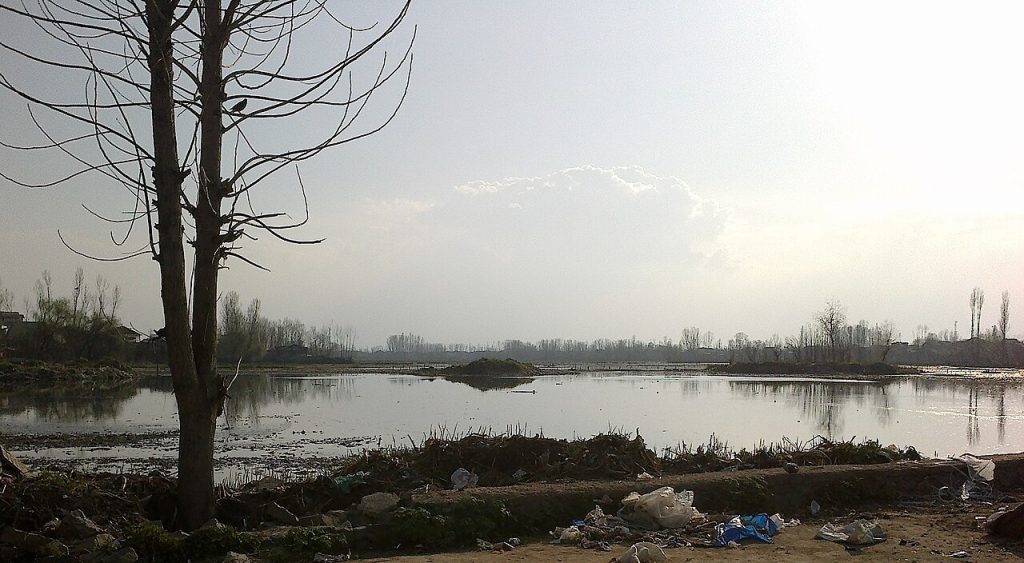
Its edges have steadily shrunk. Its waters have become shallower. Weeds choke large sections. Untreated sewage flows into it daily. Encroachments continue to nibble away at its fragile margins.
For generations of Kashmiris, Dal Lake became the face of the Valley’s waters. Nigeen earned admiration for its serenity. Wular remained synonymous with vastness.
Khushalsar and Gilsar, however, slowly slipped from public memory.
Today, these interconnected lakes – once central to Srinagar’s ecological and cultural identity – stand among Kashmir’s most endangered urban wetlands.
Their decline tells a larger story about the changing relationship between cities and nature.
Khushalsar and Gilsar are not isolated water bodies.
Historically, they formed part of Srinagar’s remarkable network of lakes, marshes and canals connected to Dal Lake and the River Jhelum.
This interconnected hydrological system acted as the city’s natural drainage network.
Floodwaters spread across wetlands. Groundwater was replenished. Nutrients circulated naturally. Aquatic life flourished. Water transport linked neighbourhoods.
Communities depended upon these lakes for fishing, vegetable cultivation and harvesting aquatic plants. The lakes were not ornamental. They were living infrastructure.
Unlike dramatic environmental disasters, the death of a lake rarely happens overnight.
It occurs gradually. Year after year. Decade after decade. A little more construction. Another drain carrying sewage. Another stretch filled with debris. Another encroachment. Another patch consumed by weeds.
Eventually, residents begin forgetting where the water once existed.
Satellite imagery over the past several decades has revealed a consistent decline in the surface area of Khushalsar and Gilsar.
What were once expansive water bodies have steadily fragmented into narrower channels and isolated pools.
Urban expansion has steadily replaced wetlands with settlements.
Natural floodplains have disappeared beneath concrete.
Many people still see urban lakes primarily as scenic spaces. Environmental scientists view them differently. Wetlands function like natural kidneys. They filter pollutants. Recharge groundwater. Moderate temperatures. Support biodiversity. Absorb excess rainwater during storms. Reduce flood risks.
In a city increasingly vulnerable to extreme rainfall, these ecological services have become even more valuable.
The devastating floods of 2014 demonstrated what happens when natural drainage systems become compromised.
Urban wetlands once stored enormous volumes of floodwater. As they shrink, that storage capacity disappears. Every lost wetland increases flood vulnerability elsewhere.
Perhaps no threat has proved more persistent than encroachment.
Over decades, residential structures, commercial buildings and informal settlements have gradually advanced towards the lakes.
Some areas once submerged now support permanent construction.
Roads have fragmented water bodies. Natural channels have narrowed. Drainage patterns have changed. The process often begins subtly. A small embankment. A temporary structure. Land filling. Eventually, what was once open water becomes dry land.
Officials now acknowledge that preventing fresh encroachments has become central to any restoration strategy.
That explains why the Lake Conservation and Management Authority has prioritised boundary demarcation.
Without clearly defined legal boundaries, protecting lakes becomes almost impossible.
Encroachment alone cannot explain the lakes’ deterioration. Pollution has transformed water quality.
Untreated domestic sewage from surrounding neighbourhoods continues entering the lake system.
Solid waste accumulates along shorelines. Plastic, organic waste and construction debris increasingly burden the ecosystem. Excess nutrients encourage explosive weed growth. The resulting eutrophication reduces oxygen levels. Fish populations decline. Aquatic biodiversity suffers. Water gradually becomes stagnant. The lake begins suffocating itself. Invasive weeds
Anyone visiting Khushalsar today immediately notices the dense vegetation covering parts of the water.
While aquatic plants naturally belong in wetland ecosystems, excessive nutrient loading creates uncontrolled growth.
Large mats of weeds reduce sunlight penetration. Water circulation slows. Oxygen decreases. Navigation becomes difficult.
Cleaning operations therefore become necessary not merely for aesthetics but for ecological recovery.
The deployment of specialised machinery such as Water Masters and barges reflects that challenge.
Yet experts caution that removing weeds without addressing sewage inflows offers only temporary relief.
Unless pollution stops, weeds simply return. Biodiversity under threat. Healthy urban wetlands support extraordinary biodiversity. Migratory birds. Resident waterfowl. Fish. Amphibians. Aquatic insects. Native vegetation.
Khushalsar and Gilsar once served as important habitats within Kashmir’s larger wetland ecosystem.
As water quality declines, many species disappear. Sensitive organisms vanish first. Invasive species often replace native ones. Bird diversity declines. Fish breeding grounds shrink. Urban biodiversity becomes increasingly impoverished.
The ecological loss extends beyond the lakes themselves. Entire food chains become disrupted.
The urgency of restoration has grown even greater as climate change alters rainfall patterns across Kashmir. Extreme precipitation events are becoming more frequent. Urban flooding risks are increasing.
Healthy wetlands provide one of the cheapest and most effective forms of climate adaptation.
They temporarily store stormwater. Reduce runoff. Slow flood peaks. Recharge groundwater. Release water gradually. Replacing these natural systems with concrete transfers flood risk elsewhere.
Saving Khushalsar and Gilsar is therefore no longer simply an environmental issue. It is increasingly a climate resilience strategy.
Kashmir has already spent decades attempting to restore Dal Lake. While progress has been uneven, important lessons have emerged. Restoration cannot rely solely upon dredging. Nor can it depend only on removing weeds.
Successful lake conservation requires integrated watershed management. Sewage treatment. Solid waste management. Catchment protection. Strict regulation of construction. Community participation. Continuous monitoring.
Khushalsar and Gilsar require exactly the same integrated approach.
Thousands of people live around the lake system. Many depend upon it directly or indirectly.
Restoration cannot succeed if local communities perceive conservation as an external government exercise.
Residents must become partners. Awareness campaigns. Citizen monitoring. Waste management. Community clean-up initiatives. Livelihood support.
Public ownership often determines whether restored ecosystems remain protected.
Around the world, successful urban wetland restoration increasingly depends upon community participation.
One of the LCMA’s most significant current initiatives involves boundary demarcation.
Although technical in appearance, this process carries enormous legal importance.
Once lake boundaries are accurately surveyed and marked, enforcement becomes easier.
Future encroachments can be identified quickly. Land ownership disputes become clearer. Restoration planning improves.
Physical protection measures – including proposed chain-link fencing along vulnerable stretches – may discourage further illegal occupation.
Without defining where the lake begins and ends, conservation remains permanently vulnerable.
Modern wetland restoration has evolved far beyond simple cleaning operations. Scientists increasingly advocate ecosystem-based restoration. That means understanding hydrology. Sediment movement. Water quality. Native vegetation. Wildlife habitat. Human pressures.
Restoration should aim not merely to beautify lakes but to recover ecological function.
Water circulation must improve. Pollution loads must decline. Native species should return. Natural shorelines require protection.
The LCMA’s emphasis on scientific management reflects this broader philosophy.
Lake restoration requires coordination across multiple agencies. Urban development. Municipal authorities. Revenue officials. Pollution control agencies. Tourism. Fisheries. Forest departments.
Conservation efforts often fail because institutions work independently rather than collaboratively.
Integrated governance therefore becomes as important as ecological restoration itself.
Some question whether restoring urban lakes justifies the cost. Environmental economists increasingly argue the opposite. Healthy wetlands reduce flood damage. Improve public health. Enhance property values. Support tourism. Provide recreational spaces. Recharge groundwater. Reduce water treatment costs. The economic benefits often exceed restoration investments over time.
Viewed this way, conservation becomes infrastructure investment rather than environmental expenditure.
Khushalsar and Gilsar are more than ecosystems. They are part of Kashmir’s cultural landscape. Generations grew up beside these waters. Traditional boats navigated them. Local histories unfolded along their banks.
Old Srinagar developed in intimate relationship with its waterways. As lakes disappear, cultural memory fades alongside ecological loss.
Restoration therefore preserves heritage as much as habitat.
The Lake Conservation and Management Authority’s latest initiatives – including accelerated boundary demarcation, stronger monitoring, deployment of restoration machinery and proposals for protective fencing – represent encouraging steps.
But experts caution that time remains critical. Every year of delay increases restoration costs. Every fresh encroachment becomes harder to reverse. Every untreated drain deepens ecological decline. Every lost wetland reduces the city’s resilience.
Saving Khushalsar and Gilsar will require more than periodic clean-up drives. It demands political commitment. Scientific planning. Strict law enforcement. Community participation. Long-term funding. Continuous monitoring.
Most importantly, it requires recognising that these lakes are not vacant land waiting for development.
They are living ecosystems performing services upon which cities quietly depend every day.
The fate of Khushalsar and Gilsar ultimately reflects a larger question facing Kashmir.
Can rapid urbanisation coexist with ecological protection?
Or will development continue consuming the very natural systems that make cities resilient?
For now, the waters still remain. The birds still return.
The channels still connect fragments of a once magnificent lake system. There is still time to restore them. But that window is narrowing.
If the current conservation drive succeeds, future generations may inherit living lakes rather than fading memories.
If it fails, Khushalsar and Gilsar risk joining a growing list of urban wetlands remembered only through old maps, fading photographs and stories of waters that once defined the heart of Srinagar.
About the Author
Tabish Khan is a multi-media journalist whose work moves fluidly across text, video, and the fast-evolving grammar of social media. With postgraduate degree in Convergent Journalism, her storytelling often bridges traditional field journalism with platform-driven formats – short-form video, visual explainers, and audience-first storytelling.