




From historic upsets to heavyweight showdowns, the FIFA World Cup 2026 has narrowed the field to four footballing giants in a tournament that has redefined the road to global glory. Syed Sameer Ahmad Nazki reports.
From historic upsets to heavyweight showdowns, the FIFA World Cup 2026 has narrowed the field to four footballing giants in a tournament that has redefined the road to global glory. Syed Sameer Ahmad Nazki reports.
The FIFA World Cup 2026 has delivered exactly what every football romantic hopes for and every tournament rarely produces: a climax worthy of its unprecedented scale. After 100 matches across three host nations and the first-ever 48-team World Cup, the competition has distilled itself into four footballing giants – Argentina, France, Spain and England.
It is a semi-final line-up that feels almost cinematic.
For the first time since FIFA’s world rankings came into existence, the world’s top four ranked teams have all reached the World Cup semi-finals. It is also the first World Cup in 36 years to feature a final four made up entirely of former champions, reviving memories of the classic contests that defined earlier eras of international football.
After weeks of shocks, underdog stories and dramatic eliminations, football’s biggest stage has ultimately rewarded quality, consistency and depth. The tournament has showcased the evolution of the modern game, where tactical flexibility, squad rotation and technology have become as decisive as individual brilliance.
The expanded 48-team format was initially met with scepticism. Critics feared diluted quality and player fatigue. Instead, it has largely exceeded expectations. Record crowds attended the group stage, more nations experienced the World Cup than ever before, and the longer format created fresh narratives without diminishing the prestige of reaching the knockout rounds.
Once the Round of 32 began, every match carried the tension only a World Cup can produce. Former champions stumbled, emerging nations challenged traditional powers, and extra-time thrillers and penalty shootouts became familiar features. Yet the defining characteristic of the tournament has been balance. Unlike previous editions dominated by one or two favourites, the remaining four teams each have a genuine claim to football’s greatest prize.
France perhaps arrive with the strongest aura.
Didier Deschamps’ side has navigated difficult knockout fixtures with remarkable composure. Their quarter-final victory over Morocco reinforced why Les Bleus remain favourites. Even after Kylian Mbappe missed an early penalty, France never lost control, relying on superior organisation, depth and attacking quality to advance.
Mbappe once again stands at the centre of France’s campaign. Already among the greatest World Cup performers of his generation, he continues to combine blistering pace with clinical finishing, while France’s balanced midfield and disciplined defence have made them one of the tournament’s most complete teams.
Standing opposite them is perhaps the competition’s most elegant side.
Spain have reaffirmed their reputation as masters of possession while adding greater attacking urgency to their game. Teenage sensation Lamine Yamal has emerged as one of the tournament’s brightest stars, while Spain’s depth has repeatedly proved decisive.
Against Belgium, substitute Mikel Merino scored the winning goal after another display of patience and technical excellence. Spain rarely panic. They simply keep moving the ball until opportunities emerge.
If France represent physical power and efficiency, Spain embody footballing intelligence.
Their semi-final promises a fascinating contrast of styles – France seeking devastating transitions, Spain pursuing complete control through possession. It has all the ingredients of a modern classic.
The other semi-final revives one of football’s greatest rivalries.
England versus Argentina requires little introduction. From the 1966 World Cup final to the drama of Mexico 1986, meetings between the two nations have always carried significance extending beyond football.
England’s journey has tested both resilience and belief.
Their dramatic quarter-final victory over Norway showcased Jude Bellingham’s growing status as one of world football’s defining players. Twice the midfielder rescued his side, scoring a stoppage-time equaliser before adding the extra-time winner in a match that also generated controversy over an overhead spidercam. FIFA later found no evidence that the incident influenced play.
England’s progress has strengthened belief that this may finally be the generation capable of ending decades of World Cup frustration. Under Thomas Tuchel, the side has steadily matured, blending youthful energy with tournament experience. Bellingham has become the heartbeat of midfield, while Harry Kane continues to provide leadership and goals.
Waiting for them is Argentina.
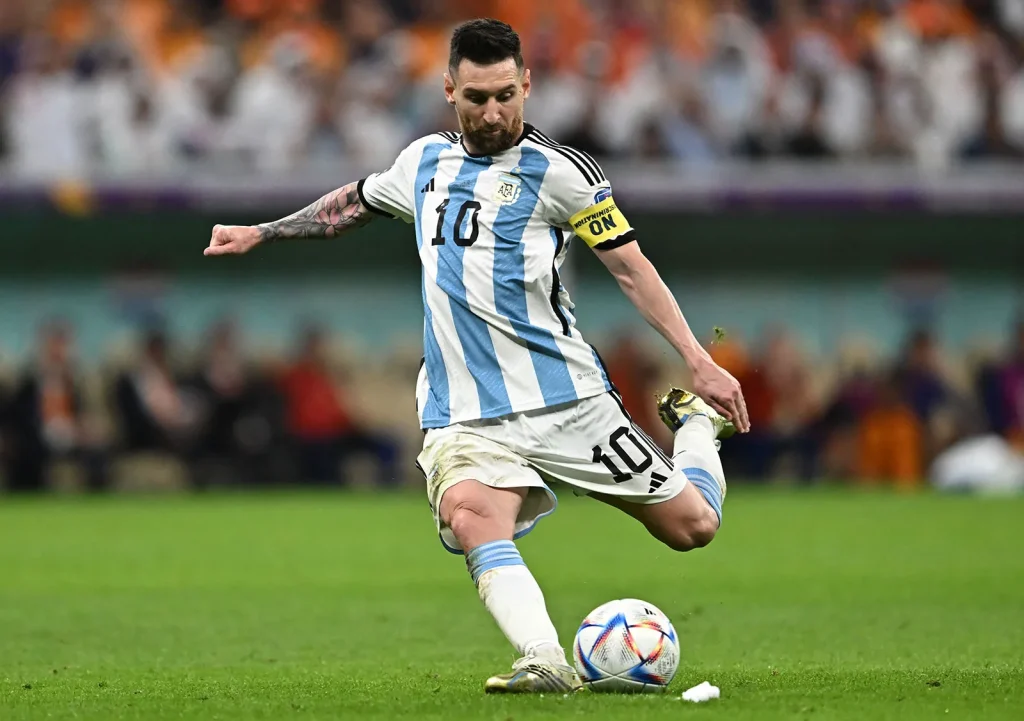
The defending champions have once again demonstrated why winning becomes a habit. Lionel Messi continues to defy both age and expectation. Though no longer dominating through pace, he controls matches with extraordinary vision, intelligence and decision-making.
Argentina’s quarter-final against Switzerland proved more difficult than the final score suggested. The Swiss matched them for long periods before a controversial red card shifted momentum. Argentina eventually prevailed in extra time, with Messi orchestrating the decisive moments and Lautaro Martinez finishing the job.
Unlike the emotionally charged run to the 2022 title, this Argentine side appears calmer, more mature and tactically adaptable. Different players have stepped forward throughout the tournament. Messi remains the symbol, but the collective remains the team’s greatest strength.
Beyond individual teams, the tournament has reflected broader changes in international football.
Sports science now shapes preparation as much as coaching. Managers rotate squads aggressively. Performance analytics influence tactical decisions in real time. Goalkeepers initiate attacks, defenders build from the back and coordinated pressing systems demand extraordinary athleticism. Success increasingly depends on squad depth rather than simply the quality of the starting eleven.
Technology has also become an integral part of the modern World Cup. Connected-ball technology, advanced VAR systems and sophisticated performance tracking have improved officiating and provided teams with unprecedented tactical insights. Debate over decisions remains inevitable, but technology has significantly reduced clear errors.
The tournament has also underlined an enduring truth: history guarantees nothing.
Traditional powers such as Brazil and Belgium exited earlier than expected despite beginning among the favourites. The expanded format may have increased the number of participants, but it has also demanded greater consistency from elite teams, who now face an additional knockout round before reaching the latter stages.
That makes the achievement of the remaining four teams even more impressive. Each has survived a longer, more demanding competition, overcome tactical challenges and handled the emotional and physical pressures unique to World Cup football.
For neutral supporters, the semi-finals offer two irresistible spectacles.
France versus Spain promises a clash between Europe’s two most complete footballing systems.
England versus Argentina revives one of the sport’s defining rivalries.
There are no outsiders. No surprise packages. Only four global heavyweights separated by the finest margins.
Ultimately, World Cups are remembered not merely for champions but for moments—Maradona’s brilliance, Zidane’s artistry, Iniesta’s winner and Messi’s coronation in Qatar.
The 2026 edition now stands on the threshold of creating its own enduring memories.
Will Mbappe strengthen his claim as the defining player of his generation? Can Messi produce one final masterpiece? Is this Bellingham’s arrival as football’s next global superstar? Or will Spain’s youthful revolution usher in a new era of international dominance?
The answers will unfold over the coming days.
What is already certain is that football’s greatest tournament has reached the stage every supporter dreams about – a final four where every match feels worthy of a final, every player carries history on his shoulders, and every touch of the ball may shape a generation’s legacy.
After a month of breathtaking football across North America, the World Cup has once again become what it has always promised to be: the ultimate examination of greatness.
Only one champion remains to be crowned. But already, the journey to the semi-finals has reminded the world why no sporting spectacle captures the imagination quite like the FIFA World Cup.
About the Author
Syed Sameer Ahmad Nazki is filmmaker with command over film editing. With a parallel interest in videography, Nazki gravitates toward stories that live at the intersection of image and emotion. Away from the edit table, he remains an engaged observer of sport, particularly cricket and football.