



Says trust has eroded after decades of unfulfilled commitments, urges restoration of J&K’s constitutional rights
Kashmir Impulse Desk
Srinagar, July 11
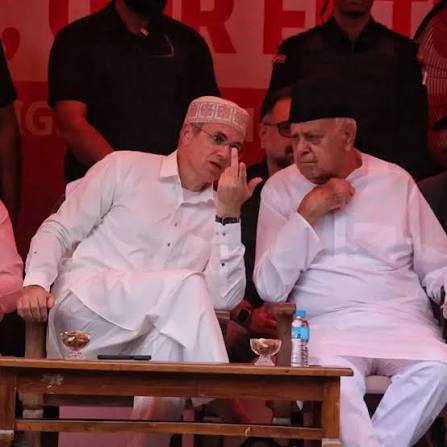
National Conference (NC) President Farooq Abdullah on Saturday accused successive governments in New Delhi of repeatedly failing to honour political commitments made to Jammu and Kashmir, saying decades of broken promises had eroded trust and deepened the divide between the region and the Centre.
Addressing party workers and supporters at the Hazratbal shrine in Srinagar, the veteran leader said the National Conference’s campaign for the restoration of statehood and constitutional rights was rooted not in political expediency but in what he described as the legitimate aspirations of the people of Jammu and Kashmir.
“We are not asking for anything that does not belong to us,” Abdullah said. “We are asking for the restoration of our rights and dignity.”
His remarks come as the National Conference intensifies its campaign for the restoration of statehood, with the party preparing to stage a protest in New Delhi later this month to press the federal government to fulfil assurances that Jammu and Kashmir would regain statehood following the completion of the democratic process.
The demand has become the central political issue in the Union Territory since New Delhi revoked the region’s special constitutional status in August 2019 and bifurcated the former state into the Union Territories of Jammu and Kashmir and Ladakh.
Abdullah said the present sense of political uncertainty reflected a pattern that stretched back decades, recalling assurances made by successive prime ministers that, he said, were never fully implemented.
Referring to discussions held during the tenure of former Prime Minister P.V. Narasimha Rao in the early 1990s, Abdullah said the Centre had acknowledged that mistakes had been made in its handling of Jammu and Kashmir and had promised corrective measures.
“We were assured that the shortcomings would be addressed and justice would be done,” he said. “Years have passed, but those commitments remain largely unfulfilled.”
The veteran politician argued that repeated failures to translate political assurances into concrete action had steadily weakened public confidence in New Delhi.
He also recalled a more recent meeting with Prime Minister Narendra Modi, attended by senior political leader Ghulam Nabi Azad, during which he said he had candidly raised the issue of mutual distrust between Kashmir and the Centre.
“I told the Prime Minister that the biggest challenge before us was the lack of trust,” Abdullah said. “If there is no trust between Delhi and Kashmir, the distance between the two can only grow.”
Although the Centre had spoken of reducing that distance, Abdullah said many Kashmiris believed the gap had widened instead.
Without naming specific political parties or leaders, Abdullah accused some of his political opponents of aligning themselves too closely with New Delhi while claiming to represent the interests of the people of Jammu and Kashmir.
He alleged that such leaders adopted different positions in Srinagar and in the national capital, tailoring their political messaging to suit those in power.
“They speak one language before the people and another before Delhi,” he said.
Abdullah urged political leaders across Jammu and Kashmir to place the interests of the region above partisan considerations, saying public representatives should act independently rather than pursue political advantage through proximity to the Centre.
In one of his strongest attacks, he accused unnamed rivals of sacrificing the region’s political interests for personal gain, saying history would judge those who failed to stand with the people during critical moments.
The National Conference has increasingly framed its campaign as a broader constitutional movement rather than a party-specific political exercise.
Party leaders have argued that the restoration of statehood is essential for strengthening democratic institutions and enabling an elected government to exercise the full range of executive and legislative powers available to other Indian states.
The Centre has repeatedly stated that statehood will be restored at an appropriate time after the democratic process is completed, a commitment it reiterated before the Supreme Court during proceedings challenging the 2019 constitutional changes.
However, no timeline has been announced, allowing opposition parties in Jammu and Kashmir to intensify pressure on New Delhi over what they describe as an open-ended delay.
Abdullah also defended the National Conference’s record in government, saying previous administrations led by the party had continued to invest in education, healthcare, road connectivity and public infrastructure despite prolonged periods of militancy and political instability.
“We governed under extraordinarily difficult circumstances,” he said. “Yet we continued to build schools, colleges, hospitals and roads because governance cannot stop during times of crisis.”
The former chief minister said the party’s current struggle was not aimed at securing political concessions but at restoring what he described as the constitutional and democratic rights of the people of Jammu and Kashmir.
“Our demand is simple,” Abdullah said. “The rights that belonged to the people should be returned to them.”
His remarks come as political parties across Jammu and Kashmir sharpen their positions over the question of statehood, setting the stage for what is expected to be an increasingly contentious debate between regional parties and the Bharatiya Janata Party in the weeks ahead.