


Faith becomes intertwined with memory.
Every year, the Kheer Bhawani festival transforms a spring in Kashmir into a place where memory, faith, and hope converge, offering a glimpse of a shared past that many believe can still shape the future. Amir Yaseen reports.
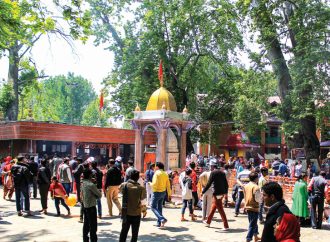
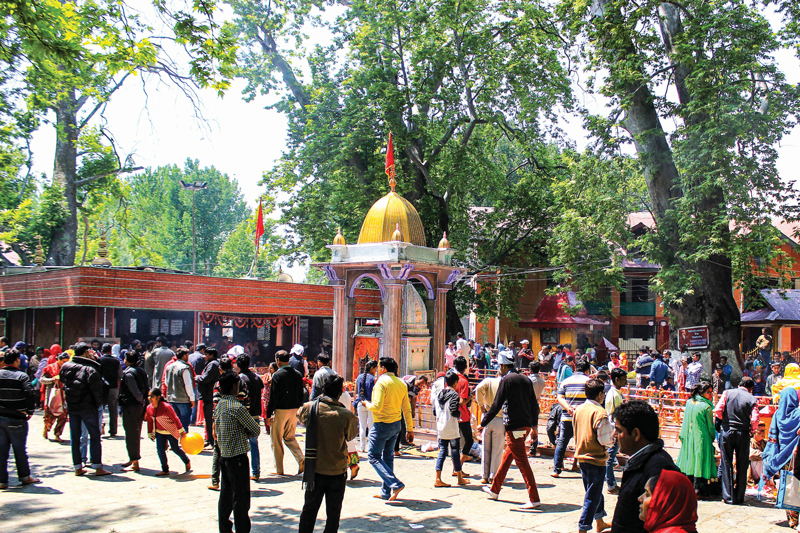
The first thing visitors notice at the Mata Ragnya Devi shrine in Tulmulla is the shade.
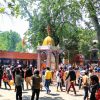
Long before they reach the sacred spring, before they join the queues of devotees carrying bowls of kheer or pause before the ancient temple, they step beneath a canopy of towering Chinar trees whose broad leaves soften the June sunlight into shifting patches of green and gold. The air is cooler here. Conversations become quieter. Even the movement of thousands of people seems to settle into a slower rhythm, as though the place insists that everyone pause before entering.
For generations of Kashmiri Pandits, this has been more than a temple. It has been a point of return.
Every year on Jyeshtha Ashtami, devotees travel from Jammu, Delhi, Mumbai, Pune and dozens of other cities to gather around the sacred spring dedicated to Mata Ragnya Devi. They bring offerings of kheer – the simple mixture of milk and rice from which the festival takes its name – and prayers for peace, prosperity and protection. Many also bring something less visible: memories carried across decades of displacement.
This year, those memories arrived with unusually large crowds.
Authorities said attendance at the annual Kheer Bhawani festival exceeded that of previous years, with thousands of devotees converging on Tulmulla from across the country. For many, the pilgrimage represented far more than a religious obligation. It was an annual journey toward a place that continues to define home, even for those who have lived elsewhere for more than three decades.
“We live in Jammu, but our hearts remain in Kashmir,” said Neeraj Santoshi, who travelled from Delhi to attend the festival.
It is a sentence heard in different forms every year.
Sometimes it comes from elderly pilgrims who remember orchards, neighbourhoods and schools left behind during the violence of the early 1990s. Sometimes it comes from younger generations who know Kashmir primarily through family stories, faded photographs and an annual visit to Tulmulla.
The festival compresses those different generations into the same sacred space.
Grandparents explain traditions to grandchildren who have never lived in the Valley. Parents point toward villages visible beyond the shrine and recount lives interrupted decades earlier. Children, many visiting Kashmir for the first time, absorb stories that belong to a place both familiar and distant.
Faith becomes intertwined with memory.
Yet if the festival is about remembrance, it is equally about relationships that endured despite separation.
Throughout the day, local Muslim residents moved among the crowds, distributing drinking water, serving refreshments, guiding elderly pilgrims toward shaded areas and helping visitors navigate the busy shrine complex. Volunteers assisted with logistics while local families welcomed guests in ways that have become part of the festival’s rhythm over generations.
“Our forefathers protected this shrine and we continue that tradition,” said Javed Ahmad, a resident of Tulmulla.
His words reflected a sentiment repeated by many local residents.
“Kashmiri Pandit brothers are our own people,” said volunteer Javed Dar, who spent the day helping pilgrims.
Such gestures rarely dominate political discourse surrounding Kashmir. They are too ordinary to become headlines and too familiar for local people to consider remarkable. Yet within the grounds of Kheer Bhawani, they reveal another dimension of the Valley’s social fabric—one sustained less by declarations than by annual acts of hospitality.
The shrine itself has witnessed centuries of such encounters.
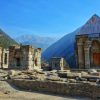
Situated amid majestic Chinar trees and centred around a sacred spring whose changing colour has long inspired local beliefs about the fortunes of Kashmir, the temple occupies a unique place in the spiritual geography of the Valley. For Kashmiri Pandits, it is among the holiest religious sites. For many Muslims living nearby, it is also an inherited responsibility – a place whose preservation forms part of the region’s shared cultural inheritance.
The result is a festival where religious devotion and neighbourhood familiarity exist comfortably alongside one another.
Security, inevitably, remains part of the picture.
Thousands of devotees gathered under an extensive security arrangement involving police, paramilitary forces and civil administration. Medical teams, transport services, sanitation workers, power department officials and volunteers worked together to ensure the smooth conduct of the pilgrimage. Senior civil and police officers monitored arrangements throughout the day, interacting with visitors and reviewing facilities.
For many pilgrims, the careful organisation allowed attention to remain focused on worship rather than logistics.
“This was a safe and well-organised pilgrimage,” observed a devotee who had travelled from Pune.
The smooth conduct of the festival reflected months of planning involving multiple government departments, each responsible for a different aspect of an event that must accommodate thousands of visitors within a single day. Accommodation, crowd management, emergency medical services, transportation and sanitation all became parts of an administrative choreography largely invisible to those participating in the rituals.
But beneath the efficient organisation lay a deeper emotional current.
The annual pilgrimage has increasingly become an occasion where questions of identity, belonging and return quietly surface between prayers.
Many elderly devotees lingered after offering kheer, sitting beneath the Chinars as families exchanged stories about villages they once called home. Some spoke of houses they have not seen for decades. Others recalled Muslim neighbours who protected property, maintained friendships or continued writing letters after migration divided communities.
Memory, here, is rarely singular.
It contains grief and affection, absence and recognition.
It also contains hope.
“My address may have changed,” said Sarla Kaul, another pilgrim, “but Kashmir is still my home.”
Those words echoed through conversations across the shrine grounds, suggesting that for many displaced families, the annual festival remains less a commemoration of loss than a reaffirmation of belonging.
Home, they seemed to suggest, is not always measured by where one lives.
Sometimes it is measured by where one continues to return.
If the prayers offered at Kheer Bhawani are deeply personal, the conversations that unfold outside the temple complex are often quietly political – not in the partisan sense, but in the larger human sense of belonging, reconciliation and the future of Kashmir.
For decades, the annual pilgrimage has functioned as one of the few occasions when displaced Kashmiri Pandits and Valley residents meet in significant numbers without the urgency of crisis or negotiation. There are no formal agendas beneath the Chinar trees. Instead, there are greetings between old acquaintances, questions about absent relatives, shared meals and recollections of neighbourhoods where temples and mosques once formed part of the same daily landscape.
The festival offers no easy answers to the complex questions surrounding the displacement of Kashmiri Pandits in the early 1990s. Those questions remain intertwined with issues of security, political representation, employment, housing and justice—matters that cannot be resolved through symbolism alone.
Yet symbols matter.
Communities often begin rebuilding trust not through grand political settlements but through repeated acts of familiarity. A glass of water offered to a pilgrim. A volunteer guiding an elderly devotee through a crowded pathway. Local families opening their homes to visitors. Such gestures cannot erase history, but they can challenge the assumption that history must dictate the future.
This year’s gathering seemed especially conscious of that possibility.
Many devotees spoke openly of return—not merely as a nostalgic wish, but as an aspiration tempered by realism. Few imagined that such a process would be immediate or simple. Most acknowledged that meaningful rehabilitation would require sustained peace, institutional support and renewed confidence among families that left more than three decades ago.
Still, the desire endures.
“We live in Jammu, but our hearts remain in Kashmir,” one pilgrim had said earlier in the day. It was a sentiment echoed in different forms across the temple grounds.
For many younger members of the community, the Valley is a place inherited through stories rather than lived experience. They know family homes through old photographs. They know neighbourhoods through grandparents’ recollections. Their connection is emotional before it is geographical.
The annual pilgrimage narrows that distance.
Children who have spent their lives in Delhi, Jammu or elsewhere suddenly hear Kashmiri spoken all around them. They taste traditional food prepared for the festival, watch elders greet Muslim residents by name and discover that the homeland they have heard about exists not only in memory but also in the living landscape around them.
For local Muslims, too, the day carries its own significance.
Many residents of Tulmulla describe the festival as part of their own annual calendar, a tradition in which hospitality is as important as ritual. Older villagers recall times when Pandit and Muslim families celebrated one another’s festivals, attended weddings together and shared everyday routines that made religious identity only one aspect of community life.
Those memories have survived separation.
“Our forefathers protected this shrine and we continue that tradition,” said Javed Ahmad, expressing a sense of responsibility that many local residents consider entirely natural.
It is perhaps one of Kashmir’s quieter paradoxes that a shrine belonging to one religious community has long been cared for with affection by members of another. The relationship has persisted through changing governments, political upheavals and periods of violence, suggesting that cultural inheritance is sometimes more resilient than public discourse allows.
Political leaders visiting the shrine drew attention to that shared inheritance.
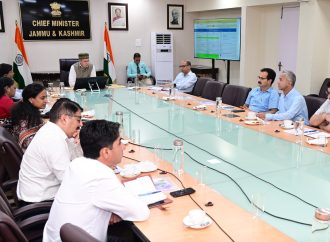
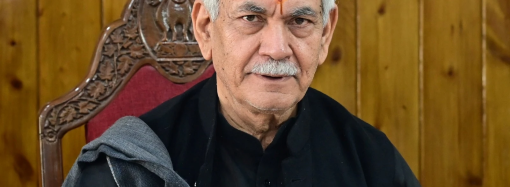
Lieutenant Governor Manoj Sinha offered prayers for peace, prosperity and communal harmony, describing the occasion as an opportunity to seek blessings for a more peaceful Jammu and Kashmir. He welcomed the large turnout and reviewed arrangements made by various government departments to facilitate the pilgrimage.
National Conference president and former chief minister Farooq Abdullah struck a more personal note, expressing hope that displaced Kashmiri Pandits would one day return permanently to the Valley.
“We want our Kashmiri Pandit brothers and sisters to return and live with us,” he said, arguing that governments and society alike shared responsibility for making such a return possible.
Former chief minister Mehbooba Mufti echoed that sentiment while urging both communities to focus on rebuilding trust rather than remaining captive to the divisions of the past. She also called for addressing practical concerns faced by displaced families, including housing and welfare, arguing that reconciliation must be accompanied by meaningful policy measures.
Their remarks reflected a rare point of convergence in Kashmir’s often-fractured political landscape.
Despite differences on many issues, there appeared to be broad agreement that the return of Kashmiri Pandits – whenever and however it might occur – would represent not only the restoration of a community but also the recovery of an idea of Kashmir itself.
Whether that aspiration becomes reality remains uncertain.
The obstacles are substantial and deeply rooted. Decades of displacement have created new lives elsewhere. Entire generations have grown up outside the Valley. Questions of employment, security, property and social reintegration remain unresolved.
Yet the festival demonstrates that emotional geography often outlasts political geography.
People continue returning, even if only for a day.
They continue praying beneath the same Chinar trees.
They continue meeting neighbours separated by time rather than affection.
Perhaps that explains why the Kheer Bhawani festival occupies such a singular place in Kashmir’s public life. It is simultaneously a religious observance, a family reunion, a cultural gathering and a quiet exercise in reconciliation. It allows memory to exist without becoming imprisoned by it.
As the day drew to a close, the crowds gradually thinned. Volunteers collected empty water bottles. Security personnel prepared for departing buses. Families packed prasad into bags for relatives waiting in distant cities. Children who had spent hours exploring the temple grounds reluctantly followed parents toward waiting vehicles.
The Chinars, as they have for centuries, watched silently.
By evening, Tulmulla had begun returning to its familiar rhythm. The temporary city created by thousands of pilgrims slowly dissolved, leaving behind only scattered footprints, fading conversations and the lingering fragrance of incense.
But something less visible travelled back with the departing devotees.
It was the reassurance that home, though complicated by history, had not become inaccessible.
It was the memory of Muslim volunteers welcoming Pandit pilgrims without ceremony or hesitation.
It was the recognition that amid competing narratives about Kashmir, there remain places where ordinary human gestures continue to speak with uncommon clarity.
Every year, the pilgrims leave.
Every year, they promise to return.
And every year, beneath the centuries-old Chinar trees of Tulmulla, Kashmir quietly rehearses the possibility that its deepest wounds may someday yield not to rhetoric, but to remembrance, neighbourliness and the patient work of rebuilding trust—one pilgrimage, one conversation and one homecoming at a time.
About the Author
Amir Yaseen is a Srinagar-based journalist with an eye for the telling detail and an ear attuned to the cadences of Kashmir. He approaches news as narrative, locating the human story within the language of policy and progress and the quiet recalibration of everyday life.