





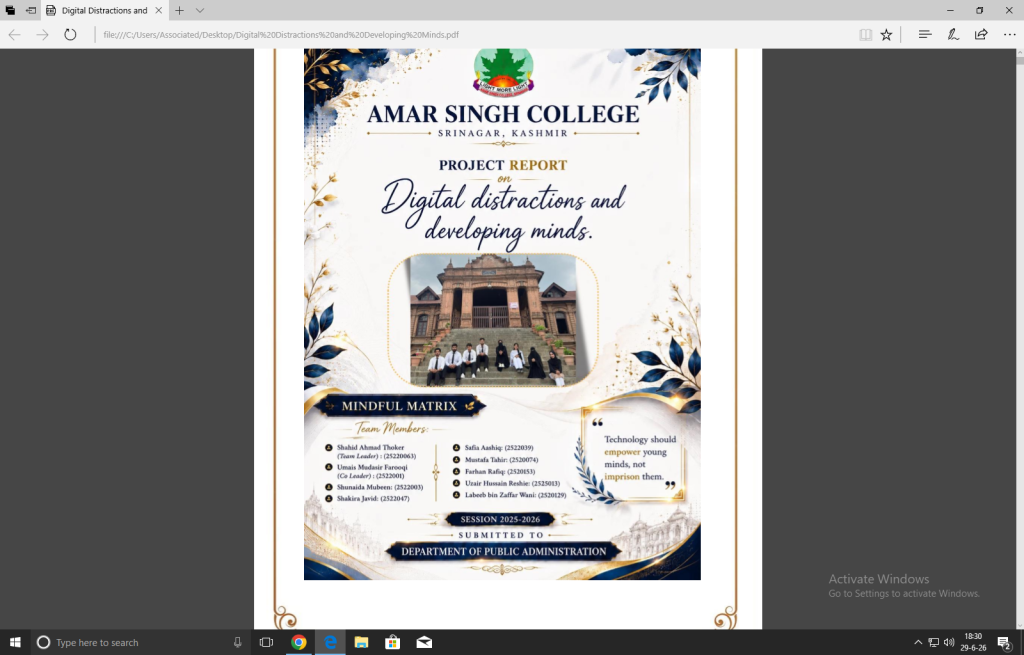
Report found that 75% of respondents spent more than 4 hours daily on smartphones
Amir Yaseen
Srinagar, June 29
Three out of every four school-going adolescents surveyed in Kashmir spend more than four hours a day on smartphones, with heavy screen use associated with declining concentration, chronic fatigue, reduced physical activity and heightened cyber-safety concerns, according to a new research study released on Monday.
The study, Digital Distractions and Developing Minds, examined the impact of social media and smartphone use among adolescents in Kashmir and found that excessive digital engagement was increasingly shaping students’ academic performance, emotional well-being and decision-making abilities.
The research was conducted by a nine-member team from the Department of Public Administration and Political Science at Cluster University of Kashmir’s Amar Singh College.
Researchers surveyed 400 students aged between 13 and 18 years studying in Classes 7 to 10 at four schools across Shopian, Kulgam, Anantnag and Srinagar to assess patterns of smartphone use and their effects on learning, behaviour and mental well-being.
The report found that 75 percent of respondents spent more than four hours daily on smartphones, placing them in the category of heavy users.
Students in that group were significantly more likely to report difficulties concentrating on studies. Around 41 percent of heavy users said stress frequently affected their ability to focus, compared with only 8 percent among students with lower screen exposure.
Overall, more than half of those surveyed said stress and digital distractions regularly interfered with classroom learning and study routines.
The study also pointed to growing concerns over cognitive functioning, with more than 80 percent of respondents reporting that they experienced some degree of confusion while making decisions under stressful situations.
Researchers attributed the trend to what they described as a “brain-drain principle”, arguing that prolonged digital exposure and constant online engagement could progressively reduce attention span and increase cognitive overload.
The findings also suggested that excessive smartphone use was contributing to poor sleep quality.
Half of the surveyed students said they woke up feeling tired or very tired most mornings, while only about one in eight reported feeling energetic at the start of the day.
Students who experienced frequent anxiety when separated from their phones were substantially more likely to report morning fatigue than those who did not display signs of digital dependence.
The report said increased screen time had also displaced physical activity, with nearly 72 percent of respondents acknowledging that excessive use of digital devices had reduced their participation in outdoor games, sports and recreational activities.
Researchers warned that the shift towards increasingly sedentary lifestyles could have long-term implications for the physical health of young people.
Social media use was also found to influence emotional well-being.
More than half of the respondents said they frequently or occasionally felt that other people’s lives appeared better than their own after viewing social media content, a perception that rose sharply among heavy smartphone users.
Nearly 45 percent of students reported experiencing moderate to severe anxiety, irritability or feelings of emptiness when separated from their digital devices, suggesting growing dependence on smartphones.
Despite spending considerable time online, many students expressed limited confidence in digital spaces.
Nearly two-thirds of respondents said they felt less safe expressing their views online than in face-to-face interactions, while researchers warned that limited awareness of cyber safety practices left many adolescents vulnerable to cyberbullying, identity theft, phishing and privacy breaches.
Alongside the survey, the research team conducted qualitative case studies that highlighted contrasting experiences of digital access among students.
One student in Kulgam reported consciously limiting screen time by choosing reading and household activities instead, while another student in Srinagar said there was no access to smartphones or the internet at home, underscoring the persistence of the digital divide.
In another case, a student in Anantnag whose family prohibited social media use altogether reported feeling socially isolated from peers, suggesting that complete digital exclusion could also have unintended consequences.
The researchers concluded that digital technology itself was not inherently harmful but warned that unregulated and excessive use posed significant risks to adolescents’ academic development and overall well-being.
The report recommended introducing structured screen-time guidelines, integrating cyber-safety and digital literacy into school curricula, and encouraging parents to model healthier technology habits.
“The future of students depends not on avoiding technology, but on developing the knowledge, discipline and awareness necessary to use it wisely,” the report said.