





Stresses security, yatri welfare
Kashmir Impulse Desk
Srinagar, June 28
Lieutenant Governor Manoj Sinha on Sunday reviewed security and logistical preparations for the annual Amarnath Yatra, directing officials to ensure comprehensive arrangements for what is expected to be one of the country’s largest Hindu pilgrimages amid heightened security in the Himalayan region.
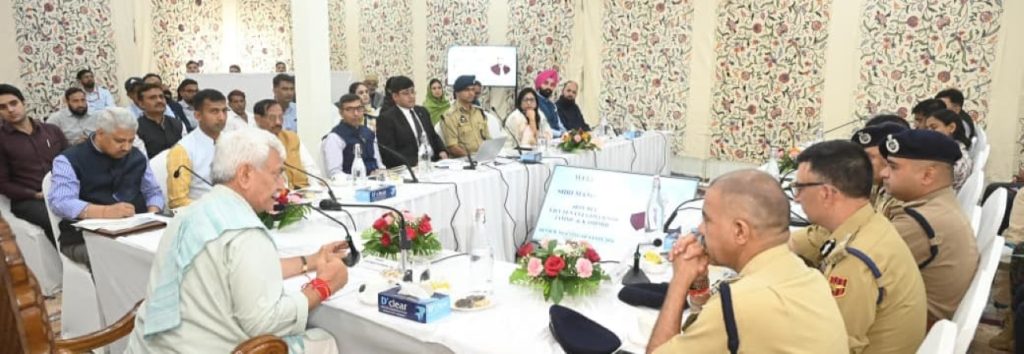
Chairing a high-level meeting at the Baltal base camp in Ganderbal district, Sinha said the administration’s priority was to ensure that pilgrims could undertake the annual pilgrimage in a safe, comfortable and well-organised environment when the yatra begins on July 3.
“My priority is that every pilgrim can undertake the spiritual journey safely and return with a fulfilling experience,” Sinha said after reviewing preparations with senior civil, police and security officials.
The annual pilgrimage to the Amarnath cave shrine, located at an altitude of nearly 3,900 metres (12,800 feet) in the south Kashmir Himalayas, attracts hundreds of thousands of devotees from across India each year. Pilgrims travel via the traditional Pahalgam route in Anantnag district or the shorter but steeper Baltal route in Ganderbal district.
The pilgrimage is conducted under extensive security arrangements owing to the region’s long-running insurgency, although militant violence has declined significantly in recent years.
Sunday’s review meeting was attended by senior officials of the Shri Amarnathji Shrine Board (SASB), Jammu and Kashmir Police, civil administration, Central Armed Police Forces and other security agencies responsible for managing the pilgrimage.
Officials briefed the lieutenant governor on security deployment, surveillance measures, access control, traffic management, emergency response plans and coordination among various departments.
The review also covered healthcare, sanitation, drinking water, electricity, accommodation, road connectivity, weather forecasting, disaster management, flood mitigation, communications infrastructure and stockpiling of essential supplies along the pilgrimage route.
Sinha instructed departments to ensure all facilities were fully operational before the arrival of pilgrims and called for close coordination among agencies throughout the pilgrimage period.
He also directed authorities to increase the number of on-the-spot registration counters at Baltal to reduce waiting time and facilitate smoother movement of devotees.
Following the meeting, the lieutenant governor inspected medical facilities, accommodation and other pilgrim amenities at the Baltal base camp.
During a visit to the base camp hospital, he reviewed emergency services, laboratories, inpatient facilities and specialist care arrangements, directing health authorities to maintain round-the-clock availability of doctors, medicines and emergency equipment during the pilgrimage.
Officials said healthcare facilities had been strengthened to respond quickly to altitude-related illnesses, weather emergencies and other medical situations commonly encountered during the trek.
Speaking to reporters, Sinha said preparations had been underway for several months through coordinated efforts involving the Shri Amarnathji Shrine Board, the Jammu and Kashmir administration, the federal government and multiple security agencies.
“Comprehensive security and other arrangements are in place. I am confident this year’s Yatra will be conducted successfully,” he said.
The lieutenant governor also launched “Shubham-Shivam”, a sanitation initiative aimed at reducing environmental degradation during the pilgrimage, where growing numbers of visitors have raised concerns about waste management in the ecologically fragile Himalayan landscape.
The campaign includes a mobile application allowing pilgrims to report litter, a steel utensil bank designed to reduce disposable plastic waste, and an incentive programme under which collected plastic waste can be exchanged for refreshments at designated service centres.
Authorities also unveiled a new campaign logo, website, mascot and a pilgrimage anthem as part of broader efforts to promote environmentally sustainable practices during the yatra.
Sinha said preserving the fragile Himalayan ecosystem was a shared responsibility of pilgrims, service providers and government agencies.
He announced stricter waste-management protocols, including mandatory segregation of waste, prescribed sanitation standards for community kitchens, or langars, and a continued ban on single-use plastics at pilgrimage camps.
Environmental concerns have assumed increasing importance in recent years as the number of pilgrims visiting the cave shrine has grown, prompting authorities to introduce measures aimed at reducing the ecological footprint of the annual event.
Officials said elaborate arrangements had been made for registration, convoy movement, accommodation, telecommunications, drinking water, electricity supply and maintenance of both pilgrimage routes.
The administration has also strengthened weather monitoring and emergency response mechanisms, given the unpredictable mountain conditions that have disrupted previous pilgrimages through heavy rain, landslides and flash floods.
The Amarnath Yatra is scheduled to commence on July 3 and continue for several weeks under multi-layered security arrangements involving the police, army and paramilitary forces.