


‘India welcomes the understanding reached between the United States and Iran. We are cautiously optimistic and hope it will succeed. It will help energy security’
Kashmir Impulse Desk
New Delhi, June 23
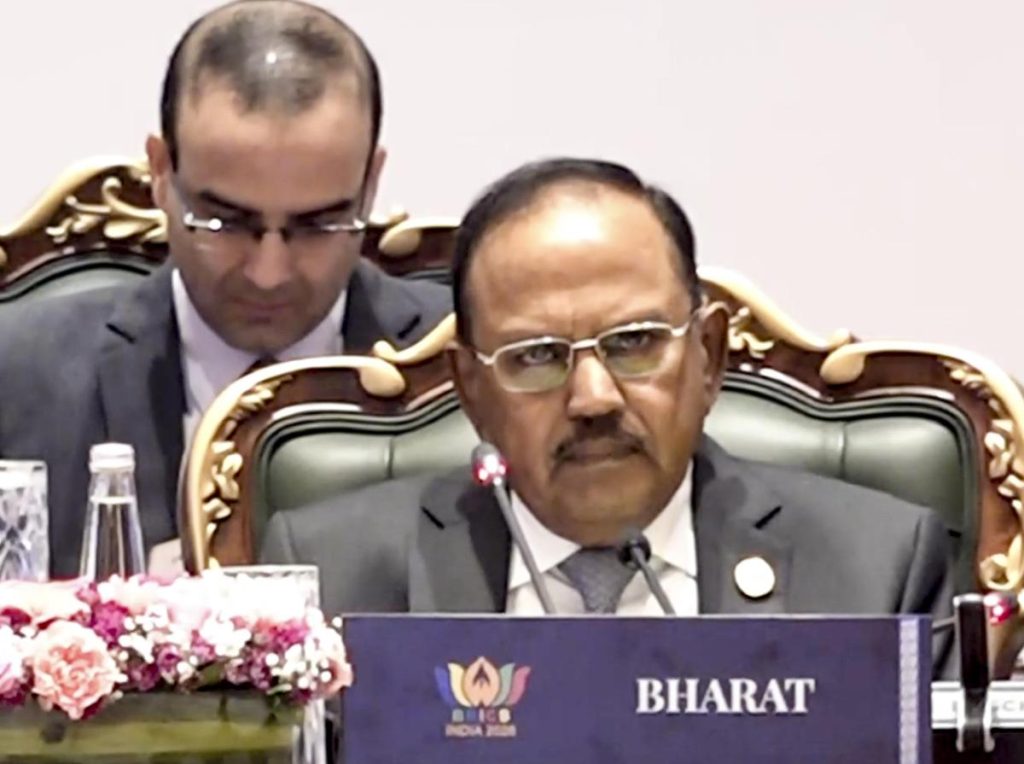
India’s National Security Adviser Ajit Doval on Tuesday welcomed the opening of the Strait of Hormuz, saying the move would strengthen energy security and ease disruptions in global supply chains.
Speaking at a BRICS security advisers’ meeting in New Delhi, Doval said freedom of navigation through the strategic shipping route would benefit countries across the region and beyond.
“India welcomes the understanding reached between the United States and Iran. We are cautiously optimistic and hope it will succeed. It will help energy security,” Doval said.
He said the opening of the Strait of Hormuz would help remove supply-chain bottlenecks and alleviate shortages in sectors such as fertilisers and chemicals.
Doval’s remarks came as representatives from BRICS countries gathered in New Delhi for a high-level conclave hosted by India, the current chair of the grouping.
Addressing the meeting, Doval said the world was facing a period of heightened geopolitical uncertainty, economic pressures and rapid technological disruption.
“We are meeting at a very tumultuous time,” he said, adding that existing international mechanisms were increasingly proving inadequate to prevent or resolve conflicts.
“The threats are compounding, while the instruments and institutional mechanisms are finding themselves increasingly inadequate to resolve or mitigate these conflicts,” he said.
Doval also warned that multilateralism was weakening and said BRICS had an important role in addressing global challenges.
Originally formed by Brazil, Russia, India, China and South Africa, BRICS has expanded in recent years to include Egypt, Ethiopia, Iran, the United Arab Emirates and Indonesia.
Doval said the grouping had evolved from an informal coalition of emerging economies into a significant platform advocating a more multipolar world order, stronger economic cooperation and a greater voice for developing nations.
“BRICS is a special coalition of countries that believe in peace, progress, development and cooperation,” he said.
The bloc now represents nearly half of the world’s population, about 40 percent of global economic output and roughly a quarter of global trade, according to BRICS estimates.