





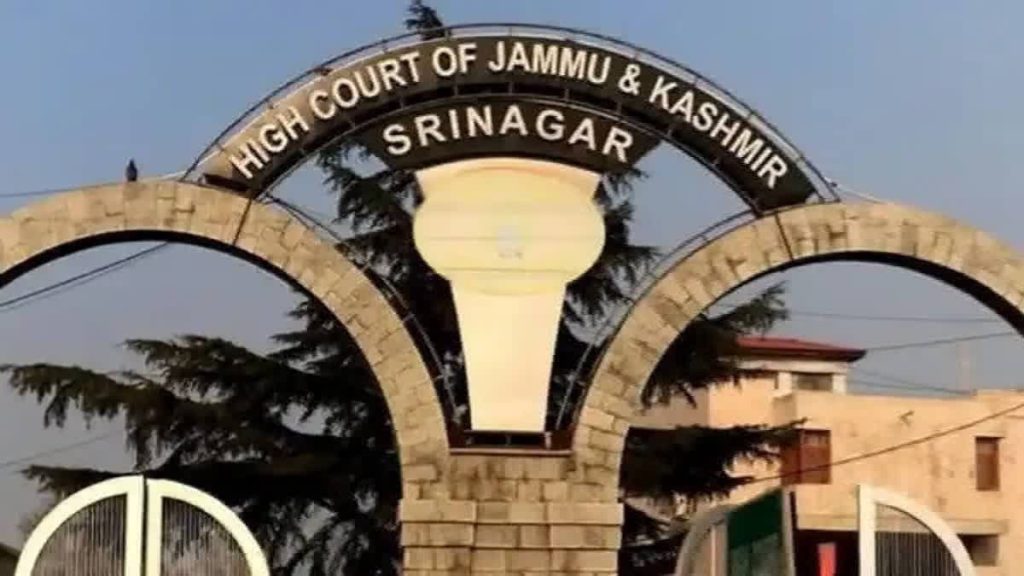
Kashmir Impulse Desk Srinagar, May 12 The High Court of Jammu and Kashmir and Ladakh has ruled that regularisation or permanent absorption in government service cannot be claimed as a matter of right outside the constitutional framework governing public employment. A bench led by Justice Sanjay Parihar dismissed a petition filed by a group of
Kashmir Impulse Desk
Srinagar, May 12
The High Court of Jammu and Kashmir and Ladakh has ruled that regularisation or permanent absorption in government service cannot be claimed as a matter of right outside the constitutional framework governing public employment.
A bench led by Justice Sanjay Parihar dismissed a petition filed by a group of seasonal labourers seeking parity with workers who had earlier been granted the status of permanent casual labourers in the Irrigation and Flood Control Department.
The petitioners argued that they had been working as seasonal labourers since 1998 and were similarly placed to four workers who were absorbed into the permanent casual labour category through a government order issued in 2014.
They contended that denial of similar treatment violated Articles 14 and 16 of the Indian Constitution, which guarantee equality before law and equal opportunity in public employment.
Rejecting the plea, the court said equality under Article 14 envisages “positive equality” and not “negative equality”.
“Merely because some benefit may have been extended in favour of another set of employees, the same by itself does not confer an enforceable right upon the petitioners to claim identical relief contrary to the governing statutory framework,” the court observed.
The government argued that the petitioners were engaged only during irrigation seasons on a need basis and did not satisfy the eligibility requirements laid down under SRO 520 of 2017.
It also said the four workers cited by the petitioners had been adjusted against watch and ward duties due to administrative requirements and seniority considerations.
The court referred to rulings of the Supreme Court of India, stating that courts should refrain from directing absorption, regularisation or permanent continuation unless appointments were made in accordance with the law.
At the same time, the bench observed that once authorities chose to regularise or continuously engage certain seasonal labourers, similarly placed workers could not be denied consideration without a reasonable basis for differential treatment.
However, the court noted that the petitioners ranked lower in seniority and continued to work only during irrigation periods, which constituted a valid distinction.
The government also informed the court that more than 3,000 seasonal labourers across Kashmir were working under similar conditions and that a blanket ban on fresh engagements remained in force.
In such circumstances, the court said, directing regularisation would amount to interference in executive policy matters.
“Judicial review under Article 226 is confined to examining the decision-making process and not the decision itself unless the same is shown to be patently arbitrary, mala fide, or violative of statutory provisions,” the court said while dismissing the petition as “devoid of merit”.















Leave a Comment
Your email address will not be published. Required fields are marked with *