
Kashmir Impulse Desk
Jammu, June 16
India is undertaking one of its most ambitious infrastructure transformations in Jammu and Kashmir, with four high-speed highway corridors worth nearly Rs 50,000 crore currently under construction and detailed project reports being prepared for another Rs 65,000 crore worth of road projects, Union Minister of State for Road Transport and Highways Ajay Tamta said on Tuesday.
The projects form part of a broader road development programme valued at more than Rs 70,000 crore currently under execution in the Union Territory, a scale of investment the minister described as unprecedented in the region’s history.
Speaking to reporters in Jammu during a four-day visit to review infrastructure projects and participate in public outreach programmes, Tamta said the ongoing works would dramatically improve connectivity across Jammu and Kashmir and reduce travel time between Jammu and Srinagar to around four hours once completed.
“Large-scale road infrastructure works are underway across Jammu and Kashmir. A substantial portion of these projects has already been completed, while bottlenecks at a few locations are being addressed on priority. Once the remaining stretches are finished, the journey between Jammu and Srinagar will take nearly four hours,” he said.
The minister said the four high-speed corridors under construction include the Jammu-Udhampur-Srinagar corridor, Jammu-Chenani-Anantnag corridor, Srinagar-Baramulla-Uri corridor and Jammu-Akhnoor corridor.
According to the Ministry of Road Transport and Highways, the projects are designed to improve connectivity not only to the Kashmir Valley but also to the Chenab region, Rajouri-Poonch belt, north Kashmir districts and strategically important border areas.
Officials said the corridors would strengthen tourism, trade, industrial activity and defence mobility while reducing travel disruptions caused by adverse weather and difficult terrain.
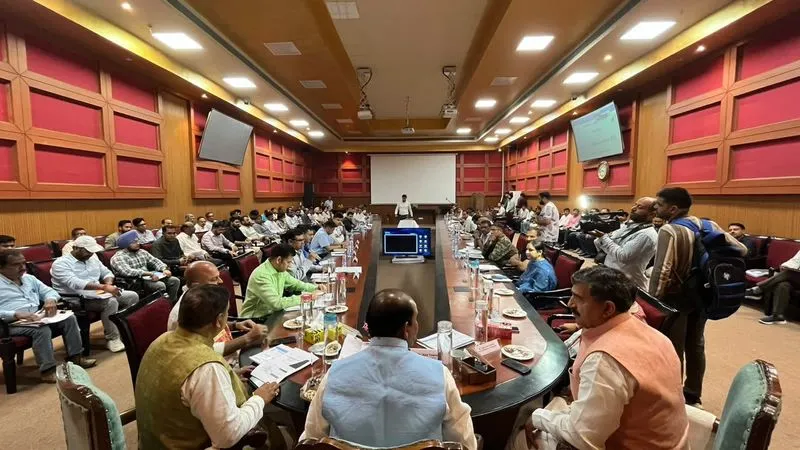
The minister’s remarks came after a high-level review meeting attended by officials of the National Highways Authority of India (NHAI), National Highways and Infrastructure Development Corporation Limited (NHIDCL), Border Roads Organisation (BRO), Public Works Department and other agencies involved in road construction projects across the Union Territory.
Tamta said the scale of infrastructure development witnessed in Jammu and Kashmir since 2014 marked a sharp departure from previous decades, when highway expansion in the region remained constrained by geographical challenges and limited investment.
“Jammu and Kashmir has witnessed remarkable progress in connectivity infrastructure over the last decade. Large investments have been made in highways, tunnels, bypasses and ring roads, fundamentally changing the region’s transport landscape,” he said.
Officials informed the review meeting that projects covering nearly 700 kilometres of highways worth approximately Rs 20,000 crore have already been completed, while another 2,300 kilometres worth Rs 50,000 crore are under construction.
Detailed project reports are being prepared for an additional 707 kilometres of highways estimated to cost around Rs 65,000 crore.
A major focus of the infrastructure programme has been tunnel construction, aimed at providing all-weather connectivity through mountainous terrain that frequently experiences landslides and weather-related disruptions.
Tamta said that before 2014, only five major tunnels existed in Jammu and Kashmir, whereas the Jammu-Srinagar national highway corridor alone now comprises 25 tunnels, of which 20 have been completed, and five remain under construction.
Among the strategic projects under implementation are the Zojila Tunnel, Sungal Tunnel, Bhimber Gali Tunnel, Sadhna Tunnel, Peer Ki Gali Tunnel, Sudhmahadev Tunnel and the parallel Chenani-Nashri alignment.
Officials said these projects are expected to improve year-round accessibility and reduce road closures caused by snowfall, landslides and difficult terrain.
The meeting was informed that the Rs 16,000 crore Jammu-Udhampur-Srinagar four-lane highway corridor has achieved nearly 95 percent completion.
Once fully operational, the project is expected to reduce the distance between Jammu and Srinagar by almost 70 kilometres and cut travel time from around nine hours to approximately four hours.
Officials said tunnels, viaducts, bypasses and advanced slope-stabilisation measures are being incorporated to improve safety and reliability along the corridor.
Authorities are also carrying out stabilisation works worth Rs 230 crore at 15 vulnerable locations between Udhampur and Banihal, one of the most landslide-prone stretches on National Highway-44.
In addition, bypass projects worth Rs 600 crore have already been completed at Banihal, Ramban, Ashajipora, Seri and Makarkote to ease congestion and improve traffic flow.
The review meeting also assessed progress on the Delhi-Amritsar-Katra Greenfield Expressway, a 670-kilometre project estimated to cost Rs 41,000 crore.
Officials said 143 kilometres of the expressway falling within Jammu and Kashmir, involving an investment of Rs 11,500 crore, are expected to be completed by August 2027.
The project will reduce the distance between Delhi and Katra by nearly 58 kilometres and improve access for pilgrims visiting the Shri Mata Vaishno Devi shrine.
Urban mobility projects also featured prominently during the review.
Officials said the 104-kilometre Srinagar Ring Road project, estimated at Rs 7,200 crore, would divert through traffic away from the city and improve connectivity to Baramulla, Kupwara, Bandipora, Gurez, Kargil and Leh.
Meanwhile, the 58-kilometre Jammu Ring Road is nearing completion, with 53 kilometres already operational. Work is also underway on planning the proposed 33-kilometre Eastern Jammu Ring Road.
The next phase of road expansion will include several major corridors, including the proposed 125-kilometre Katra-Srinagar High-Speed Corridor, the Rafiabad-Kupwara-Tangdhar route incorporating the Sadhna Tunnel, the Surankote-Bufliaz-Doodhpathri-Magam corridor with the Peer Ki Gali Tunnel and the Srinagar-Sonmarg-Gumri corridor.
Officials also informed the minister that detailed project reports are being prepared for road infrastructure worth Rs 3500 crore associated with the annual Amarnath Yatra.
The review meeting further discussed plans for ropeway development aimed at improving access to major tourism and pilgrimage destinations.
Authorities said 54 ropeway proposals worth around Rs 30,000 crore have been received, with eight projects worth approximately Rs 16,000 crore identified for implementation in the first phase.
These include ropeways at the Amarnath cave shrine, Shankaracharya Temple, Thajiwas Glacier, Bhadarwah, Sanasar and Doodhpathri.
Tamta said the projects collectively represent a shift from what he described as “difficult and disrupted connectivity” towards a modern transport network characterised by high-speed corridors, all-weather access and integrated mobility infrastructure.
He directed implementing agencies to adhere to timelines while maintaining quality and safety standards, saying the projects would play a key role in supporting tourism, industry, pilgrimage traffic, defence logistics and broader economic growth across Jammu and Kashmir.