
For six tense hours, cable cars hung silent above Kashmir’s most visited meadow while rescue teams, locals and officials worked against terrain, weather and time to bring everyone down safely. Suneem Mir reports.
On most spring mornings in Gulmarg, the line begins early.
Before the cafés begin pouring kahwa.
Before the ponies are led out onto the green slopes.
Before the meadow fills with families adjusting scarves against the mountain wind and tourists holding phones toward the snow line.
The queue gathers beneath the steel cables of the gondola station, inching forward in bursts of anticipation, waiting to be lifted above the pines.
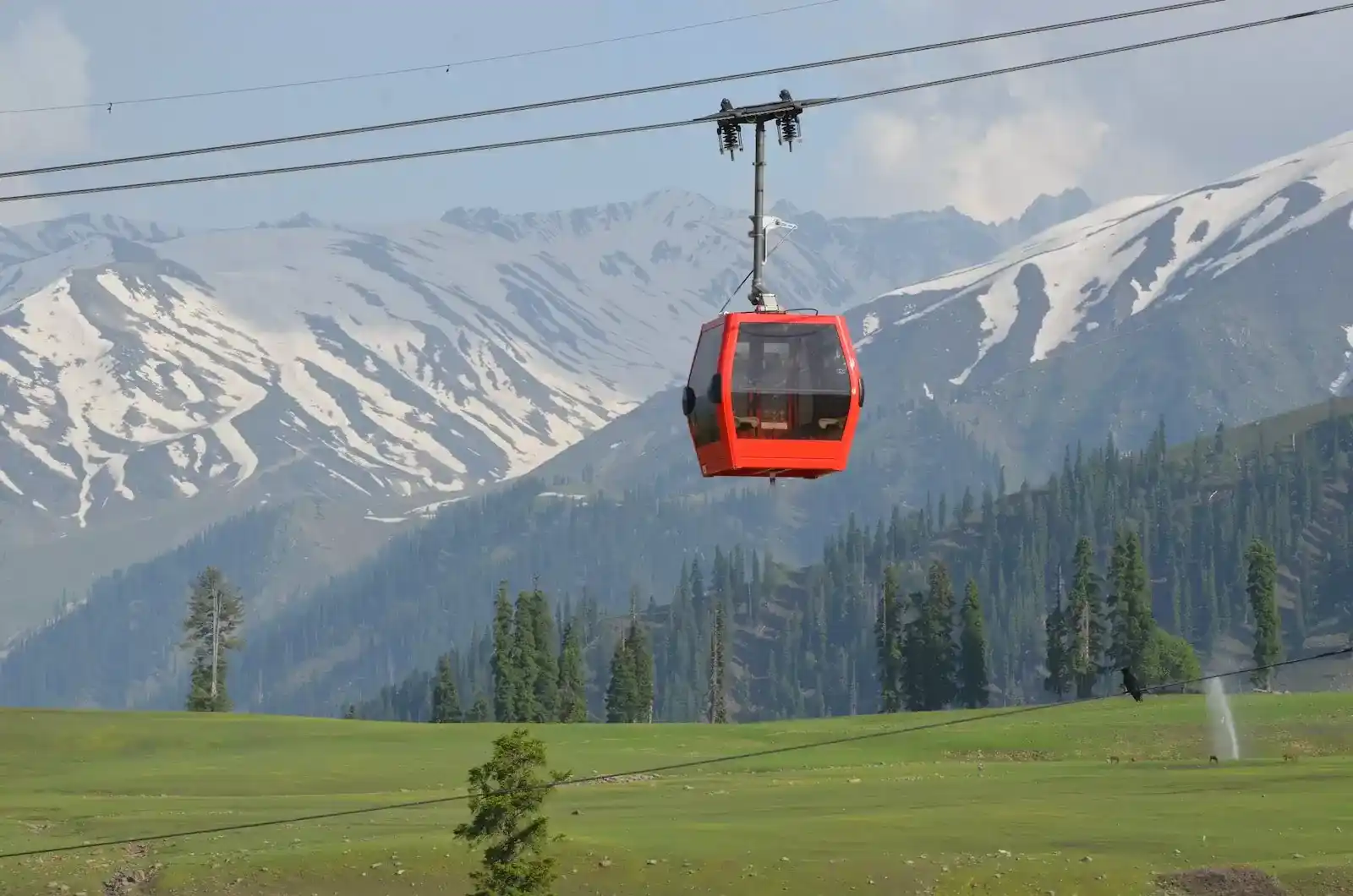
The Gulmarg Gondola – one of the world’s highest cable-car systems – is not merely transport. It is the ascent itself: part ride, part spectacle, part promise.
Visitors enter glass cabins at the base station and rise silently over fir and slope toward Kongdoori, watching the valley widen beneath them.
For many, it is the centrepiece of a visit to Kashmir.
On Monday morning, that ascent was interrupted.
Somewhere along the stretch between the Base Station and Kongdoori – Phase I of the gondola route – a technical malfunction halted movement in the cable system. Cabins stopped mid-air.
Doors remained shut.
Steel wheels went still against the cable.
And dozens of tourists found themselves suspended above the mountainside, waiting.
Below them, Gulmarg continued moving for a few moments longer before it, too, began to pause.
Officials later said the disruption affected sixty-five cable cars in total – 55 occupied cabins carrying tourists and ten empty ones.
What began as a mechanical failure quickly became a full-scale emergency response stretching across the hillside.
Distress calls were made to police, rescue services, and the army.
Then the mountain answered.
Within minutes, personnel from the Indian Army, Jammu and Kashmir Police, the State Disaster Response Force, civil administration, and local rescue agencies began converging toward the gondola base. Vehicles climbed toward the site.
Radios crackled between teams.
Tourists gathered below looking upward, trying to identify cabins against the shifting mountain light.
From the ground, the cable cars appeared motionless against the sky – small coloured capsules hanging above a landscape that remained vast and indifferent around them.
An army spokesperson said rescue teams were mobilised after the force received an emergency call from the police and the Gondola Management Authority.
“The army swiftly moved rescue teams to the affected area to assist in evacuation efforts despite difficult terrain and adverse weather,” the spokesperson said.
The terrain mattered.
The slope between the base station and Kongdoori is beautiful from above. From below, in rescue conditions, it becomes something else entirely: steep gradients, uneven tracks, patches of melting snow, changing visibility and difficult access between towers. Reaching stranded passengers required urgency, but also caution.
Troops from the Butapathri Battalion deployed three casualty assistance teams between the base station and Phase I.
An all-terrain vehicle was pressed into service. Additional ATVs were arranged through the Gulmarg ATV Association as the scale of the evacuation became clearer and technical restoration appeared likely to take time.
By then, word had spread beyond the hill station.
Videos began appearing online showing gondola cabins suspended over the slope.
Families back in Srinagar, Delhi, Mumbai and elsewhere called relatives travelling in Gulmarg. Hotel staff fielded questions.
Tour operators waited for updates.
On social media, concern spread faster than information.
At the site, however, the work remained physical and immediate.
Rescuers moved between access points coordinating evacuations cabin by cabin.
Officials said trained personnel worked to bring stranded passengers to safety as technical teams separately assessed the cause of the fault.
For the passengers inside, time slowed.
Some had boarded expecting a ten-minute ride uphill. Instead they sat enclosed in glass cabins held still above the forested incline.
Children cried. Some passengers reportedly attempted to reassure one another.
Others filmed the mountains beneath them, or called family members, or simply waited in silence.
For tourists visiting Kashmir for the first time, the experience must have felt surreal: beauty interrupted by uncertainty, adventure suddenly overtaken by vulnerability.
Yet those on the ground insist calm held.
Officials later said the cabins remained secure throughout the disruption and that rescue teams worked steadily to ensure safe evacuation without panic.
By afternoon, senior officials began arriving in person.
Deputy Chief Minister Surinder Kumar Choudhary reached Gulmarg on the instructions of Chief Minister Omar Abdullah to oversee the rescue effort.
He reviewed operations at the site and directed agencies to ensure swift and coordinated evacuation of the remaining passengers.
Member of Legislative Assembly Farooq Ahmad Shah was also present alongside senior civil administration and police officials.
Major General Manoj Joshi, General Officer Commanding of the 19 Infantry Division, reviewed rescue operations on the ground, monitoring evacuation and assistance efforts in coordination with local authorities.
The presence of officials was visible.
But so was something less formal: a collective local response that has long defined emergencies in Kashmir’s mountain regions.
Drivers offered vehicles.
Local operators assisted movement along difficult stretches.
Tourism workers stood by to help coordinate stranded visitors once evacuated.
Residents waited near the base station for updates. Workers from nearby establishments stepped in where needed.
By evening, the rescue had become not simply an operation, but a collective holding of breath.
Hours later, the breathing eased.
Lieutenant Governor Manoj Sinha said all stranded passengers were brought to safety after what became a six-hour rescue operation.
“The nation stands united in applauding the extraordinary bravery of disaster response teams who safely rescued tourists stranded mid-air in Gulmarg’s cable cars,” he said in a statement after the evacuation.
He praised the Indian Army, Jammu and Kashmir Police, State Disaster Response Force, National Disaster Response Force and district administration for their swift response.
Chief Minister Omar Abdullah also commended the rescue teams and technical personnel involved, praising the speed, coordination and professionalism of the operation.
“The safety and well-being of tourists and visitors remains the government’s priority,” he said, adding that the incident would be thoroughly examined and responsibility fixed for any lapses.
An inquiry into the technical malfunction is expected.
Officials said technical teams were continuing to assess the cause of the fault and evaluate the extent of the failure in the system.
By late evening, Gulmarg had begun returning to itself.
The ATVs quietened.
Emergency personnel began dispersing.
Families reunited at the base station.
Tourists stepped onto solid ground after hours suspended above it.
Some embraced.
Some sat down.
Some immediately called home.
The gondola, meanwhile, remained still.
Its cabins hung where they had been halted, visible against the fading mountain sky.
In Kashmir, infrastructure often exists in dramatic conversation with geography.
Roads carve through mountain passes prone to snow and landslides.
Bridges span rivers that swell without warning.
Cable cars float above terrain impossible to cross quickly on foot.
Beauty and fragility coexist here more visibly than in many places.
The Gulmarg Gondola represents both ambition and access – a tourism landmark and engineering feat carrying thousands each season into alpine heights once reachable only through long climbs.
But Monday’s malfunction was a reminder of how quickly machinery can become precarious when suspended against mountain weather.
It was also a reminder of how many systems must work together when one fails.
Army units. Police. SDRF personnel. Local administration. Technical teams. Drivers. Tourism workers. Local volunteers.
By nightfall, all passengers had been evacuated without major injury.
That fact became the headline.
Yet beneath it was another story: of coordination under pressure, of movement across difficult terrain, of emergency response unfolding across one of Kashmir’s busiest tourist destinations in full public view.
And above it all – the image many will remember longest – was simpler still.
Dozens of gondola cabins suspended in silence over Gulmarg.
A hillside looking upward.
And a mountain town waiting for everyone to come down.
About the Author
Mir Suneem is a filmmaker and a postgraduate in filmmaking from Jamia Millia Islamia. With a strong grounding in film editing and narrative craft, she is drawn to stories the frame extends beyond the visible into the lived.