
From ancient caravan routes and timeless monasteries to remote border villages and breathtaking landscapes, Ladakh brims with an enduring spirit, rich heritage, and boundless tourism potential. Aasif Bashir sends a report along with visuals from the cold desert.
The first light reaches Ladakh long before it reaches the traveller.
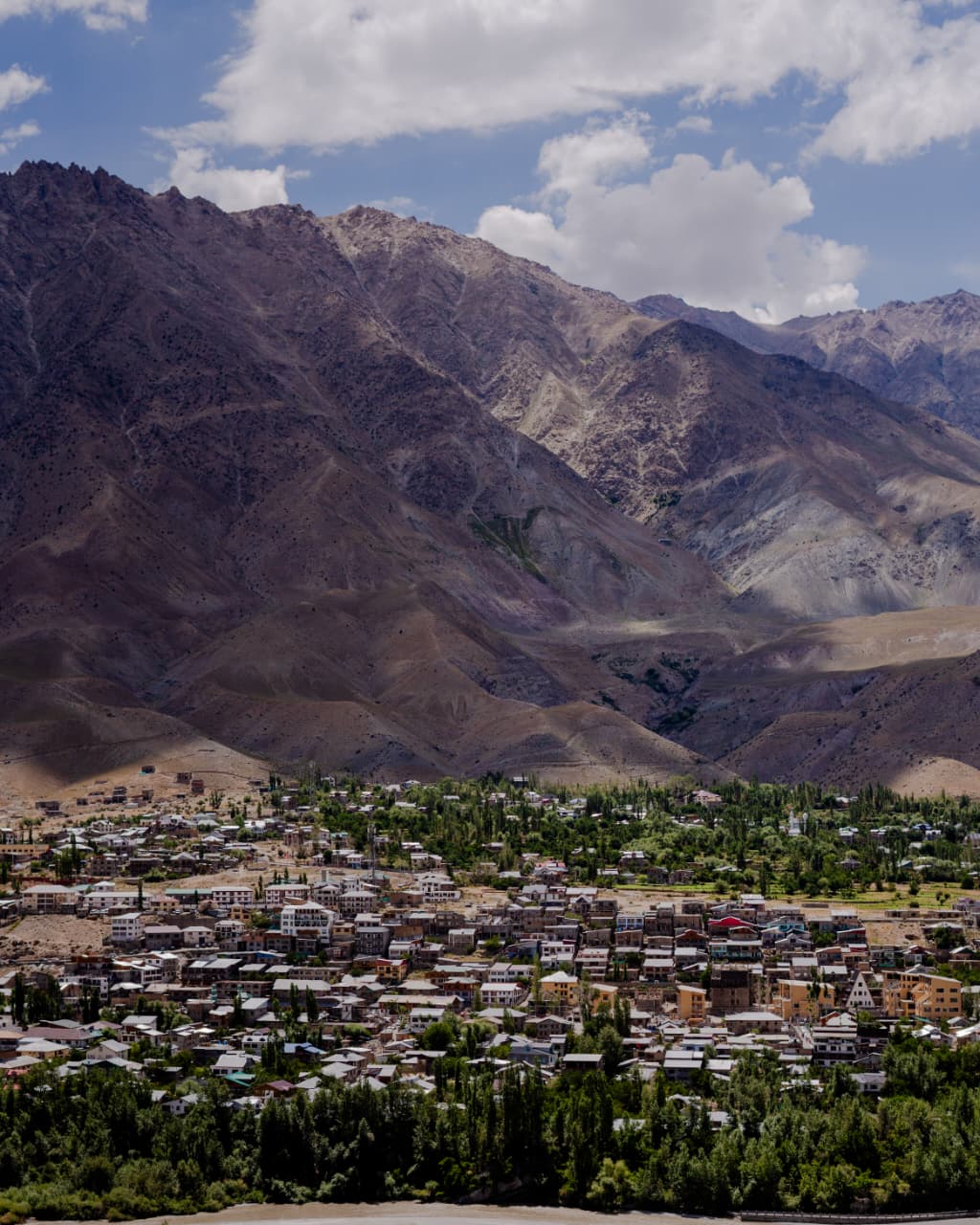
It spills gently over serrated mountain ridges, glints off whitewashed monasteries perched impossibly on rocky cliffs, and settles upon the broad valley carved by the Indus River thousands of years ago. In Leh, shopkeepers lift the shutters of old bazaars where caravans once paused after weeks of crossing the Karakoram and Himalayas. Prayer wheels begin to turn inside ancient gompas. The call to prayer rises from the historic Jama Masjid in the heart of the town, echoing across streets where Buddhist monks, Muslim traders and tourists from every corner of the world quietly begin another day.
Few places in the world carry so many identities at once.
Ladakh is India’s highest plateau, a cold desert where annual rainfall is measured in mere inches, where villages survive through ingenious irrigation channels fed by glacial melt, and where roads climb higher than many mountain summits elsewhere on Earth. Yet beneath its stark landscapes lies a region whose history has always been defined not by isolation but by connection.
Long before modern borders divided Asia, Ladakh stood at the crossroads of civilizations. Merchants transported silk from China, pashmina wool from Changthang, spices from India and precious stones from Central Asia. Buddhist monks, Persian scholars, Sufi saints and caravan traders all left their imprint on this remote Himalayan kingdom. Every mountain pass opened not merely into another valley but another culture.
Today, those ancient trade routes have become tourist trails, drawing visitors seeking landscapes unlike anywhere else in India. As tourism emerges as one of Ladakh’s principal economic engines, the region is increasingly being recognized not simply as a destination for adventure enthusiasts but as one of South Asia’s richest repositories of living history, cultural diversity and ecological significance.
At nearly 11,500 feet above sea level, Leh remains the heart of this transformation.
Its old town still preserves narrow alleys lined with mud-brick homes, centuries-old merchant houses and traditional Ladakhi architecture. Looming above it is Leh Palace, a reminder of the Namgyal dynasty that ruled the Himalayan kingdom for centuries. Nearby stands the Jama Masjid, built in the seventeenth century following an agreement between the Mughal Empire and the rulers of Ladakh after a conflict that reshaped regional politics. The mosque, with its distinctly Tibetan architectural influences, symbolizes a coexistence that continues to define the town even today.
Unlike many destinations where religious landmarks stand apart, Leh’s monasteries, mosques and temples coexist within walking distance of one another. Monks in crimson robes cross paths with Muslim artisans, while visitors drift between cafés, handicraft stores and prayer halls without noticing where one cultural tradition ends and another begins.
This quiet coexistence has become one of Ladakh’s most understated attractions.
While much of the world’s attention has focused on its strategic importance and spectacular scenery, Ladakh’s greatest strength may lie in its ability to preserve diverse traditions within an unforgiving landscape that demands cooperation for survival.
The mountains, after all, have little regard for faith.
They reward resilience.
That resilience is perhaps nowhere more visible than at Hemis Monastery.
Hidden within a fold of barren mountains southeast of Leh, Hemis rises almost unexpectedly, its white walls and gilded roofs contrasting sharply against brown cliffs that seem untouched by time. Founded in the seventeenth century, the monastery belongs to the Drukpa lineage of Tibetan Buddhism and houses some of the region’s most revered religious treasures.
Each summer, thousands gather here for the Hemis Festival, when masked monks perform sacred cham dances in a tradition that blends ritual, theatre and spiritual philosophy. Visitors often arrive for the spectacle of colourful costumes and giant thangka paintings, but leave with an appreciation of a culture that has endured despite centuries of political upheaval and geographic isolation.
The monastery is not merely a place of worship. It is a living archive of Himalayan civilisation.
The same could be said of countless smaller monasteries scattered across Ladakh’s valleys, many perched atop rocky outcrops where silence itself feels sacred.
Yet Ladakh is not defined solely by Buddhism.
Its western districts tell a different story.
Travelling west from Leh towards Kargil, the landscape begins to soften. The valleys widen. Apricot orchards appear beside the road. Villages become greener as streams descending from snowfields nourish fertile patches of land.
For many Indians, Kargil remains synonymous with the 1999 conflict that transformed national consciousness. Memorials and mountain peaks immortalized in military history continue to attract visitors wishing to understand the sacrifices made during that summer.
But beyond the battlefields lies an older and quieter Kargil.
It is a district where Balti, Purig and Shina cultures converge; where ancient Buddhist rock carvings coexist with Islamic seminaries; where families cultivate barley, buckwheat and apricots beneath towering peaks that remain snow-covered well into spring.
Increasingly, local communities are encouraging travelers to stay longer – not merely to visit war memorials, but to experience village life, local cuisine and centuries-old traditions that have survived in the shadow of geopolitical conflict.
A few hours away lies one of the Himalayas’ most remarkable hidden landscapes.
For generations, reaching Zanskar required days of travel across narrow mountain roads frequently blocked by snow. Winter isolated entire communities for months, forcing residents to rely on carefully stored food and livestock. The frozen Zanskar River became the famous Chadar route, allowing villagers – and later trekkers – to walk across ice to reach the outside world.
New roads and improved connectivity are steadily changing this reality.
Yet Zanskar retains an extraordinary sense of remoteness.
Ancient monasteries overlook deep gorges. Whitewashed villages cling to river terraces. Fields of barley shimmer briefly during the short Himalayan summer before giving way once again to months of snow and silence.
For adventure travelers, the region offers trekking, mountaineering and river expeditions. For others, it offers something increasingly rare in modern tourism: genuine solitude.
Elsewhere in the world, silence has become a luxury.
In Zanskar, it remains part of everyday life.
North of Leh, the road climbs relentlessly towards one of the world’s highest motorable mountain passes before descending into a landscape that appears to belong to another continent altogether.
The Nubra Valley, where the Shyok and Nubra rivers weave through broad expanses of sand and gravel, is often described as a cold desert. Yet the phrase scarcely captures its improbable beauty. Here, snow-clad peaks overlook rolling dunes, while groves of willow and poplar line villages nourished by glacial streams. In spring, apricot blossoms soften the stark terrain, and in summer, fields of barley and vegetables briefly transform the valley into a patchwork of green.
Centuries ago, Nubra was an important stop on the caravan routes linking Leh with Yarkand and Kashgar in Central Asia. Traders crossed the formidable Karakoram Pass with silk, tea, spices, carpets and the famed pashmina wool, resting in the valley before continuing their arduous journeys. The caravans have disappeared, but traces of that mercantile past remain in old settlements, monasteries and family histories passed from one generation to the next.
Perhaps the valley’s most unexpected residents are its double-humped Bactrian camels. Introduced centuries ago to transport goods across the high-altitude deserts of Central Asia, they now wander the sand dunes of Hunder, offering visitors an evocative reminder of Ladakh’s role in transcontinental commerce. Their presence is more than a tourist attraction; it is a living relic of the ancient Silk Route.
Not far from Hunder lies a village that challenges many assumptions about Ladakh.
Turtuk, one of India’s northernmost inhabited settlements, remained largely unknown to the outside world until recent decades. Before the 1971 Indo-Pakistan War, it formed part of Baltistan. When the border shifted, the village became part of India, while many families found themselves separated by the newly drawn Line of Control.
Today, Turtuk is among Ladakh’s most captivating cultural destinations.
Unlike much of central Ladakh, where Tibetan Buddhism shapes the landscape, Turtuk is predominantly home to Balti Muslims. Stone houses, terraced orchards and narrow irrigation channels define the village, while the Balti language, traditional wooden architecture and centuries-old customs continue to flourish.
Visitors often arrive expecting dramatic mountain scenery and leave remembering conversations with villagers whose family histories are intertwined with the politics of partition, war and borders. Elderly residents still recount memories of trading across mountains that are now inaccessible, reminding travelers that geopolitical maps can change far more quickly than cultural identities.
Tourism has brought new opportunities to Turtuk. Family-run guesthouses, orchard cafés and heritage walks now supplement traditional agriculture, allowing younger generations to remain in the village while sharing their culture with an increasingly global audience. Yet residents remain conscious that preserving their distinct heritage is as important as welcoming visitors.
Further west, near Kargil, another village offers an altogether different encounter with history.
Hunderman appears almost suspended between two worlds.
Perched on a steep mountainside overlooking the Line of Control, the village bears silent testimony to decades of conflict. Stone homes abandoned after the 1971 war still stand with remarkable dignity. Household utensils, wooden doors, faded family photographs and empty rooms remain much as they were left, creating an open-air museum unlike any other in the Himalayas.
Unlike conventional war memorials that commemorate battles, Hunderman preserves the quieter consequences of conflict—the interrupted lives of ordinary families. Walking through its narrow lanes, visitors encounter not monuments to victory or defeat but reminders of displacement, resilience and memory.
In recent years, community-led heritage initiatives have transformed parts of the village into a museum documenting the social history of the borderlands. For many travelers, the experience is among the most moving in Ladakh, offering a human perspective often overshadowed by military narratives.
These border villages are gradually redefining tourism in the region.
Instead of merely viewing frontiers as zones of tension, visitors increasingly seek to understand the cultures that have long existed along them. In doing so, Ladakh is broadening the very idea of border tourism—from one centred on conflict to one rooted in history, heritage and human resilience.
No journey through Ladakh, however, feels complete without witnessing the extraordinary spectacle of Pangong Lake.
Stretching for more than 130 kilometres across eastern Ladakh into the Tibetan Plateau, the lake changes character with every passing hour. Morning sunlight lends it shades of pale turquoise. By afternoon, the waters deepen into cobalt blue before reflecting the crimson hues of sunset. Against the backdrop of barren mountains and immense skies, Pangong possesses a visual drama that has captivated photographers, filmmakers and travelers alike.
Its growing popularity has transformed the surrounding villages. Campsites, homestays and small cafés now provide livelihoods for local families who once relied primarily on pastoralism. Yet the very success of tourism has brought new challenges.
Pangong lies within the fragile Changthang ecosystem, one of the world’s highest inhabited plateaus. Black-necked cranes, bar-headed geese, marmots, Tibetan wild asses and elusive snow leopards depend upon habitats that are acutely vulnerable to human disturbance. Water resources remain scarce, waste management is increasingly complex, and climate change is altering glacial systems that sustain both wildlife and communities.
Across Ladakh, these environmental concerns are becoming central to discussions about the future of tourism.
The region has embraced a growing emphasis on sustainability, encouraging responsible travel, homestays, waste reduction, renewable energy and community participation. Rather than pursuing mass tourism alone, planners increasingly advocate a model that protects Ladakh’s ecological balance while ensuring that economic benefits reach remote villages.
That balance may determine whether Ladakh’s greatest asset—its pristine landscapes—can endure for future generations.
Yet the region’s appeal extends beyond scenery.
Adventure enthusiasts arrive for high-altitude trekking, mountaineering, rafting on the Zanskar and Indus rivers, mountain biking and wildlife expeditions. Pilgrims visit monasteries whose traditions span centuries. Historians explore ancient forts, petroglyphs and caravan settlements. Astronomers and photographers are drawn by some of the clearest night skies in the country, where the Milky Way appears close enough to touch.
Increasingly, Ladakh is emerging as a destination where nearly every form of tourism converges – heritage, spiritual, ecological, cultural, adventure, wildlife and even astronomical tourism.
Its strategic location, once viewed primarily through the lens of geopolitics, has become part of its wider narrative. Roads built for connectivity now carry tourists as well as supplies. Border villages once associated only with military significance are finding new identities as guardians of unique cultural traditions. Communities that endured decades of isolation are opening their homes to visitors while striving to preserve their languages, architecture and customs.
The challenge ahead is not simply attracting more tourists, but ensuring that tourism enriches rather than overwhelms the region.
Ladakh has always demanded respect from those who travel through it. The altitude humbles even the fittest visitors. The weather changes without warning. Distances that appear modest on a map can require hours of careful driving across mountain passes. These realities encourage a slower pace, inviting travelers to observe rather than consume.
Perhaps that is Ladakh’s greatest gift.
In an era when destinations are increasingly measured by social media trends and crowded itineraries, Ladakh rewards those willing to linger—to listen to the flutter of prayer flags outside a monastery, to share butter tea in a Balti home, to watch Bactrian camels cross the dunes of Nubra, or simply to sit beside Pangong Lake as the colours of the water shift with the passing light.
For centuries, the mountains of Ladakh have watched caravans, pilgrims, kings, soldiers and explorers come and go. Today they welcome a different kind of traveller—one searching not merely for spectacular photographs but for stories etched into stone, preserved in monasteries, whispered in mosques, carried across rivers and safeguarded by communities who continue to call these highlands home.
It is these stories, as much as the landscapes themselves, that make Ladakh one of the most compelling destinations in the Himalayas. In its mountains, history is not confined to museums, faith is woven into everyday life, and every road, however winding, ultimately leads to a deeper understanding of a region where nature and civilisation have learned to endure together.
As India looks to expand sustainable tourism in its frontier regions, Ladakh stands not only as a destination of extraordinary beauty but also as a living testament to cultural coexistence, environmental stewardship and the enduring human capacity to thrive at the roof of the world.
About the Author
Aasif Bashir is a visual journalist with a postgraduate degree in convergent journalism. He works at the intersection of imagery and narrative.