
Kashmir Impulse Desk
New Delhi, June 26
The Government of India on Friday unveiled a three-year national strategy to dismantle drug trafficking networks, with Home Minister Amit Shah calling for an intelligence-led offensive against narcotics cartels, narco-financing and synthetic drug production as part of a broader effort to eliminate organised drug crime.
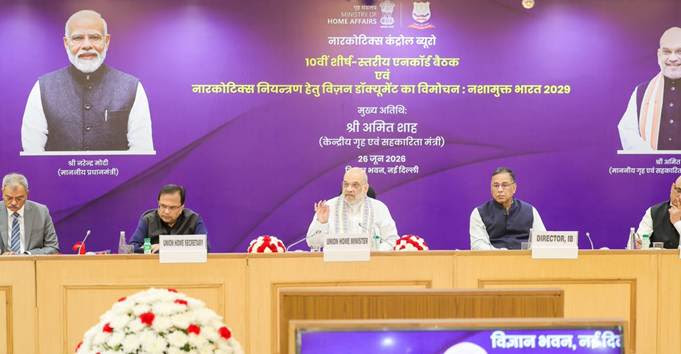
Speaking at the 10th apex-level meeting of the Narco-Coordination Centre (NCORD), Shah launched the government’s Vision Document on Drug Control (2026-29), outlining a roadmap built around the strategy of “Detect, Disrupt and Destroy.”
The plan seeks to strengthen enforcement against drug trafficking while expanding financial investigations, intelligence sharing, rehabilitation programmes and inter-agency coordination.
“The next three years will determine whether addiction defeats us or we defeat addiction,” Shah said, urging central and state agencies to adopt what he described as a whole-of-government and whole-of-society approach to combating narcotics.
The Home Minister said drug trafficking had evolved beyond a law-and-order challenge into a threat to India’s internal security, economic stability and public health, citing links between narcotics trafficking, organised crime, terror financing and cross-border criminal networks.
He said traffickers were increasingly using sophisticated methods, including drones, maritime cargo routes, encrypted online platforms, cryptocurrencies and darknet marketplaces, requiring law enforcement agencies to adopt technology-driven and intelligence-based responses.
As part of the initiative, Shah released the NCB Annual Report 2025, inaugurated new zonal offices of the Narcotics Control Bureau (NCB) in Jammu and Guwahati, and launched a nationwide campaign to destroy seized narcotics.
Officials said drugs weighing more than 2.09 lakh kilograms and valued at approximately Rs 6000 crore would be destroyed under the campaign.
The strategy rests on four pillars: enforcement and intelligence operations, control of precursor chemicals and synthetic drugs, demand reduction through rehabilitation and awareness programmes, and institutional capacity building with improved coordination among agencies.
Shah directed states to strengthen Anti-Narcotics Task Forces, enhance financial investigations under anti-money laundering laws and improve real-time intelligence sharing to identify and dismantle trafficking networks.
He also called for greater monitoring of online pharmacies, darknet transactions and cryptocurrency-based payments, while urging state governments to establish dedicated narcotics courts for faster prosecution of major cases.
Highlighting the government’s anti-drug campaign, Shah said authorities had seized narcotics worth Rs 1.84 lakh crore between 2014 and 2026, compared with Rs 40,000 crore during the preceding decade.
He said drugs worth nearly Rs 90,000 crore had been destroyed over the same period and that enforcement agencies had significantly expanded action against illegal cultivation of narcotic crops.
India lies between the so-called “Golden Crescent” and “Golden Triangle” – two of the world’s largest illicit opium-producing regions – making it vulnerable to transnational drug trafficking networks that exploit its land and maritime borders.
The government has increasingly prioritised narcotics enforcement as part of its wider national security strategy, particularly against networks suspected of financing organised crime and militant groups.