
As Jammu and Kashmir launches an ambitious decongestion drive, officials are redesigning traffic flow in Srinagar and Jammu but for commuters, relief still feels a long way off. Suneem Mir reports.
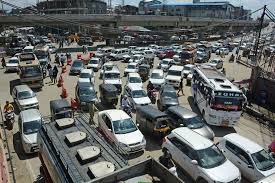
By mid-morning in Srinagar, the traffic begins to harden.
Cars inch across intersections with the patience of habit.
Motorcycles squeeze between buses and parked vehicles.
Delivery vans idle with hazard lights blinking. Auto-rickshaws angle into whatever space opens briefly before closing again.
At junctions across the city, horns merge into a continuous background note – urgent but familiar enough to go almost unnoticed.
For thousands of commuters in Srinagar and Jammu, traffic is no longer a temporary delay. It has become part of the architecture of the day.
School runs are timed around it.
Office arrivals are negotiated through it.
Shopkeepers plan deliveries against it.
Ambulances fight through it.
Entire neighbourhoods move according to its mood.
And increasingly, the administration appears to be treating it as one of the region’s most visible urban crises.
This week, the Jammu and Kashmir administration launched one of its most extensive traffic enforcement and decongestion efforts in recent years, initiating action against more than 39,000 habitual traffic violators as part of a broader plan to ease pressure on the roads of Srinagar and Jammu.
The measures are sweeping: suspension and cancellation of driving licences and registration certificates, seizure of vehicles, blacklisting of repeat offenders, expansion of one-way systems, new diversion routes, parking reforms and the gradual rollout of smart traffic regulation technology.
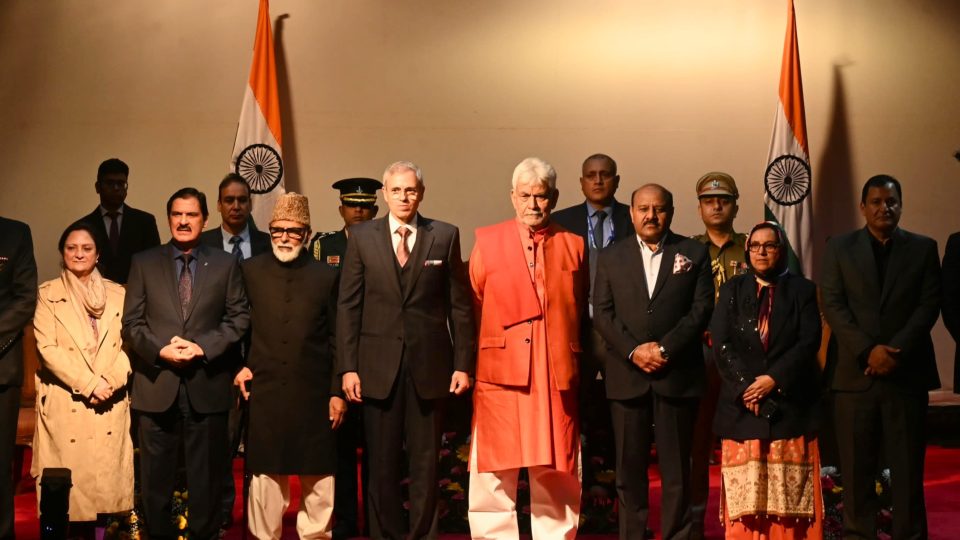
The strategy was reviewed during a high-level meeting chaired by Chief Secretary Atal Dulloo, who assessed progress on what officials described as a comprehensive traffic decongestion plan for the twin capitals.
Behind the numbers lies a problem every commuter already knows intimately.
In both Srinagar and Jammu, the roads are carrying more than they were built for.
Vehicle ownership has surged over the years while road expansion has struggled to keep pace. Narrow commercial corridors now handle streams of private cars, public transport, vendors, delivery traffic and pedestrians simultaneously. Illegal parking spills onto already congested lanes. Wedding venues and schools empty directly into choke points. Major intersections lock up within minutes during peak hours.
The result is less a traffic jam than a daily urban stalemate.
Officials told the meeting that several diversion routes have already been opened to reduce pressure on key corridors – 10 in Jammu and five in Srinagar – with more adjustments expected as traffic patterns are studied.
Technology is also being positioned as part of the solution.
Authorities are expanding Intelligent Traffic Management Systems, Automated Traffic Management System junctions and Smart City Command and Control Response Systems to improve signal coordination and traffic monitoring.
On paper, it is a modern urban traffic blueprint.
On the ground, however, traffic remains deeply human.
A driver waits ten minutes to cross a junction because cars are parked along both sides of the lane.
A parent leaves home earlier each week because the school route keeps slowing.
A shopkeeper unloads inventory from the roadside because there is nowhere else to stop.
A patient sits inside an ambulance watching the road refuse to move.
Congestion here is not only about infrastructure. It is about how city life presses into limited space.
To manage that pressure, the administration has also introduced one-way systems at key locations and is moving ahead with plans for additional no-vehicle zones, particularly in crowded commercial and hospital areas.
Dedicated e-rickshaw zones are being established as well—six in Jammu, with multiple operational and restricted zones planned across Srinagar—in an effort to regulate short-distance transport and improve last-mile connectivity without adding further road chaos.
Parking has become another major front in the campaign.
Officials said GIS-based parking mapping is underway in Srinagar to identify space more systematically, while parking facilities in Jammu have already been tendered and partially operationalised.
Municipal authorities have also begun addressing institutions that contribute to congestion from the edges – issuing notices to banquet halls and schools lacking adequate parking capacity, whose overflow often spills directly onto public roads.
It is a reminder that traffic rarely begins with the vehicle itself. It begins with planning decisions made years earlier—where a building was allowed, where parking wasn’t considered, where a road remained narrow while the city around it expanded.
Chief Secretary Dulloo directed departments to speed up pending projects and ensure visible improvements in commuter convenience and traffic flow as early as possible.
Whether commuters feel that improvement soon may determine how the drive is remembered.
For now, in both capitals, traffic remains the one civic experience nearly everyone shares.
It is democratic in that way.
Government officials and students wait in the same queues. Shopkeepers and tourists edge through the same intersections. Office workers and taxi drivers watch the same red light linger.
And every day, in the slow crawl of Srinagar and Jammu’s roads, the question repeats itself: whether the cities can move faster than the congestion growing inside them.
About the Author
Mir Suneem is a filmmaker and a postgraduate in filmmaking from Jamia Millia Islamia. With a strong grounding in film editing and narrative craft, she is drawn to stories the frame extends beyond the visible into the lived.