
Kashmir Impulse Desk
New Delhi, Aug 4
India has brought back 274 fugitive criminals from 36 countries since 2019, the government said on Tuesday, as it highlighted what it described as a more coordinated, intelligence-led and technology-driven effort to pursue offenders who have fled abroad.
The government said the campaign, carried out under Prime Minister Narendra Modi and Home Minister Amit Shah, had made the extradition of fugitives a “national priority” and involved sustained legal, diplomatic and law-enforcement efforts.
The government said India had strengthened its framework for dealing with fugitives through legislative changes, international cooperation, improved information-sharing and closer coordination among central and state agencies.
It said the Modi government enacted the Fugitive Economic Offenders Act in 2018 and, under Shah’s guidance, developed an integrated model to pursue fugitives and facilitate their return to India.
Before 2014, India’s extradition framework had become outdated and the country had extradition treaties with only 37 countries, the government said. There was also no dedicated law to deal with economic fugitives or to confiscate their assets.
Between 2004 and 2013, India secured the extradition of only four fugitives a year on average, while 110 extradition requests remained pending, it said.
Incomplete documentation and slow processing had made extradition proceedings cumbersome and had often resulted in foreign courts rejecting Indian requests, the government said. Legal and judicial hurdles, including the principles of double jeopardy and dual criminality, also contributed to the rejection of extradition requests.
The government also cited a lack of effective coordination and a unified strategy among the Home Ministry and other departments, while information-sharing on fugitives, location tracking and the issuance of Interpol Red Corner Notices had progressed slowly.
It said the government’s strategy was based on three pillars – global outreach, strong coordination and “smart diplomacy” – and described fugitive offenders as an issue linked to India’s sovereignty, economic stability, law and order and national security.
In 2019, the government amended the National Investigation Agency Act and the Unlawful Activities (Prevention) Act. From 2020, efforts to bring fugitive offenders back to India were taken up in “mission mode”, the government said.
The scope of action was expanded beyond proscribed organisations to include individual terrorists, handlers, funding networks and support systems operating from abroad, it said.
In 2024, India implemented three new criminal laws that included provisions relating to fugitive offenders. Sections 355 and 356 of the Bharatiya Nagarik Suraksha Sanhita provide for trial in absentia, allowing judicial proceedings, including trial and prosecution, to be completed even when a fugitive accused is not present, according to the government.
India hosted the 90th Interpol General Assembly in 2022, where Shah stressed the importance of what he described as the three pillars of global policing: communication, collaboration and cooperation.
To improve coordination, connectivity and information-sharing between Indian and international law-enforcement agencies, Shah launched BHARATPOL in January 2025.
The government said BHARATPOL had created an information infrastructure linking the Central Bureau of Investigation, state police headquarters through Interpol Liaison Officers and district police headquarters on a single platform.
More than 1,400 units of state and central agencies have been connected through the portal, the government said. The system has reduced the time taken to share information between the CBI and other law-enforcement agencies, with information generally being provided within 10 to 20 days and, in some cases, within three to 10 days.
The government said Shah had held five important meetings in this direction.
The government also said enforcement of the Prevention of Money Laundering Act had been strengthened. Between 2019 and 2026, assets worth Rs 17,874 crore (USD 2.1 billion) belonging to fugitive criminals were attached under the law, it said.
The CBI has established a Special Global Operations Centre to coordinate in real time with police agencies around the world through Interpol, the government said. The agency has also designated Interpol Contact Officers in every state and in all central investigating agencies to improve coordination and international cooperation in fugitive investigations.
The number of Interpol Red Corner Notices issued has also risen sharply, according to the government. India issued 40 such notices in 2022, 100 in 2023, 107 in 2024 and 112 in 2025, while 182 had already been issued in 2026 as of the date of the government statement.
Over the past three years, Red Corner Notices have been issued against 401 fugitive criminals, the government said.
It said Operation Trishul had been launched to geo-locate absconding criminals. With support from Interpol, Indian agencies used satellite inputs, surveillance and digital footprint analysis to establish the locations of fugitives, according to the government.
Some fugitives had changed their names or identities while living abroad, but advanced technology and profile mapping enabled Indian agencies to identify and trace them, it said.
Technology has also been used to speed up extradition proceedings, including through video conferencing for court hearings, the government said.
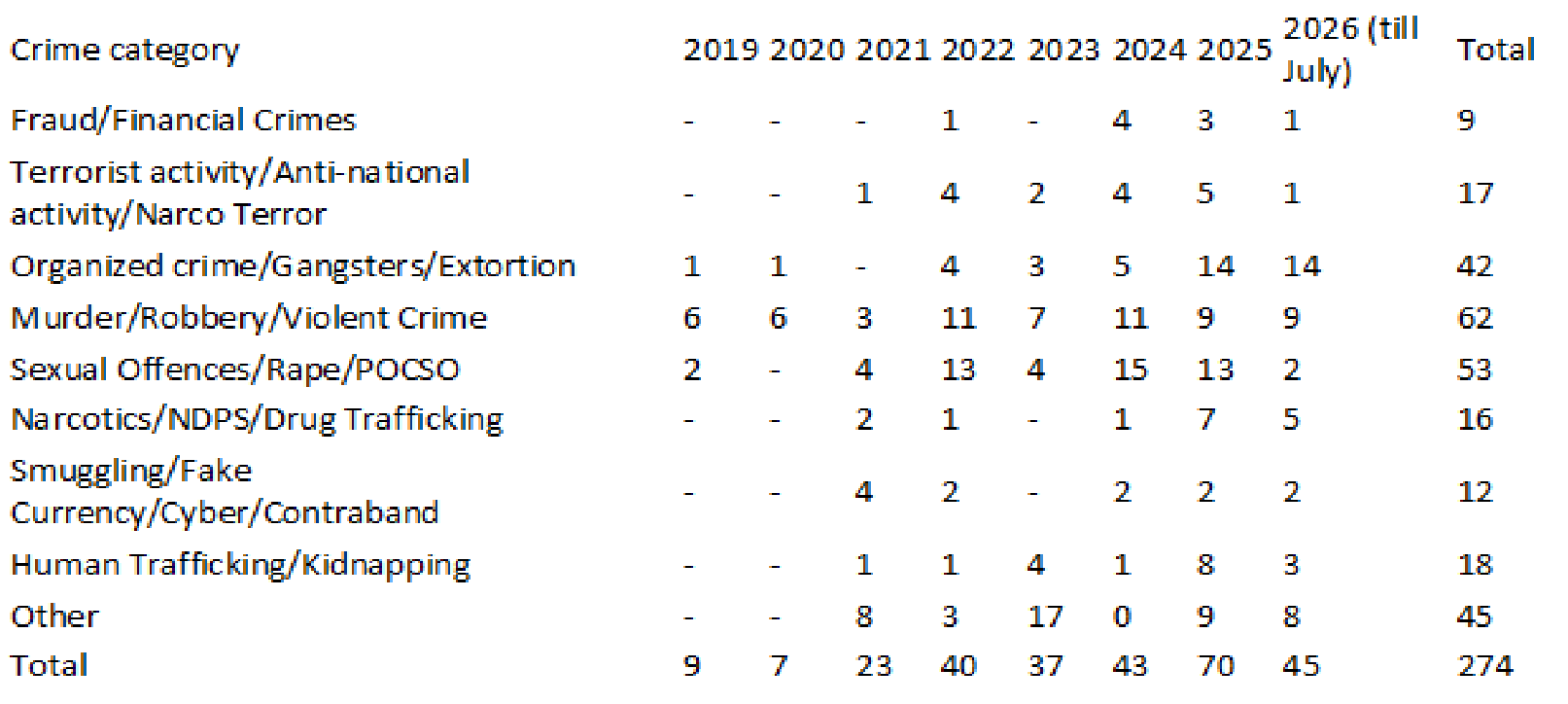
The government provided a year-wise breakdown of the 274 fugitives brought back to India between 2019 and 2026, with 2026 figures running through July.
The government said extradition requests were now being prepared in a more professional and standardised manner. Written assurances were also provided after taking into account the documentary requirements and legal expectations of the country receiving the request, it said.
The fugitives brought back to India include people wanted in cases involving terrorism, organised crime, financial offences, narcotics, murder, rape and offences under the Protection of Children from Sexual Offences Act, the government said.
The campaign also covers cases involving terrorism, pro-Khalistan extremism, the gangster-terror nexus, narcotics trafficking, cyber fraud and fake currency.
The extradition of Tahawwur Hussain Rana from the United States was cited by the government as a significant example of India’s efforts to pursue complex terror cases through sustained legal and diplomatic action.
In cases linked to Jammu and Kashmir, the government said fugitives operating from abroad had been used to sustain terrorism, narco-terrorism and cross-border support networks.
The government attributed the progress to legal preparation, diplomatic persistence, credibility and continuous follow-up, rather than chance.
At the domestic level, it said the effort involved close coordination among the Intelligence Bureau, Central Bureau of Investigation, Research and Analysis Wing, National Investigation Agency, Enforcement Directorate, Ministry of External Affairs, Narcotics Control Bureau, Directorate General of Goods and Services Tax Intelligence and state police forces.
The government described this as a “Whole-of-Government” approach under which central and state agencies work together to secure the return of fugitive offenders and deliver speedy justice to victims.
In January 2026, the Intelligence Bureau’s Multi Agency Centre constituted a Standing Focus Group, which the government described as a significant institutional step in strengthening India’s fugitive management framework.
The group is responsible for prioritising fugitive cases, standardising dossiers, addressing information gaps, ensuring sustained follow-up with foreign partners and providing national-level support to cases initiated by state agencies, the government said.
“Fugitives operating from abroad are not dormant case files,” the government said, describing them as live operational threats requiring sustained, coordinated and proactive action.
The government said the measures taken since 2018 had strengthened India’s ability to identify, track and pursue fugitives, while improving the country’s capacity to secure their return through extradition and other legal mechanisms.