




Behind the optimism of a Srinagar job fair lies an urgent question: can J&K create enough opportunities for its ambitious young generation? Mir Suneem reports.
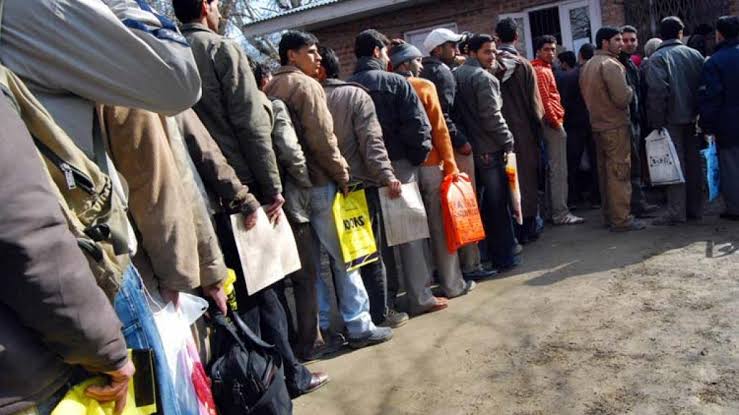
The young people arrived carrying the usual evidence of hope.
There were résumés folded into transparent files, degree certificates tucked carefully between documents, phones in one hand and expectations in the other. At Amar Singh College in Srinagar, the 77th state-level mega job fair brought together thousands of candidates and more than fifty employers from across India, including companies with operations in the Gulf and the Middle East.
For many, the event was more than a recruitment exercise. It was an encounter with one of the oldest questions facing Jammu and Kashmir: what happens to a generation that has spent years preparing for employment, only to discover that the economy has not created enough jobs to meet its expectations?
The answer offered from the stage was both hopeful and, in its own way, an admission of the scale of the problem.
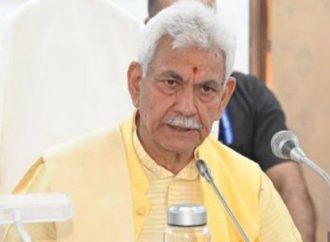
Lieutenant Governor Manoj Sinha told the young audience that they should not think of themselves merely as job seekers.
“You are not merely job-seekers. You are the makers of India’s future,” he said.
Chief Minister Omar Abdullah, speaking at the closing session, put the matter more directly. If the government cannot provide employment to every young person, he said, it has a responsibility to create opportunities elsewhere – through private-sector recruitment, entrepreneurship, skills and stronger links between educational institutions and industry.
Together, the two speeches captured the central paradox of youth employment in Jammu and Kashmir.
The government is being asked to create jobs at a time when the number of young people seeking work is growing, while the traditional source of secure employment – the public sector – has limits that cannot simply be wished away.
The government job remains, for many young people, the gold standard. It offers security, a predictable career and, in an economy where private employment can be uncertain, a sense of permanence. Families invest years in education and competitive-examination preparation in the hope that one member will eventually enter government service.
But no government can indefinitely expand its payroll to absorb every graduate.
The real responsibility of the state, therefore, is to build an economy in which a government job is one option among many – not the only option worth having.
That transformation is easier to describe than to accomplish.
At the job fair, nearly 5,300 candidates registered. Around 470 received job offers, while another 430 reached the final stages of recruitment, according to Omar Abdullah. Nearly 900 young people had therefore either secured employment or were close to doing so.
For those candidates, the numbers represent something deeply personal. A job offer can mean the first salary in a household, an end to years of uncertainty, or the possibility of staying close to home instead of leaving for another city or country.
But the larger arithmetic is harder to ignore.
If thousands of young people must gather at a single employment fair to compete for a few hundred positions, the problem is not simply a shortage of recruitment drives. It is a shortage of economic opportunities on a much larger scale.
A job fair can connect a person with an employer. It cannot, by itself, create the thousands of companies, enterprises and institutions that a growing workforce requires.
That is where the government’s responsibility becomes more complicated.
Sinha urged young people to pursue skills, innovation and entrepreneurship. He asked them to “never make dreams small, never stop learning, and always embrace innovation.”
It is advice suited to the economy of the twenty-first century. Digital technologies are changing industries, artificial intelligence is altering professional work, and businesses increasingly require skills that did not exist in their present form a decade ago.
A degree, by itself, is no longer a guarantee of employment.
But there is a danger in placing too much emphasis on the individual.
When governments tell young people to become more skilled, innovative and entrepreneurial, they are asking them to adapt to a changing economy. That is reasonable. But the economy must also adapt to its young people.
A graduate can acquire skills, but where are the jobs that require them?
An entrepreneur can develop an idea, but where is the capital to finance it?
A startup can be launched, but where are the markets, mentors and institutional networks that allow it to survive?
These are not questions that individual ambition can answer. They require public policy.
This is why Omar Abdullah’s remarks about government responsibility may be more significant than the immediate success of the job fair.
“If we cannot provide government employment to every young person, then it becomes our duty to open more doors of opportunity,” he said.
The statement acknowledges something that governments do not always find easy to acknowledge: the state has limits.
But recognising those limits does not diminish responsibility. It expands it.
If the government cannot be the employer of last resort, it must become the facilitator of opportunity.
That means making it easier for businesses to invest and grow, supporting micro, small and medium enterprises, strengthening infrastructure and improving access to finance. It also means ensuring that entrepreneurs are not discouraged by unnecessary bureaucratic obstacles.
Just as importantly, it means changing the relationship between education and employment.
For too long, the university degree has often been treated as the final destination. A student completes a course, receives a certificate and is left to navigate the labour market alone.
Omar Abdullah argued that colleges and universities should play a larger role in helping students move from education into employment.
That transition should begin long before graduation.
Career guidance should not be an occasional seminar. Internships should not be available only to the fortunate. Campus recruitment should not be an exception.
The Chief Minister called for recruitment to become a regular feature across Jammu and Kashmir’s universities and colleges, including the University of Kashmir, the Islamic University of Science and Technology, the University of Jammu and Sher-e-Kashmir University of Agricultural Sciences and Technology.
The idea is simple: if universities are preparing young people for the world of work, then they must also be connected to that world.
Education and employment cannot exist in separate rooms.
Sinha made a similar argument, saying education should not be confined to classrooms or examinations. Students, he said, must leave institutions with practical understanding, skills and confidence.
The message is particularly relevant in a region where educated unemployment has become a defining feature of the economic conversation.
The problem is not necessarily a lack of education. In many cases, it is a mismatch between education and opportunity.
A young person may hold a degree but lack the skills demanded by an employer. An employer may have vacancies but struggle to find candidates with the right training. A university may produce thousands of graduates without knowing which sectors are likely to hire them.
The result is a peculiar stalemate: young people are unemployed, employers complain about skill shortages, and educational institutions continue to produce graduates.
Breaking that cycle requires cooperation.
Sinha called upon industry representatives to become recruiters, mentors and partners in developing the region’s workforce.
For years, the conversation about unemployment has often placed the entire burden on government. But a functioning economy requires three partners: the state, educational institutions and industry.
The state creates the policy environment. Universities create knowledge and skills. Industry creates employment and economic value.
When those three systems operate independently, young people fall through the gaps. When they work together, a student can learn skills because an industry needs them, an employer can recruit directly from a campus, and an entrepreneur can find mentorship and finance.
This is how employment ecosystems are built – not through a single announcement, but through thousands of connections.
Entrepreneurship is likely to play an increasingly important role in that ecosystem.
Omar Abdullah said the government was working to strengthen Jammu and Kashmir’s startup environment and connect young entrepreneurs with venture capital and institutional support.
The region has no shortage of young people with ideas. What is often missing is the infrastructure that allows those ideas to become businesses.
Entrepreneurship should not, however, become a euphemism for unemployment.
Telling a young graduate who cannot find a job to “start a business” is not a serious employment policy unless that person also has access to finance, training, mentorship and markets.
A startup ecosystem requires patience. Government policy must therefore be designed not merely to launch enterprises but to help viable businesses survive and grow.
The same state that asks young people to innovate must create conditions in which innovation can flourish.
Sinha referred to Jammu and Kashmir’s performance under the Prime Minister’s Employment Generation Programme in 2021-22 and expressed confidence that the region could build a stronger identity in innovation, startups and modern industries.
That ambition is worth pursuing, but it must be accompanied by a larger economic vision.
Jammu and Kashmir cannot solve its employment challenge by producing more government vacancies. Nor can it solve it by asking every graduate to become an entrepreneur.
It must create a diversified economy in which government employment, private companies, small businesses, tourism, technology, agriculture, handicrafts, startups and emerging industries all contribute to the employment landscape.
The challenge is particularly urgent because youth unemployment is never merely an economic statistic.
For a young person, prolonged unemployment can mean delayed independence and years spent preparing for examinations rather than building a career. For families, it can mean continued financial dependence. For society, it can produce frustration and a sense that education has failed to deliver on its promise.
That is why employment is ultimately about more than wages.
It is about dignity.
It is about the ability to imagine a future and believe that there is a place for you in it.
The young people at Amar Singh College were therefore not simply looking for jobs. They were looking for evidence that the system around them had a place for their ambitions.
The job fair offered some of them that evidence.
But the larger test lies beyond the exhibition halls and recruitment desks.
Can Jammu and Kashmir create enough economic activity to ensure that its educated youth do not have to wait years for a government vacancy? Can universities become active participants in employment rather than passive providers of degrees? Can the private sector be persuaded to invest, recruit and build careers in the region? Can entrepreneurship become a genuine path to economic independence rather than a slogan attached to employment programmes? And can the government create an environment in which a young person with a degree, a skill or an idea has more than one door to knock on?
These questions will not be answered at a single job fair.
But they point towards a different understanding of what government responsibility means.
The state cannot promise every young person a government job. It should not pretend otherwise.
What it can promise – and what it must work towards – is an economy where a young person does not need a government job to have a future.
That future will require the government to create the conditions for opportunity, universities to prepare students for the realities of work, industry to invest in people, and young citizens to keep learning and adapting.
The responsibility is shared. But the first responsibility remains with those who govern.
If young people are, as Sinha said, “the makers of India’s future,” then the government must ensure that they have the tools, institutions and opportunities with which to make it.
The 77th mega job fair, Sinha said, should mark “the beginning of a new chapter in the employment history of J&K.”
The real measure of that new chapter will not be the number of offer letters handed out on a Tuesday in Srinagar.
It will be whether, years from now, a young person graduating from a college in Jammu and Kashmir looks at the future and sees something more expansive than a government recruitment notice.
A future with choices. A future with risks, perhaps, but also possibilities. A future in which the question is no longer, “Which government job can I get?”
But rather: “What can I build?”
About the Author
Mir Suneem is a filmmaker and postgraduate in filmmaking from Jamia Millia Islamia, with a strong interest in editing and narrative craft.