



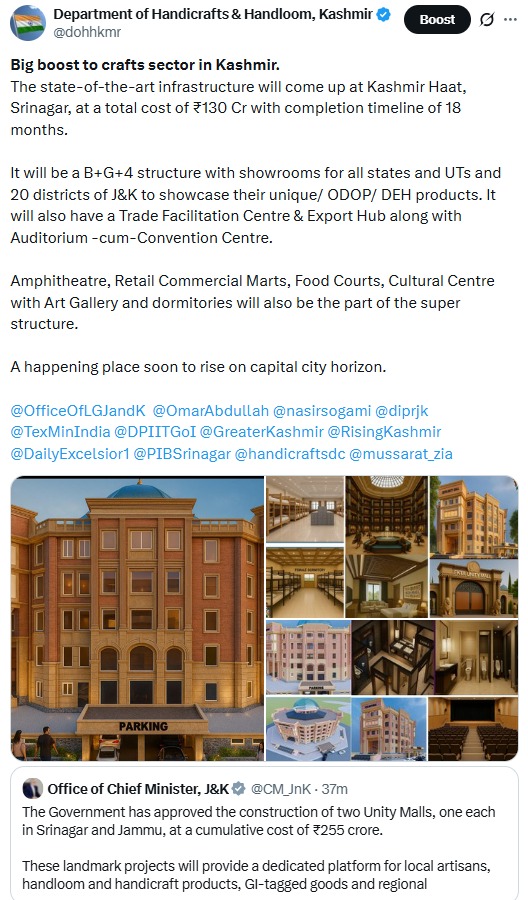
The proposed Rs 130-crore Unity Mall promises to showcase Kashmir to the world; its proposed location could instead deepen Srinagar’s most familiar urban troubles. Amir Yaseen reports.
A city can reveal its ambitions through the buildings it chooses to construct – and its anxieties through the places it chooses to demolish.
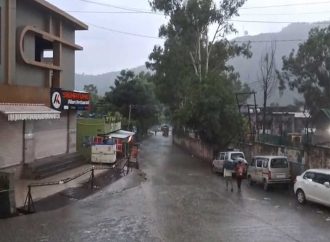
Srinagar, for years, has struggled with a contradiction that is visible almost everywhere: a city whose economy and population have grown faster than its infrastructure, and whose aspirations for a modern urban future repeatedly collide with the physical limits of an old and fragile landscape.
The latest proposal brings that contradiction into sharp focus.
The government has approved two Unity Malls in Jammu and Kashmir at a combined estimated cost of Rs 255 crore – one in Jammu and the other in Srinagar – with the stated aim of creating major platforms for local artisans, handicrafts, handlooms, GI-tagged products and other indigenous goods.
There is little argument against the idea itself.
Srinagar needs new commercial spaces. It needs modern exhibition facilities. It needs large, well-designed venues where Kashmiri artisans can meet buyers, tourists, exporters and consumers. It needs infrastructure capable of taking the region’s handicraft economy beyond the traditional circuits of workshops, bazaars, and middlemen. It needs places where a visitor from Mumbai, Bengaluru, Delhi, or Dubai can encounter the breadth of Kashmir’s products in one location.
What Srinagar does not necessarily need is another large-scale commercial and convention complex inserted into one of its busiest and most congested urban zones.
That, however, is what the proposed Unity Mall appears set to become.
The Srinagar project, estimated at Rs 130 crore, is proposed at Kashmir Haat, where the existing facility is to be redeveloped and expanded into a state-of-the-art B+G+4 complex. The project is expected to be completed within 18 months and will include showrooms representing all states and Union Territories, alongside products from all 20 districts of Jammu and Kashmir.
On paper, it is an impressive proposition.
There would be spaces for One District One Product and District Export Hub products, a trade facilitation centre and export hub, an auditorium-cum-convention centre, an amphitheatre, retail commercial marts and food courts. A cultural centre, art gallery, and dormitory facilities are also envisaged.
The proposed complex is thus not merely a mall in the conventional sense. It is intended to be a marketplace, exhibition venue, cultural centre, tourism destination, and trade gateway rolled into one.
And that is precisely why its location matters so much.
A building of this scale will not simply occupy land. It will generate movement.
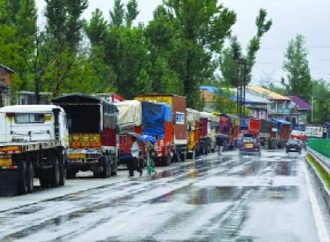
It will bring shoppers, tourists, traders, exhibitors, buses, taxis, private vehicles, delivery trucks, event attendees, and employees. It will require parking, loading and unloading areas, pedestrian access, emergency routes, and public transport connectivity. It will produce a daily rhythm of traffic, with periodic surges during exhibitions, conventions, festivals, and trade events.
In a city already struggling to move its existing traffic, the question is not whether Srinagar needs the Unity Mall.
It is whether Srinagar needs the Unity Mall at Kashmir Haat.
The distinction is crucial.
Kashmir Haat is not an empty tract waiting to be activated. It occupies a location within the city’s established urban fabric, an area already experiencing pressure from traffic and commercial activity. Any substantial vertical expansion of the site risks adding a major new generator of footfall and vehicular movement without necessarily creating the infrastructure required to absorb it.
The result could be predictable: more congestion, more roadside parking, more pressure on adjoining roads, more encroachment and, eventually, the kind of urban disorder that Srinagar has spent years trying to reverse.
The irony would be difficult to miss.
A project conceived to showcase Kashmir’s finest crafts and cultural traditions could end up becoming a symbol of the city’s inability to plan its future spatially.
The government has already recognised the importance of location in Jammu. The Unity Mall there is proposed on the outskirts of the city, according to the government’s announcement. That approach offers a useful precedent for Srinagar.
The summer capital, too, has an urban periphery.
It has land where a large, purpose-built complex could be developed without squeezing another major institution into the city’s already crowded core. A peripheral location could allow the project to be designed not simply as a building but as a destination – with ample parking, bus bays, pedestrian areas, landscaped public spaces, and room for future expansion.
It could become a destination people travel to, rather than another place everyone must travel through.
This is particularly important because the proposed Unity Mall is expected to attract visitors from outside Srinagar. Tourists arriving from the airport, travellers coming from Jammu, traders from other districts and international buyers would all need to access the facility. Locating it near a major highway corridor or on the outskirts, with direct road connectivity, could turn the very distance from the city centre into an advantage.
There is a larger urban principle at stake here.
Not every important building needs to be in the centre of a city.
Modern cities increasingly distribute major commercial, exhibition and entertainment facilities across carefully planned zones. Convention centres, wholesale markets, exhibition grounds, and large shopping complexes require space. They require transport infrastructure. They require parking. They require the ability to accommodate crowds without paralysing the surrounding neighbourhoods.
Srinagar has often done the opposite.
Major functions have accumulated in and around the existing urban core, where every new project competes for the same limited road space and parking capacity. The city then spends years trying to manage the consequences – widening roads, building flyovers, restricting traffic, regulating parking – without addressing the underlying question of where large new developments should be located in the first place.
The proposed Unity Mall presents an opportunity to do things differently.
It could become an anchor for a new commercial and cultural district on the outskirts of Srinagar.
Imagine a purpose-built crafts and trade destination with large exhibition halls, permanent showrooms, convention facilities and cultural spaces, surrounded by landscaped public areas and adequate parking. Imagine space for buses carrying tourists and school groups, logistics facilities for artisans and exporters, and a dedicated transport system connecting the complex with the city centre and the airport.
Such a facility could become more than a mall.
It could become a gateway to Kashmir’s craft economy.
The government’s stated objectives make the case for this approach. The proposed centre is expected to give local artisans access to organised markets and provide greater visibility to GI-tagged products, ODOP and DEH products. It is also expected to help producers connect with domestic and international markets through a trade facilitation centre and export hub.
These functions need space.
A convention centre cannot be treated like a neighbourhood shop. An export hub cannot operate like a retail arcade. An amphitheatre and cultural centre will generate crowds. Food courts and commercial marts will increase footfall. An art gallery and exhibition facilities will require regular programming.
The more successful the project becomes, the greater the pressure it will place on its surroundings.
That is the paradox that planners must confront now, before construction begins.
If the Unity Mall succeeds, Kashmir Haat could become too crowded.
If it fails because access becomes difficult and the surrounding roads are perpetually congested, the project will have undermined its own purpose.
There is also the question of heritage and urban memory.
Kashmir Haat, whatever its limitations as a contemporary commercial facility, occupies a place in the city’s institutional landscape. Srinagar is a city where the relationship between built form and cultural identity is unusually delicate. Its historic neighbourhoods, gardens, waterways and public spaces are not merely physical assets; they contribute to the character through which the city is experienced.
The answer to Srinagar’s infrastructure deficit cannot always be to build bigger structures on the sites that are easiest to acquire.
The city needs a more imaginative approach to land.
It needs to identify what belongs in the historic and central city, what belongs in new commercial districts, and what should be moved to the periphery. It needs to distinguish between preserving the city’s core and modernising it. Above all, it needs to stop treating every vacant or publicly controlled parcel as an opportunity for another large construction project.
The Unity Mall should not be opposed because it is large.
It should be welcomed precisely because it is ambitious – and its ambition should be matched by equally ambitious urban planning.
There is a compelling case for a major national-level marketplace for Kashmiri crafts. The region’s artisans have long produced objects of extraordinary skill and cultural value, yet many remain disconnected from organised markets and international buyers. A modern trade and export ecosystem could help change that.
The proposed Unity Mall could provide the institutional infrastructure for such a transformation.
But infrastructure is not only about what a building contains. It is also about where the building stands.
The Jammu model offers an obvious lesson. If one Unity Mall can be planned on the outskirts of Jammu, there is no reason Srinagar cannot be given a similarly spacious, future-oriented site.
Indeed, Srinagar may need it even more.
The city is already confronting a familiar catalogue of urban problems: traffic bottlenecks, inadequate parking, pressure on roads, unplanned commercial growth, and the steady conversion of public spaces into informal parking and trading areas. Adding a B+G+4 complex with national showrooms, district-level outlets, convention facilities, food courts, and cultural attractions to such an environment risks intensifying precisely the problems that the city is trying to solve.
The government has an opportunity to reconsider the location without reconsidering the project.
The two decisions are not inseparable.
Srinagar can have its Unity Mall. It can have a trade and export hub. It can have a national showcase for the handicrafts and handlooms of Jammu and Kashmir and the rest of India. It can have an auditorium, an amphitheatre, a cultural centre, and a marketplace where the products of all 20 districts can be presented under one roof.
But perhaps that roof should stand somewhere with room beneath it for the city to breathe.
The ideal Unity Mall would be connected to Srinagar without being trapped inside it. It would be accessible by road, public transport and, eventually, mass transit. It would have enough parking to prevent surrounding roads from becoming parking lots. It would have space for buses, logistics, and future expansion. It would be surrounded by a planned urban environment rather than squeezed into an already stressed one.
Most importantly, it would allow Srinagar to grow outward instead of endlessly densifying inward.
The decision to build the mall is an opportunity to think about the next 50 years of the city, not merely the next 18 months of construction.
A new generation of Kashmiris will inherit whatever Srinagar builds today. They will live with its traffic patterns, its commercial districts, and its planning mistakes long after the ribbon-cutting ceremonies are forgotten.
The Unity Mall could become one of the region’s most important economic and cultural institutions.
That is why its location deserves more than a passing administrative decision.
Srinagar needs a new mall.
It needs one that celebrates its crafts, creates markets for its artisans, welcomes visitors, and connects Kashmir’s products with the world.
But it also needs a city that can move, breathe, and grow.
The best place for such a mall may therefore not be at the heart of Srinagar, where every additional vehicle adds to an already fragile urban equation.
It may be at the edge – where there is room to build not just a mall, but a new kind of city around it.
About the Author
Amir Yaseen is a Srinagar-based journalist with an eye for the telling detail and an ear attuned to the cadences of Kashmir. He approaches news as narrative, locating the human story within the language of policy and progress and the quiet recalibration of everyday life.