





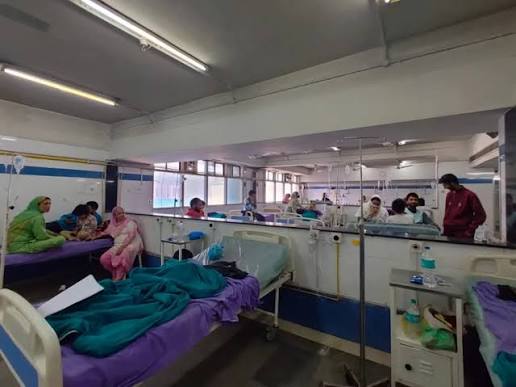
Broken equipment, bureaucratic delays, and weak accountability are pushing Kashmir’s patients towards avoidable suffering. Bilquees Punjabi writes.
The continuing failure of critical diagnostic services at SMHS Hospital and Super Specialty Hospital, Shireen Bagh, is not merely an administrative lapse. It is a symptom of a much deeper malaise in Kashmir’s public healthcare system – one in which broken equipment, delayed procurement, bureaucratic inertia and a lack of accountability routinely combine to put patients at risk.
For nearly four months, patients requiring Cardiac CT investigations have reportedly been left without the service at a major government hospital. At Super Specialty Hospital, the Digital Subtraction Angiography (DSA) Cath Lab is non-functional, affecting cardiology, radiology and neurology services. Echocardiography services have also reportedly remained disrupted for months. At SMHS, patients are allegedly being prioritised for ECHO only in emergencies, while existing equipment is itself inadequate for the growing demands of a tertiary-care hospital.
These are not minor inconveniences. These are essential diagnostic services that can determine whether a patient receives timely treatment for a heart attack, stroke, pulmonary embolism, aortic dissection or other potentially fatal conditions.
The most disturbing part is that, according to reports, some replacement components required to restore the Cardiac CT service have already reached the hospital. If that is indeed the case, the question is obvious: why is the machine still not operational?
This is where Kashmir’s healthcare story becomes less about resources and more about governance.
A government hospital can have the best doctors in the country, but their expertise becomes meaningless when the machines they depend upon are lying defunct. A cardiologist cannot diagnose a patient with equipment that does not work. A neurologist cannot effectively treat a stroke patient if essential imaging is unavailable. A radiologist cannot perform advanced procedures without functioning infrastructure.
The government must therefore recognise that healthcare is not simply about constructing new hospitals or announcing new medical colleges. It is equally about ensuring that the infrastructure already created actually works.
Kashmir has invested heavily in healthcare infrastructure over the years. New hospitals have been built, medical colleges established and specialist services expanded. Yet the system continues to struggle with the most basic requirement of modern healthcare: keeping critical equipment functional.
This points towards a fundamental weakness in the procurement and maintenance system.
The government must immediately move towards comprehensive annual maintenance contracts for high-end medical equipment, with clearly defined response times and penalties for vendors who fail to repair machines within stipulated deadlines. Every tertiary-care hospital should have a dedicated biomedical engineering division capable of identifying faults, coordinating repairs and maintaining an inventory of essential spare parts.
There must also be a centralised, publicly monitored dashboard showing the operational status of critical equipment in government hospitals. If a CT scanner, MRI, ECHO machine, Cath Lab or ventilator is non-functional, the public should know how long it has been out of service and what action is being taken to restore it.
Most importantly, responsibility must be fixed.
A machine cannot remain non-functional for three or four months without someone being held accountable. There should be a clear chain of responsibility – from the hospital administration to the procurement agency and the concerned department. If a repair is delayed because a file is moving between offices, that is not a technical problem. It is an administrative failure.
The Jammu and Kashmir Medical Supplies Corporation Limited (JKMSCL), which plays a critical role in procurement and supply, must also be made more responsive. Procurement agencies cannot function merely as purchasing bodies. They must ensure the entire lifecycle of medical equipment – from purchase and installation to maintenance, repair and eventual replacement.
The government should consider establishing a dedicated Medical Equipment Management Authority or Cell for Jammu and Kashmir, staffed by biomedical engineers and technical experts. Its mandate should include equipment mapping, preventive maintenance, emergency repairs, vendor performance monitoring and ensuring availability of critical spare parts.
The present system appears to rely too heavily on reactive maintenance. A machine breaks down, a requisition is sent, correspondence begins and patients wait. Modern healthcare systems cannot operate this way.
Preventive maintenance must become mandatory.
Every critical machine should have a maintenance calendar, and hospitals should be required to report downtime. Equipment that is repeatedly breaking down should be replaced rather than endlessly repaired. Procurement decisions should also be based on lifecycle costs, not merely the lowest initial purchase price.
There is another dimension to this crisis that cannot be ignored: the burden it places on ordinary families.
When government diagnostic services fail, patients are pushed towards private hospitals and diagnostic centres. For a middle-class or poor family, the cost of an ECHO, CT angiography or other specialised investigation can be substantial. For patients travelling from remote districts, there are additional expenses – transport, accommodation, food and lost wages.
For many families in Kashmir, a medical emergency can quickly become a financial catastrophe.
This is particularly concerning in a region where people from far-flung areas routinely travel to Srinagar for tertiary care. A patient from Kupwara, Bandipora, Ganderbal, Anantnag, Shopian or other districts may spend hours travelling to a tertiary hospital, only to discover that the required diagnostic service is unavailable.
That is unacceptable.
Kashmir’s geography makes a strong public healthcare system even more important. Harsh winters, snowfall, landslides and difficult terrain can disrupt connectivity. In emergencies, patients cannot always be transported quickly to another city or state. The region therefore needs redundancy in its healthcare infrastructure – multiple hospitals capable of providing critical services, rather than dependence on a handful of facilities.
The government should develop a regional emergency diagnostic network, ensuring that critical services such as CT angiography, MRI, Cath Lab and advanced ultrasound are available across strategically located hospitals. District hospitals should gradually be upgraded so that the pressure on Srinagar’s tertiary-care institutions is reduced.
At the same time, Kashmir needs to focus on emergency medicine and time-sensitive care. Heart attacks and strokes do not wait for office hours, procurement approvals or government tenders. Every minute matters.
The government must also strengthen transparency. Hospitals should publish monthly data on equipment availability and downtime. Citizens have a right to know whether the public facilities they depend upon are functioning. Such transparency would also create pressure for timely corrective action.
But ultimately, the issue is one of political and administrative priority.
Healthcare cannot be treated as a sector where announcements are enough. A new building does not save a life. A functioning machine does. A doctor with access to the right diagnostic tools does.
The government must therefore move beyond ribbon-cutting and infrastructure creation towards building a culture of accountability, maintenance and performance.
Kashmir’s healthcare professionals have repeatedly demonstrated their commitment, often working under enormous pressure and treating patients far beyond the capacity of their institutions. They deserve a system that supports them.
The people of Kashmir deserve nothing less.
A healthcare system is judged not by how many hospitals it builds, but by whether a patient in distress can walk into one and receive timely, affordable and quality care.
If a cardiac patient waits months because a machine is broken, if a stroke patient is sent elsewhere because a scanner is unavailable, or if a poor family is forced into private healthcare because a government machine has remained defunct, then the system has failed—not the patient.
The government must act now. It must fix the machines, fix the procurement system, fix the maintenance mechanism and, above all, fix accountability.
Because in healthcare, every day of administrative delay can carry a human cost—and sometimes, that cost is a life.
About the Author
Bilquees Punjabi has a Masters in Computer Applications and approaches journalism not just as storytelling, but as a system – one shaped by algorithms, audiences, and the quiet mechanics of the web. Her interests lie in the evolving world of online journalism, where headlines compete for attention, metrics shape narratives, and clicks, traction, and ads become part of the story itself.