



For Kashmir’s families, farmers, and orchardists disaster often brings a second tragedy – the struggle to rebuild without a financial safety net. Tabish Khan report.
In Kashmir, calamity has a way of arriving twice.
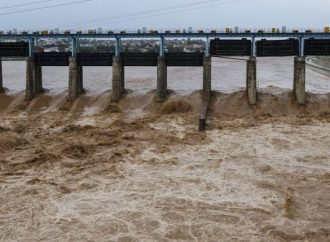
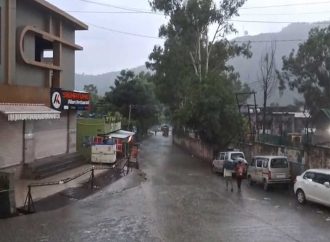
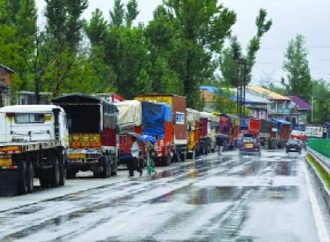
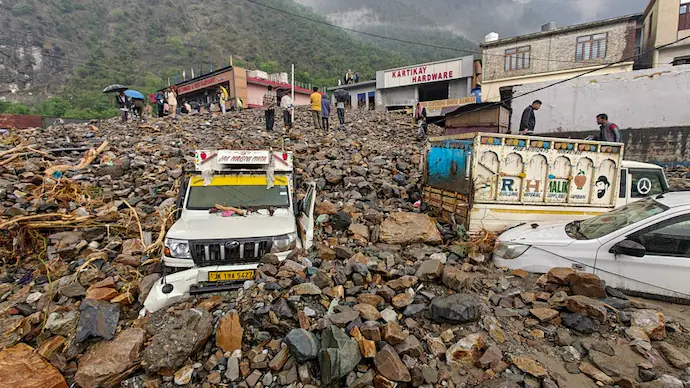
The first time it comes as water rising through a doorway, as a hillside giving way, as an earthquake shaking the walls, as hail stripping an orchard bare, or as violence closing a shop and interrupting a family’s income. The second time it arrives in the months and years afterward, when the damaged house has to be rebuilt, the orchard replanted, the loan repaid, the child sent back to school and the family somehow returned to the life it had before.
It is in that second phase that the absence of insurance becomes most visible.
A Kashmiri family may own a house, a small piece of agricultural land, an orchard that represents decades of work, a vehicle, livestock and perhaps a modest business. On paper, it may appear reasonably secure. But much of that wealth is often uninsured or inadequately insured. A family may have spent its life accumulating assets without ever acquiring the financial mechanism that protects those assets when they disappear overnight.
The result is a peculiar contradiction. Kashmiris insure their vehicles because the law requires it. They insure houses because a bank financing the construction may require it. Yet many do not insure their lives adequately, their health comprehensively, their homes against the full range of disasters, or their orchards and agricultural livelihoods against every significant risk they face.
When disaster strikes, the family turns first to relatives, then to savings, then to loans—and finally, when these resources run out, to the government.
The rest is often left to God.
The floods of 2014 offered perhaps the clearest illustration of this vulnerability. The catastrophe did not end when the waters receded. For thousands of families, the real disaster began afterward: damaged homes, lost household goods, interrupted businesses, destroyed documents, ruined crops and years of debt. The same pattern can repeat in smaller forms every year, when an orchard is damaged by hail, an unseasonal weather event destroys a crop, or a family faces a sudden medical emergency.
The tragedy is not simply that Kashmir is vulnerable. It is that vulnerability has not yet been converted into a widespread culture of financial preparedness.
Insurance, after all, is not a luxury reserved for the wealthy. It is precisely a mechanism designed for people who cannot afford to absorb a large loss on their own. The official Pradhan Mantri Fasal Bima Yojana describes insurance in almost these terms: a way of transferring and sharing risk so that a large unexpected loss does not become a financial disaster for one individual. The scheme covers specified crop risks including flood, inundation, landslide, hailstorm and certain weather-related losses, although its exclusions and coverage conditions matter greatly.
The challenge in Kashmir is therefore not merely to sell more insurance policies. It is to build a social understanding of risk.
For an orchardist, a tree is not simply a tree. It is an investment that may take years to mature. For a farmer, one season’s crop may determine whether a family can repay a loan. For a shopkeeper, the shop is both workplace and household income. For a salaried employee, the greatest financial asset may be the future stream of income that disappears if the breadwinner dies prematurely or becomes permanently disabled.
This is why the familiar question, “Is Rs 1 crore insurance enough?” has no universal answer.
For one family, Rs 1 crore may be substantial. For another, it may be inadequate from the moment the policy is purchased.
Imagine a household with a Rs 20-lakh loan, two children whose education will require another Rs 20 lakh, and a need for Rs 40 lakh to support the family after the death of the principal earner. Add an emergency reserve and other unavoidable expenses, and a Rs 1-crore policy may appear reasonable. But consider a household spending Rs 1 lakh a month, carrying a large home loan and supporting children and ageing parents. The same Rs 1 crore can begin to look surprisingly small.
The calculation is even more complicated when inflation is considered.
A sum that appears enormous today must ultimately pay for tomorrow’s education, healthcare, housing and living expenses. A family should therefore think not in terms of a round number but in terms of the financial life that the money is expected to replace.
The basic calculation is simple: outstanding debts, future education and marriage expenses where relevant, household expenditure, emergency reserves and other financial responsibilities, minus genuinely accessible savings and existing insurance. A commonly used starting point is life cover of roughly 10 to 15 times annual income, but that is only a starting point, not a rule. Two families earning the same amount can have radically different insurance needs.
The same principle applies to Kashmir’s farmers and orchardists.
A farmer should not ask merely, “What is the premium?” He should ask: What would happen if I lost this crop? What would happen if floodwater destroyed the standing harvest? What if hail damaged the orchard? What if illness prevented me from working for six months? What if the family’s main earner died?
The government already has a framework through schemes such as PMFBY, and the official insurance platform now provides digital application, policy-status and grievance mechanisms. The scheme’s current architecture also includes technology-enabled crop-loss assessment and a farmer helpline.
But a scheme existing on paper and a scheme functioning in the imagination of the farmer are two different things.
The government should therefore consider Kashmir’s insurance problem as a matter of public resilience, not merely financial inclusion.
The first step should be a Universal Kashmir Risk Cover, designed specifically around the region’s particular vulnerabilities. It could combine subsidised basic protection for low-income households with optional top-up insurance for those who can afford it. The package could include a minimum life cover, basic health insurance, home and household-goods protection, personal accident and disability cover, and disaster-linked assistance.
For farmers and orchardists, the government should work with insurers to develop products that reflect the economics of Kashmir’s agriculture rather than forcing farmers into generic insurance products designed elsewhere.
An apple orchard cannot be valued in the same way as an annual crop. The cost of planting, the years required for trees to mature, the value of a standing orchard and the loss of future income must all be considered. A farmer who loses mature trees does not simply lose one season’s harvest; he may lose years of future earnings.
Insurance products should therefore be designed around real replacement costs and real income loss, with transparent formulas that farmers can understand.
The government could also make insurance easier to buy by integrating it with existing agricultural and land records. Every farmer should receive, at the beginning of each agricultural season, a simple statement showing: the risks covered, the premium, the subsidy, the sum insured, the exclusions and the deadline for filing a claim.
There should be no mystery.
The second major reform should be automatic disaster insurance for vulnerable households. When the government officially declares a flood, earthquake or major natural disaster, eligible households in the affected zone could receive a predefined emergency payment through a public-private insurance pool. Such a system would not eliminate government relief; it would complement it.
The third is health insurance literacy.
In many families, a single hospitalisation can consume years of savings. A household that has insured its car but not its health has protected a machine while leaving its financial future exposed. Government health schemes have expanded access to hospital care, but families should still understand what is covered, where treatment is available, what exclusions apply and what expenses may remain outside the policy.
Schools, colleges, panchayats, cooperatives, banks and agricultural extension centres should become insurance-literacy points.
The fourth reform is perhaps the most important: trust.
People do not buy insurance when they believe claims will become a battle. Every claim delayed without explanation deepens public suspicion. Every complicated form discourages another family. Every opaque exclusion becomes a story told across a village.
The insurance industry and government must therefore make claims simpler, faster and more visible. Satellite imagery, drones, weather stations and digital land records can help assess crop and property losses, but technology should be used to reduce disputes—not to create another layer of bureaucracy.
The government’s role, however, cannot substitute for individual responsibility.
Every household should begin with a financial inventory. List the house, land, orchard, vehicle, livestock, loans and other significant assets. Then list the people who depend on the family’s income. Keep copies of land records, bank documents, loan papers and insurance policies in secure digital and physical locations.
The principal earning members should consider term life insurance. The amount should be based on actual family needs rather than the attraction of a large, round figure. A ₹1-crore policy may be appropriate for one household and wholly inadequate for another.
Families should also consider health insurance, personal accident and disability cover, and appropriate protection for homes and businesses. Farmers should investigate crop and weather insurance available in their area and understand precisely what is—and is not—covered. The official PMFBY framework, for example, covers certain crop losses caused by risks including flood, inundation and landslide, while also listing exclusions such as war, riots and certain other perils. This makes it essential for farmers to read the actual policy terms rather than assume that every disaster is automatically insured.
The government can subsidise premiums. It can simplify claims. It can create public awareness. But no government can completely replace a family’s own financial preparation.
A household should also maintain an emergency fund, ideally sufficient to cover several months of essential expenses. It should avoid excessive debt where possible and diversify income when practical. An orchardist whose entire household income depends on one crop is more vulnerable than one who has another source of seasonal or supplementary income.
Cooperatives could play a crucial role here.
Instead of approaching insurance individually, orchardists and farmers could form larger risk pools through cooperatives and producer organisations. Collective purchasing can improve bargaining power, reduce administrative costs and make it easier for insurers to assess large groups of similar risks.
There is, finally, a cultural question.
Kashmir has a strong tradition of community support. When disaster comes, neighbours open their doors, relatives send money, and strangers contribute. This social solidarity is one of the Valley’s great strengths.
But solidarity should be the first line of compassion, not the last line of financial survival.
A family should not have to sell its land because its breadwinner died. A farmer should not have to borrow at punishing rates because hail destroyed a harvest. An orchardist should not spend decades rebuilding an orchard that could have been partially protected by a properly designed insurance policy. A flood should not turn a temporary disaster into a permanent descent into poverty.
Insurance cannot prevent floods. It cannot stop earthquakes. It cannot undo violence. It cannot restore a dead family member.
What it can do is buy time.
It can allow a family to rebuild without immediately selling its assets. It can keep a child in school. It can prevent a medical emergency from becoming a lifetime of debt. It can give an orchardist the capital to plant again. It can turn catastrophe from an existential event into a severe but survivable one.
Kashmir will remain a land of extraordinary beauty and extraordinary risk. The mountains will continue to rise around it; rivers will continue to run through it; weather will remain unpredictable, and history will remain capable of intruding upon ordinary lives.
The question, then, is not whether calamity will come.
It is what happens when it does.
For too long, the answer has been that families will depend on savings, relatives, loans, government relief – and, when all else fails, God.
It is time to build something in between.
A society that prepares for disaster is not a society that expects disaster. It is a society that refuses to let disaster decide its future.
For Kashmir, the next great investment may therefore not be another road, bridge or building.
It may be a safety net woven quietly, household by household, orchard by orchard and farm by farm – before the water rises.
About the Author
Tabish Khan is a multi-media journalist whose work moves fluidly across text, video, and the fast-evolving grammar of social media. With postgraduate degree in Convergent Journalism, her storytelling often bridges traditional field journalism with platform-driven formats – short-form video, visual explainers, and audience-first storytelling.