





Yatris set off from Pahalgam, Baltal routes despite rain; authorities deploy extensive security, medical infrastructure for 57-day yatra
Kashmir Impulse Desk
Srinagar, July 3
Thousands of yatris began the annual Amarnath Yatra on Friday, trekking through the Himalayan mountains of Kashmir under heavy security as the 57-day yatra to one of Hinduism’s holiest shrines formally got underway.
The first batches of devotees left the twin base camps at Nunwan in south Kashmir’s Anantnag district and Baltal in central Kashmir’s Ganderbal district early on Friday, chanting religious hymns as they embarked on the journey to the 3,880-metre (12,730-foot) Amarnath cave shrine, where a naturally formed ice stalagmite is worshipped as a symbol of Lord Shiva.
The yatra opened a day after Lieutenant Governor Manoj Sinha flagged off the first convoy of 4822 yatris from the Bhagwati Nagar base camp in Jammu. Officials said 2,510 yatris travelled to the traditional Pahalgam route, while 2,312 headed towards the shorter Baltal route.
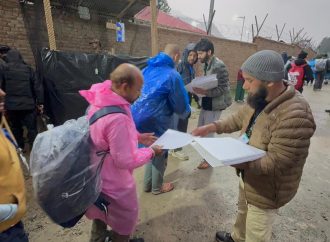
Despite intermittent rain in Kashmir, yatris began their ascent before dawn, many on foot while others used ponies or palanquins to negotiate the steep mountain trails.
Deputy Commissioner Bilal Mohi-ud-Din, Senior Superintendent of Police Amod Ashok Nagpure and other civil and police officials flagged off the first batches from Nunwan, while Ganderbal Deputy Commissioner Jatin Kishore, Senior Superintendent of Police Sudhanshu Dhama, Deputy Inspector General Maqsood-ul-Zaman and Baltal Nodal Officer Rahul Yadav oversaw the departure of yatris from the Baltal base camp.
The Amarnath shrine can be reached through two routes. The traditional Pahalgam route covers about 48 kilometres over several days and includes overnight halts, while the Baltal route, approximately 14 kilometres long, is shorter but significantly steeper, allowing many yatris to complete the yatra and return the same day.
Authorities said elaborate arrangements had been made to facilitate the yatra, which is expected to attract hundreds of thousands of devotees over the next two months.
Thousands of personnel from the Jammu and Kashmir Police, Central Reserve Police Force, Indo-Tibetan Border Police, the Army and other security agencies have been deployed along both routes, supported by aerial surveillance, electronic monitoring systems and multi-layered security checks.
Medical and disaster response infrastructure has also been expanded, with a 100-bed hospital established along the Baltal route, emergency medical teams, ambulances, oxygen support, mountain rescue units and helicopters placed on standby to respond to emergencies in the high-altitude terrain.
Officials said telecommunications facilities had been extended across much of the yatra route to improve connectivity for yatris and emergency responders.
“Our focus is to ensure a safe and smooth yatra for every devotee,” Baltal Nodal Officer Rahul Yadav told reporters. He said shelters had been established at multiple locations along the route and authorities expected around 10,000 yatris to begin the journey from Baltal on the opening day.
Yatris from across India expressed satisfaction with the arrangements despite the wet weather.
Sadhus participating in the yatra also described it as an important spiritual tradition linking Kashmir with centuries of Hindu religious history.
Officials said the Shri Amarnathji Shrine Board (SASB) and the Jammu and Kashmir administration had strengthened arrangements this year by expanding accommodation, sanitation facilities, medical services and emergency response systems at both base camps and along the trekking routes.
The annual yatra remains one of India’s largest religious events and is conducted under extensive security because of the region’s long-running insurgency, although militant violence has declined significantly in recent years. Authorities review security arrangements annually, with additional deployments made to safeguard yatris travelling through the mountainous routes.
The yatra will conclude on August 28, coinciding with the Hindu festival of Raksha Bandhan.