





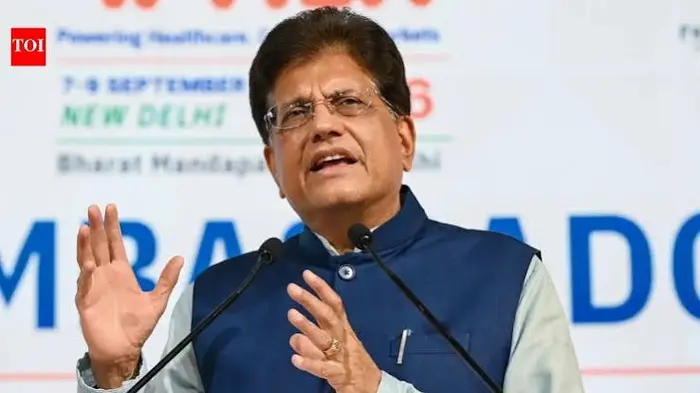
It can reshape trade relations: Commerce and Industry Minister Piyush Goyal
Kashmir Impulse Desk
New Delhi, June 21
India and the European Union are expected to sign a landmark Free Trade Agreement (FTA) by December, with implementation likely beginning in early 2027, Commerce and Industry Minister Piyush Goyal said on Sunday, signalling a major breakthrough in one of India’s most significant trade negotiations.
Speaking at an event in Mumbai, Goyal said the proposed agreement would provide Indian businesses with unprecedented access to one of the world’s largest consumer markets and significantly strengthen economic ties between India and the 27-member European bloc.
“Almost the entire European market will be open for us,” Goyal said, expressing confidence that the agreement would boost exports, attract investment and enhance India’s global competitiveness.
The announcement comes nearly five months after negotiators from India and the European Union concluded talks on the long-pending trade pact on January 27.
Officials have described the agreement as the “mother of all trade deals” because of its scale and potential impact on multiple sectors of the economy.
The European Union is among India’s largest trading partners, with bilateral trade exceeding hundreds of billions of dollars annually and spanning sectors ranging from pharmaceuticals and textiles to engineering goods, information technology and services.
Trade experts say the proposed agreement could substantially reduce tariffs on a wide range of products, making Indian exports more competitive in European markets while lowering costs for European goods entering India.
The negotiations have been closely watched by businesses on both sides because of the potential benefits for manufacturing, technology, digital services, renewable energy, automobiles and investment flows.
For India, improved market access could particularly benefit labour-intensive sectors such as textiles, garments, handicrafts, leather goods and engineering products, which have long sought preferential access to European markets.
The agreement is also expected to encourage foreign investment by providing greater regulatory certainty and strengthening economic cooperation in emerging sectors.
Economists say the timing of the deal is significant as countries seek to diversify supply chains and adapt to shifting global trade patterns amid geopolitical tensions and economic uncertainty.
India has increasingly pursued trade agreements with major economies as part of its strategy to expand exports and integrate more deeply into global value chains.
In recent years, New Delhi has concluded trade agreements with several countries and blocs while accelerating negotiations with others.
European officials have similarly viewed India as an increasingly important strategic and economic partner, particularly as the EU seeks to strengthen engagement with fast-growing Asian economies.
Industry bodies have largely welcomed progress on the agreement, arguing that greater integration with European markets could help Indian firms expand internationally and attract new technologies and investment.
Before taking effect, the agreement will require legal review, approval and ratification by relevant institutions in India and the European Union.
Officials expect that process to be completed by February or March 2027.
If implemented as planned, the India-EU FTA would rank among the most consequential trade agreements signed by India in recent decades and could significantly influence the country’s export trajectory and economic relations with Europe for years to come.