





A census is often described as a count of people. But it is also a count of realities.
The launch of the self-enumeration drive for Census 2027 in Jammu and Kashmir and Ladakh may appear administrative at first glance – a new portal, a digital form, another government exercise. But for Kashmir, the census is never just about numbers.
It is about visibility.
For the first time, residents of Jammu and Kashmir and Ladakh are being invited to digitally enumerate themselves as part of India’s census process. On paper, it is a technological shift. In practice, it is something larger: a moment that asks citizens to record who they are, where they live and how they live – within a region where questions of land, population, mobility and identity have long carried political meaning beyond statistics.
A census is often described as a count of people. But it is also a count of realities.
How many people live in a village that has expanded beyond its roads? How many homes now stand where orchards once did? How many families have migrated from rural districts into Srinagar’s growing outskirts? How many households still lack sanitation, internet access or reliable drinking water? How many young people are leaving? How many are staying?
Without those answers, governance relies on approximation. Development becomes uneven. Welfare risks missing those who need it most.
This is why Census 2027 matters deeply for Jammu and Kashmir.
Much has changed since the last full census. The region has seen political reorganisation, urban expansion, demographic movement, shifting municipal boundaries and changing economic aspirations. Entire neighbourhoods have transformed. New roads have altered settlement patterns. Tourism has redrawn local economies. Climate pressures have changed how communities relate to land, agriculture and water. Yet much of the official statistical picture remains outdated.
Policy cannot move faster than data.
If the numbers are old, decisions become old with them.
Schools are planned using yesterday’s populations. Hospitals are measured against outdated demand. Roads are designed for traffic patterns that may no longer exist. Welfare schemes risk overlooking settlements that have expanded or communities that remain underserved.
For Kashmir especially, accurate enumeration is not a bureaucratic exercise—it is the foundation of representation.
Numbers shape how resources are allocated, where infrastructure is prioritised, how local bodies are planned and how the state understands its own population. They influence everything from housing and healthcare to education, transport, electricity and employment planning.
That makes participation essential.
The introduction of self-enumeration is a welcome innovation. It offers households greater convenience and agency, particularly in urban areas where digital access is widespread. It modernises the process and aligns India’s census with global digital practices. But digital access alone will not guarantee inclusion.
Kashmir’s geography remains unequal. Connectivity varies sharply between cities and remote villages. Snow-bound regions, mountainous terrain, border belts and areas with weak internet infrastructure continue to face practical barriers. Many elderly residents may find digital forms unfamiliar. Others may hesitate to share information online without clarity or trust.
Which means the success of the census will depend not just on technology, but on public confidence.
People must understand why they are being counted, how their information will be used, and how privacy will be protected. Officials have spoken of encryption and digital safeguards. That assurance must continue clearly and consistently.
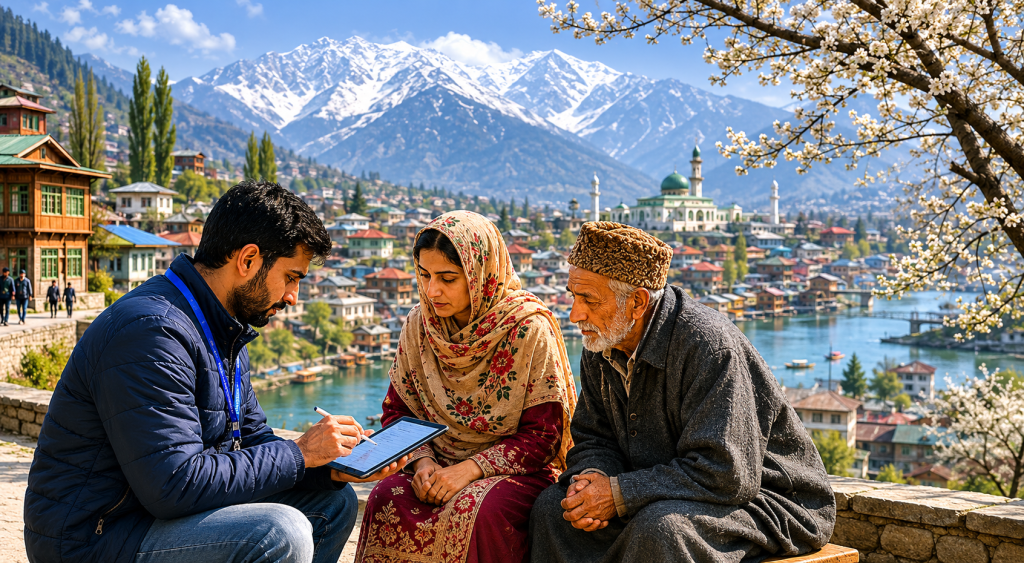
Equally important is accuracy on the ground. Enumerators entering homes across Jammu and Kashmir will carry more than tablets. They will carry responsibility.
Every entry matters.
A missed household is not simply a clerical omission. It becomes a gap in the public record. A family uncounted can become a family unseen in planning.
Census 2027 offers Jammu and Kashmir an opportunity not merely to count its people, but to better understand itself after years of rapid transition.
If done well, it will produce more than data tables.
It will create a clearer picture of how Kashmir lives now—its cities expanding outward, its villages adapting, its households changing, its aspirations evolving.
And in a place where identity is often debated in political language, there is value in something quieter but equally powerful: being counted accurately, fully and fairly.
Because before any region can be planned for, it must first be seen.










Leave a Comment
Your email address will not be published. Required fields are marked with *