




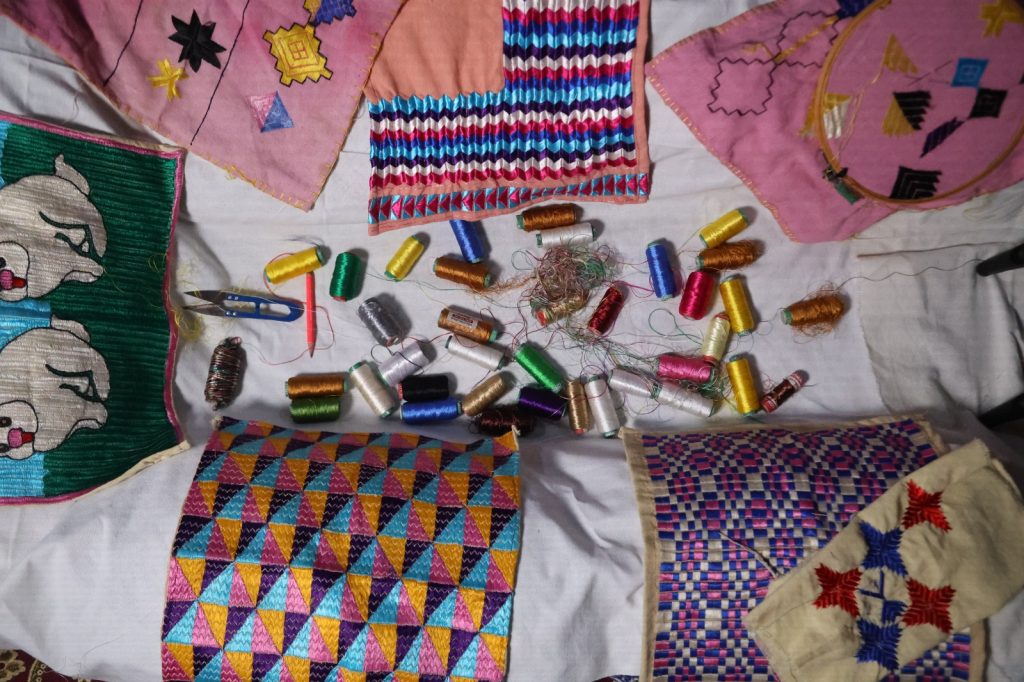
Known for its floral motifs, geometric arrangements and striking colours, Phulkari has long occupied a special place in Jammu’s artistic identity.
In Jammu, Phulkari embroidery continues to stitch together memory, identity, and livelihood. Syed Rashid Bukhari reports.
In many homes across Jammu, embroidery begins quietly.
A folded piece of cloth is spread across a lap. Bright silk threads – red, yellow, green, orange – are separated by hand. A needle passes through fabric with practiced rhythm, building flowers, patterns and symmetry one stitch at a time.
What emerges is more than ornament.
It is Phulkari – literally “flower work” – one of the region’s most vibrant textile traditions, carrying within it stories of family, celebration, womanhood and heritage.
Recognised as a notified product under the District as Export Hub initiative in Jammu, Phulkari embroidery remains both a cultural expression and a growing economic craft, connecting generations of artisans to wider national and global markets.
Known for its floral motifs, geometric arrangements and striking colours, Phulkari has long occupied a special place in Jammu’s artistic identity.
Though historically linked to the broader cultural landscape of North India, the embroidery evolved a distinct presence in Jammu through centuries of cultural exchange and local adaptation.
Its roots are believed to stretch back to the 18th and 19th centuries, when embroidered textiles flourished across regions that now include Punjab and Jammu.
Through migration, shared traditions and royal patronage during the Dogra period, Phulkari became deeply embedded in the social fabric of Jammu.
Inside homes, it became part of everyday life.
Women embroidered shawls, dupattas, ceremonial cloths and decorative textiles not simply for use, but for memory.
Pieces were prepared for weddings, festivals, births and family rituals.
They were often passed down through generations, preserved as heirlooms carrying emotional and cultural significance.
Every motif held meaning.
Flowers represented beauty and growth.
Peacocks stood for grace and prosperity.
Wheat stalks symbolised abundance and fertility.
Repeating geometric patterns reflected harmony and balance.
Even colours spoke a language of their own – red for joy and prosperity, yellow for happiness, green for renewal, white for peace.
Phulkari was never just decoration.
It was storytelling in thread.
During the Dogra era, the craft received patronage from royal and noble households, where embroidered textiles were used for garments, wall hangings and ceremonial drapes.
The embroidery came to signify refinement, prosperity and social status, while retaining its intimate place within domestic life.
Young girls traditionally learned the craft from mothers and grandmothers at an early age. Phulkari pieces formed an essential part of bridal trousseaux, symbolising care, skill and familial blessings.
But like many handmade traditions, Phulkari faced decline in the decades following industrialisation.
By the mid-20th century, machine-made textiles became more common, changing consumer habits and reducing demand for labour-intensive hand embroidery.
Many traditional forms of domestic embroidery slowly disappeared from everyday use.
Yet Phulkari endured.
In recent years, revival efforts by the Jammu and Kashmir Handicrafts Department, women’s self-help groups, artisan collectives and embroidery training centres have brought renewed energy to the craft.
Across Jammu district, training programmes now teach both traditional and contemporary Phulkari techniques to women and young artisans, helping preserve skills while creating income opportunities.
The embroidery has also evolved with changing markets.
Beyond traditional dupattas and ceremonial textiles, Phulkari now appears on stoles, cushion covers, handbags, wall décor, scarves and fashion accessories designed for contemporary buyers.
The motifs remain rooted in heritage, even as the products adapt to modern tastes.
This balance between tradition and reinvention has helped Phulkari find new relevance.
For many artisans in Jammu today, embroidery is both cultural inheritance and livelihood.
It sustains households, supports women-led entrepreneurship and keeps a centuries-old visual language alive through everyday work.
Under the District as Export Hub initiative, recognition of Phulkari as an export product has further strengthened efforts to promote the craft beyond regional markets, offering opportunities for branding, skill development and wider commercial visibility.
But for many who continue to practice it, Phulkari remains something deeply personal.
It is memory stitched into cloth.
A grandmother’s design repeated by a granddaughter.
A motif remembered without tracing.
A handmade object carrying the warmth of labour and the rhythm of tradition.
In Jammu, Phulkari is not simply embroidery.
It is a living archive – of colour, resilience and identity – still blooming through thread.
About the Author
Syed Rashid Bukhari is a photographer and drone operator with a keen eye for detail and a deep-rooted passion for filmmaking and visual storytelling. With years of experience behind the lens, he approaches each frame as a narrative, seeking not just to document, but to evoke.














Leave a Comment
Your email address will not be published. Required fields are marked with *