





The court said public employment must strictly conform to the constitutional principles of equality and equal opportunity.
Kashmir Impulse Desk
Srinagar, May 22
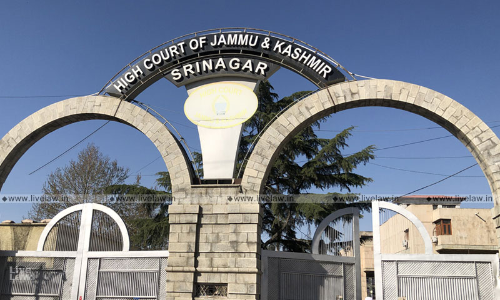
The High Court of Jammu and Kashmir and Ladakh Friday held that ad hoc and temporary appointments made through a “pick-and-choose” method without public advertisement or competitive selection, followed by policies for their regularisation, amount to a “fraud on the Constitution.”
A division bench of Justice Sanjeev Kumar and Justice Sanjay Parihar made the observation while dismissing a batch of petitions filed by three junior engineers engaged by the University of Kashmir on a contractual basis.
The petitioners had challenged an advertisement notification issued by the university on March 30, 2026, for filling one post of Junior Engineer (Electrical) and two posts of Junior Engineer (Civil) through open recruitment.
The court said public employment must strictly conform to the constitutional principles of equality and equal opportunity.
“The State cannot frame policies for regularisation of ad hoc, temporary, consolidated or contractual employees engaged without advertisement and a proper selection process,” the bench said. It added that constitutional courts cannot direct regularisation of such appointments at the expense of eligible candidates who were denied an opportunity to compete under Articles 14 and 16 of the Constitution.
The university had engaged the three junior engineers in January 2017 on consolidated monthly wages of Rs 15,000 under what it described as a “hire and fire” arrangement. Their contractual terms were extended periodically, with the latest extension valid until May 22.
Fearing disengagement following the fresh recruitment notification, the petitioners had approached the Central Administrative Tribunal in Srinagar seeking quashing of the advertisement and regularisation of their services. After the tribunal declined interim relief, they moved the High Court.
Rejecting their plea, the bench held that their appointments had been made without advertisement or a competitive selection process and could not be regularised in violation of the constitutional mandate governing public employment.
The court also criticised successive governments in Jammu and Kashmir for what it described as a long-standing pattern of backdoor appointments followed by regularisation.
“The modus operandi adopted by successive governments for achieving cheap political motives is to first recruit handpicked candidates on account of political affiliations and proximities and then engage them on ad hoc, contractual, temporary and daily-wage basis,” the court said.
It said such employees are then continued over time until the government introduces a policy to regularise them through executive orders, statutory rules or legislative action.
“Whatever be the mode adopted by the government to regularise these temporary, ad hoc, contractual and daily-wage employees, picked up arbitrarily other than through a fair process of selection, is nothing short of fraud on the Constitution,” the bench said.
The court said such practices had effectively undermined Articles 14 and 16, which guarantee equality before law and equal opportunity in matters of public employment.
In its ruling, the bench relied on the Supreme Court’s Constitution Bench judgment in Secretary, State of Karnataka vs Uma Devi and subsequent rulings that require public employment to adhere to principles of fairness, transparency and open competition.
The court also rejected the petitioners’ argument based on “legitimate expectation,” holding that temporary or contractual employees appointed without due process cannot seek permanent absorption through judicial intervention.
It held that a 2013 University Council decision concerning regularisation of certain casual and contractual employees did not apply to appointments made in 2017 and had “outlived its utility.”
The bench clarified that the one-time exception recognised in the Uma Devi judgment applied only to “irregular” appointees who had completed 10 years of service as of April 10, 2006, without the protection of court orders.
While dismissing the petitions, the court said the petitioners were free to participate in the ongoing recruitment process, subject to eligibility, and granted them an additional 15 days from the date of judgment to submit their application forms.














Leave a Comment
Your email address will not be published. Required fields are marked with *