





Maecenas mauris elementum, est morbi interdum cursus at elite imperdiet libero. Proin odios dapibus integer an nulla augue pharetra cursus.
Kashmir Impulse Desk
Srinagar, March 31
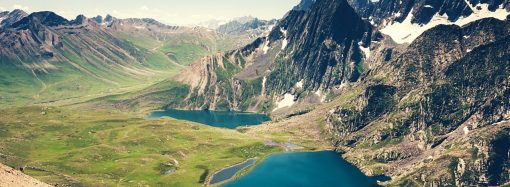
High in the Kashmir Himalaya, where glacial waters gather in still, blue basins beneath receding ice, a quiet threat is taking shape – one that scientists and officials say could, under the right conditions, unleash sudden and destructive floods downstream.
The government of Jammu and Kashmir said this week that five glacial lakes – Bramsar Lake, Chirsar Lake, Nundkol Lake, Gangabal Lake and Bhagsar Lake – have been classified as carrying a “very high susceptibility” to Glacial Lake Outburst Floods (GLOFs).
The designation, confirmed by the chief minister, CM Omar Abdullah, places the lakes among a small subset identified by recent scientific analysis as particularly vulnerable to sudden breaches – events that can release massive volumes of water and debris with little warning.
For communities in districts like Ganderbal, Shopian and Kulgam, the risks are not abstract.
A preliminary government assessment found that more than 2700 buildings, about 15 major bridges, stretches of road and even a hydropower installation lie along potential flood paths below the lakes.
Yet officials were careful to frame the findings with nuance.
A classification of “high susceptibility,” CM Omar told lawmakers, does not mean that an outburst is imminent, nor that the lakes are currently unstable.
Rather, it indicates that under certain triggering conditions like heavy rainfall, rapid snowmelt, or a landslide into the lake they could be more prone to failure than others.
The assessment draws on a growing body of research into how climate change is reshaping mountain landscapes.
In a recent study published in the Journal of Glaciology, scientists analysed 155 glacial lakes across the region, evaluating factors such as how quickly the lakes are expanding, the stability of their natural dams and the terrain surrounding them.
From that broader landscape, the five lakes stood out.
Even so, significant uncertainties remain.
Officials acknowledged that accurately predicting the scale, speed and timing of a potential flood would require detailed measurements of lake depth and volume – data that is largely unavailable for Himalayan lakes.
“Such information can only be obtained through field-based studies,” the government said, noting that much of the region’s glacial terrain remains difficult to access.
In the meantime, authorities have begun laying the groundwork for risk mitigation.
That includes mapping downstream exposure using geospatial tools, identifying vulnerable settlements and infrastructure, and integrating GLOF scenarios into district-level disaster planning.
Scientists at the Department of Geoinformatics at the University of Kashmir are working on early-warning systems tailored to mountain environments, combining satellite monitoring with field sensors and real-time communication networks.
A high-precision, echo-sounding survey vessel has recently been procured to improve data collection from remote lakes.
Officials say these efforts are part of a longer-term push to better understand and manage a hazard that is both natural and increasingly shaped by a warming climate.
For now, the lakes remain still, their surfaces reflecting the surrounding peaks.
But for those living downstream, the government’s acknowledgment underscores a growing reality: that even in the quietest corners of the mountains, the risks are no longer distant.










Leave a Comment
Your email address will not be published. Required fields are marked with *