





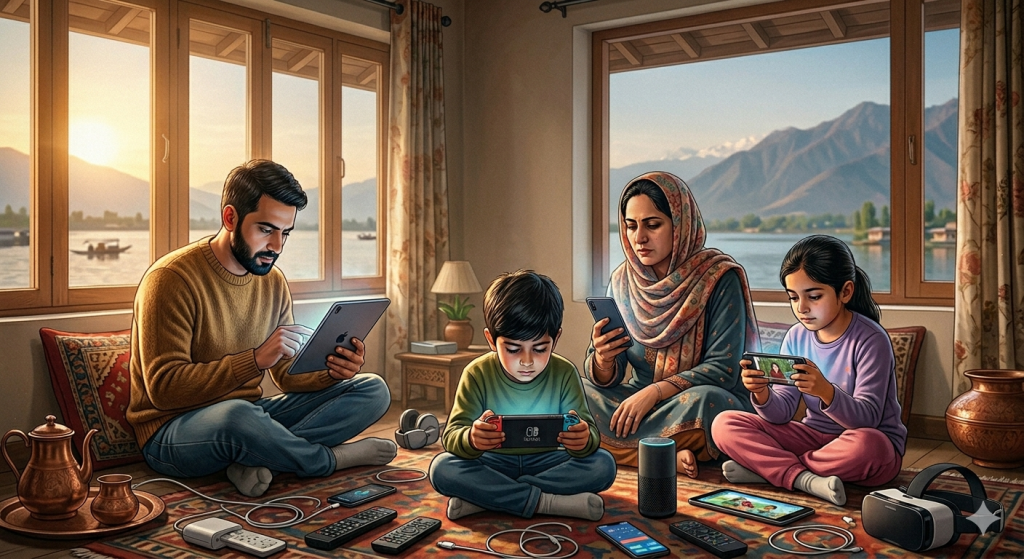
Are we raising smart kids armed with gadgets and technology, or are the gadgets intruding childhood.
Are we raising smart kids armed with gadgets and technology,
or are the gadgets intruding childhood.
Gone are the days when mothers and grandmothers would soothe crying babies by singing lullabies or making stories. Now everyone knows how to make a weeping baby smile – just put a smart phone in their hand with a video playing. Humaira, a mother of two, says that she has to hide her phone from her seven-year old. “I had to lock all my apps because he often deletes my important data while playing with the phone. I even try to hide my phone from him but I don’t know how he gets to know where it is,” she said. In a way it won’t be wrong to say that children are now born with smart phones in their hands. They don’t ask for candies or chocolate from visitors, but they will grab their phone straightaway, may be even scream for it. Researchers have for long been lamenting the overexposure of gadgets like video consoles and television to children, but smartphones, the little indispensable devices of our age, have taken the intrusion of gadgets into childhood to a whole new level. Research by child education specialists at the Michael Cohen Group, New York revealed that touch screens have taken over all other forms of playful delight for kids. Sixty percent of parents with kids under the age of 12 reported that their child plays on a portable screen often, while 38 percent apparently play very often.
Instead of playing outside and getting social, children Big alienated from the society. This prevents them from forming normal social relationships and having activities with their friends. Sociologist Farah Qayoom, who teacher at the University of Kashmir says, gadgets are impacting the social and family bonds. The well-knit structure of family which was reinforced by interactions between family members has been affected as gadgets have come in between. “There used to be strong bond between family members as there was face to face interaction. But now the familial bond has been affected, children don’t spent too much time with their family because they are too busy with the gadgets,” Qayoom said. She adds that playing outside was very important for the development of children, which was also encroached upon by gadgets. “Children are making gadgets their virtual friends and the peer group interactions are gradually coming to an end,” she said. This, she says, has a bearing on the social skills that children acquire while playing with other kids. Dr Mohammad Muzaffar Khan, Consultant Clinical Psychologist says the decreased socialization affects the inter-personal problem solving capacity of children. “A child knows how to resolve inter-personal issues when he/she plays outside with other children, but when a child sticks to the gadgets, he/she stays unaware of such things and faces many problems while communicating or socializing,” said Dr Khan. Excessive use of gadgets have other health risks such as poor sitting postures and eye strain. There are also social and emotional risks like gaming addiction and cyber-bullying. Lack of physical activity indirectly leads to childhood obesity. Children today prefer spending hours playing with their tablet or cell phone instead of heading outdoors to a park or getting active with friends. Just imagine a kid siting with a tablet in hand and playing a game. What physical exercise is done here? Hardly any! Psychiatrist, Dr Arshad Hussain says, “Increased use of gadgets effects the development of kids adversely. It decreases physical abilities, social intelligence and ability to socialize in real life scenarios.” Moreover while taking a tablet or smart phone to the dinner table, experts say, a child can not control the normal food intake. Either they eat too quickly or too much as they are focused on the screen, not on the meal. Dr Khan, says that that excessive gadget use also affects the self-confidence and self-esteem of a child. “Kids are so engaged with these gadgets that their co-curricular/extra-curricular activities are affected, socialization and inter personal interactions have decreased, which leads to long term deficiency in inter-personal skills,” says Dr Khan. He adds that it also leads to lack of assertiveness and the effects stay with the child as they reach adulthood. Despite what the experts say, many parents feel proud to have their children handle gadgets at an early age. Some believe that it is important for education these days. So they encourage their children to watch TV, use mobile phones, laptops and other gadgets.
Muneer Ahmad, a tech-savvy father of a four-year old is an example. “I like to see my son using gadgets because I feel that way he will be more witty and confident. It will also help him in future as today’s education demands the use of technology,” said Ahmad. However, according to the American Academy of Pediatrics (AAP) there is no such thing as educational TV for children under two years of age. There are presumptions that screen time can be educational, but the AAP says that toddlers under two do not have the cognitive ability to comprehend such programs. What it actually does is interfere with “talk time” between the parent and the child, which results in delayed language skills. Researchers from Boston College, Massachusetts found that students from developing countries scored better in math, science and reading than students from the developed countries where children were overexposed to technology. A study conducted by the US based Kaiser Family Foundation found that heavy media use amongst pre-school, elementary and high school students was associated with several potential setbacks, including behavioral problems and lower grades. Dr Khan is of the view that excessive reliance on gadgets takes toll on a person’s memory. “We don’t remember the contact numbers as we used to remember years ago, because now we are dependent on our mobile memory. And thus next generations may have weak memories” said Dr Khan. The effect on person’s memory will have a differential impact on the creative abilities of a person which helps them in the adjustment and growth. Another aspect of excessive gadget use is its adverse impact on eyes. Using electronic gadgets for a long time can dry the cornea. With all the gadgets kids use these days, it has been noticed that more and more children have dry eyes. Dry eye is a condition in which there are insufficient tears to lubricate and nourish the eye. Tears are necessary for maintaining the health of the eye and for providing clear vision. But in case of dry eyes, the eyes become inflamed, swollen and the vision is blurry. Dr Sajjad Fazilli, an ophthalmologist and director Fazilli Eye Care Centre says, “There is no evidence but regular use of gadgets can cause eye strain and discomfort. It will show up as blurred vision, double vision, dry and red eyes, eye irritation, headache, neck and back pain”. The unprecedented access to internet provided by the gadgets also opens doors for cyber bullying of the children. Cyber bullying encompasses the use of information and communication technologies to harm a victim(s) in deliberate, repeated, and hostile ways. It can affect the social, emotional, and physical health of a child. According to a study published by United Nations Office on Drugs and Crime (UNODC) this can include but is not limited to the use of the Internet, cell phones or other gadgets to send or post text or images intended to hurt or embarrass another person. Cyber bullying even includes a harsh response to a child’s Facebook status update. Children who engage in risky online behavior (and negligence to online safety and privacy) face a higher risk of exploitation, cyber enticement, solicitation or grooming. Cyber bullying is especially prominent amongst children aged approximately 10 to 13. Although the exploitation of children is not a new phenomenon, the digital age has exacerbated the problem and made the children more vulnerable. Dr Khan also talks about the Disuse hypothesis, according to which the system that is not used much by our body, may get weak or even stop working which means it leads to the atrophy of that system. “Little or no physical exercise leads to disuse atrophy. And the excessive use of gadgets may cause this atrophy in new generations and they may have weaker limbs or body,” says Dr Khan. A study conducted by Dr Shariq Rashid Masoodi, senior consultant endocrinology, SKIMS shows that the dependence of children on gadgets makes them suseptible to early onset of diabetes. “We are headed a dangerous way considering how our children are growing up. They are given access to junk food and then they accumulate it in thier bodies when the spend hours on smart phones and playing with other gadgets”, said Dr Shariq. According to him the average onset age of diabetes has been reduced to 40 because of this lifestlye. He said, “This is not something that can be brushed aside.”















Leave a Comment
Your email address will not be published. Required fields are marked with *