





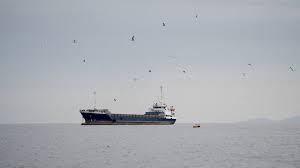
The United States said it would impose a blockade on Iranian ports from Monday, prompting Tehran to warn that ports across the Persian Gulf and Gulf of Oman could be targeted in retaliation, escalating tensions in a key global energy corridor.
Kashmir Impulse Desk
New Delhi, April 13
The United States said it would impose a blockade on Iranian ports from Monday, prompting Tehran to warn that ports across the Persian Gulf and Gulf of Oman could be targeted in retaliation, escalating tensions in a key global energy corridor.
The US military’s Central Command (CENTCOM) said the blockade would apply to vessels of all nations entering or leaving Iranian ports and coastal areas, part of efforts to pressure Iran to reopen the Strait of Hormuz and accept a proposed peace deal.
Iran responded with sweeping threats, saying security in regional waters “is either for everyone or for no one,” and warning that no port in the region would remain safe.
The developments raise the risk of a broader confrontation that could disrupt global trade and energy supplies, with about 20% of the world’s oil passing through the Strait of Hormuz in normal times.
It was not immediately clear whether the blockade had come into force at its scheduled start time of 10 a.m. EDT (1400 GMT). A notice from the United Kingdom Maritime Trade Operations (UKMTO) agency said restrictions covered the entire Iranian coastline, including ports and energy infrastructure.
The advisory said transit through the strait to non-Iranian destinations was not formally blocked, but vessels could encounter a heightened military presence.
Iran has effectively restricted passage through the strait since the conflict began, allowing limited transit for selected ships while imposing fees, drawing accusations from some quarters of disrupting global trade.
Oil prices surged on Monday, with Brent crude rising about 7 percent to around USD 102 per barrel, compared with roughly USD 70 before the conflict, reflecting concerns over supply disruptions.
Shipping activity has dropped sharply.
Data from Lloyd’s List Intelligence showed just over 40 commercial vessels transiting the strait since a ceasefire took hold last week, down from 100-135 daily passages before the conflict.
Analysts said it remained unclear how effective a blockade would be or whether it could be enforced without significant risks to US forces, raising questions over whether economic pressure on Iran or rising global energy costs would prove more decisive.
US President Donald Trump said in a social media post that Iran’s navy had been “completely obliterated” but warned that any remaining vessels approaching the blockade would be “immediately eliminated.”
Iranian officials struck a defiant tone.
Ebrahim Rezaei, spokesperson for parliament’s National Security Commission, dismissed the US move as “more bluffing than reality” but warned Tehran could escalate if necessary. Parliament Speaker Mohammad Bagher Ghalibaf said, “If you fight, we will fight.”
The standoff follows failed ceasefire talks between the United States and Iran over the weekend in Pakistan, with no indication of when negotiations might resume.
US Vice President J D Vance said discussions broke down after Iran rejected US demands related to its nuclear programme, including halting uranium enrichment and dismantling key facilities.
Iran has maintained its nuclear activities are peaceful, though it has advanced enrichment and missile capabilities that Western powers say could be used to develop a weapon.
Iranian officials said disagreements also centred on sanctions relief and war reparations.
Diplomatic efforts are continuing.
British Prime Minister Keir Starmer said he would work with French President Emmanuel Macron to push for a resolution, including reopening the Strait of Hormuz without conditions.
The current ceasefire is due to expire on April 22, with uncertainty over whether it will be extended. Turkish Foreign Minister Hakan Fidan suggested a possible extension of 45–60 days to allow further negotiations, while Pakistan said it would continue mediation efforts.
The conflict, which began on February 28 with US and Israeli strikes on Iran, has killed thousands across the region and damaged infrastructure in multiple countries, underscoring the risks of further escalation.


















Leave a Comment
Your email address will not be published. Required fields are marked with *