





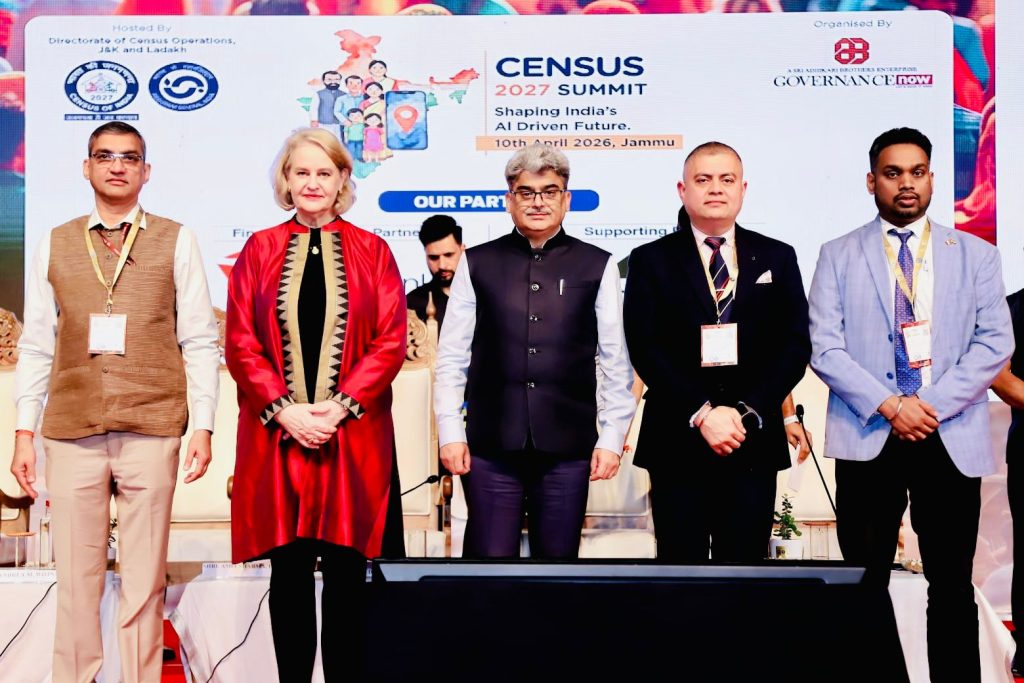
Chief Secretary Atal Dulloo on Friday said upcoming Census 2027 will mark a shift toward a fully digital, citizen-focused framework aimed at strengthening evidence-based policymaking.
Kashmir Impulse Desk
Jammu, April 10
Chief Secretary Atal Dulloo on Friday said upcoming Census 2027 will mark a shift toward a fully digital, citizen-focused framework aimed at strengthening evidence-based policymaking.
Speaking at a summit in Jammu, Dulloo described the exercise as more than a population count, calling it a “national digital transformation mission” that will rely on real-time data collection, validation and integration with national platforms.
The event, hosted by the Directorate of Census Operations for Jammu and Kashmir and Ladakh at Abhinav Theatre, brought together policymakers, technology experts and representatives from international organisations to discuss the roadmap and preparedness for India’s first fully digital census.
Dulloo said census data forms the backbone of governance, guiding welfare delivery, resource allocation and development planning.
He said that India is at a “data inflection point,” with growing reliance on digital systems such as Aadhaar and other national databases to improve transparency and efficiency.
He said the 2027 exercise will use mobile-based enumeration, artificial intelligence and cloud technology to enhance accuracy and speed, replacing the traditional manual methods used in the 2011 Census of India.
Highlighting India’s demographic diversity, Dulloo said the country has a strategic advantage in building large datasets that can support emerging technologies and data-driven governance.
The census in Jammu and Kashmir will be conducted in two phases, officials said.
The first phase, covering house listing and housing data, will include a self-enumeration period from May 17 to May 31, followed by door-to-door surveys from June 1 to June 30, 2026.
The second phase, focused on population enumeration, will begin in September 2026 for snow-bound areas and in February 2027 for other regions.
Amit Sharma, Chief Principal Census Officer and Director of Census Operations for Jammu and Kashmir and Ladakh, said the process will be fully paperless, with enumerators using mobile applications to collect data.
A web portal available in multiple languages will allow citizens to submit information online before field visits.
He said that a Census Management and Monitoring System will enable near real-time tracking of field operations, training and overall progress.
Authorities have also introduced geospatial mapping to ensure accurate demarcation of enumeration areas.
Officials said a structured training program for enumerators and supervisors is underway to ensure readiness for the exercise.
Dulloo directed district administrations to complete training and preparations on time, stressing that census data will play a key role in determining financial allocations and shaping development policies over the next decade.
Speakers at the summit, including representatives from the United Nations Population Fund, Unique Identification Authority of India and G20 policy forums, highlighted the importance of reliable and inclusive data systems in addressing development challenges.
Andrea M Wojnar said digital and self-enumeration practices are increasingly being adopted globally and emphasized that accurate data is essential to ensure no population group is left out of welfare programs.
Officials also stressed the importance of data security, noting that the census will use encrypted systems and secure data infrastructure to protect citizen information.
The summit included discussions on promoting self-enumeration, countering misinformation and using artificial intelligence to improve governance outcomes, with participants emphasising the role of public awareness and community participation in the success of the exercise.



















Leave a Comment
Your email address will not be published. Required fields are marked with *